You’re finalizing the plumbing specification for a housing project in Lahore or a central heating system in a commercial building in Islamabad — and you need to know exactly what PPRC pipe will cost you, which brands hold up under pressure, and what specifications are non-negotiable. This guide is built for that decision.
Pakistan’s construction sector has been expanding rapidly, with the Pakistan Bureau of Statistics reporting construction output growth of over 9% in recent fiscal years. Piping systems — particularly PPRC for hot and cold water — represent a significant line item in any residential or commercial build. Yet price lists are rarely published openly, brand claims are often exaggerated, and specifying the wrong pressure class can lead to costly failures after handover.
This post gives you the 2026 PPRC pipe price in Pakistan with a full brand comparison, pressure class breakdown, and expert guidance on what actually matters when sourcing polypropylene pipe for Pakistani projects.
What Is PPRC Pipe and Why Does It Matter for Pakistani Projects?
PPRC stands for Polypropylene Random Copolymer — a thermoplastic pipe material that handles both hot and cold water in a single system. Unlike standard uPVC, which is rated for cold-water applications only, PPRC pipe can handle temperatures up to 95°C continuously and up to 110°C for short-term peaks, making it the go-to choice for central heating, solar hot water circuits, and potable supply systems in residential buildings, hospitals, and hotels across Pakistan.
The material complies with DIN 8077/8078 and ISO 15874 standards. It is joined using heat fusion — a socket-welding process that creates a joint stronger than the pipe wall itself when done correctly. No solvent cement, no mechanical fittings with leak-prone O-rings.
In Pakistan’s climate — where water temperatures fluctuate significantly between summer and winter, and where water quality in cities like Karachi, Faisalabad, and Multan can be corrosive to metal pipework — PPRC offers a corrosion-free, scale-resistant alternative that outperforms galvanized iron in long-term performance. The pipe is also chemically inert, making it suitable for pharmaceutical manufacturing facilities and food processing plants in Sialkot, Gujranwala, and Lahore’s industrial zones.
NEWTECH’s PPRC pipe range (63mm–110mm) is manufactured to DIN 8077/8078 and carries PSQCA certification, ensuring compliance with Pakistan’s national quality standards.
PPRC Pipe Price in Pakistan 2026: Updated Rate List by Size and Class
Prices below reflect 2026 market rates in major Pakistani cities. Rates vary by dealer margins, city logistics costs, and batch size. Wholesale pricing for quantities above 500 meters typically offers 8–15% reduction on list price.
PPRC Pipe Price Table — Pakistan 2026 (PKR per meter, approximate)
| Pipe Size (mm) | PN10 (Cold Water) | PN16 (General Use) | PN20 (Hot Water) | PN25 (High Pressure/Heating) |
|---|---|---|---|---|
| 20mm (½”) | PKR 180–220 | PKR 230–280 | PKR 290–340 | PKR 370–430 |
| 25mm (¾”) | PKR 230–270 | PKR 290–350 | PKR 360–420 | PKR 460–540 |
| 32mm (1″) | PKR 310–370 | PKR 390–460 | PKR 480–560 | PKR 610–700 |
| 40mm (1¼”) | PKR 420–500 | PKR 530–620 | PKR 650–760 | PKR 820–950 |
| 50mm (1½”) | PKR 600–720 | PKR 760–890 | PKR 940–1,100 | PKR 1,180–1,380 |
| 63mm (2″) | PKR 900–1,080 | PKR 1,150–1,350 | PKR 1,420–1,650 | PKR 1,800–2,100 |
| 75mm (2½”) | PKR 1,250–1,480 | PKR 1,580–1,850 | PKR 1,950–2,280 | PKR 2,480–2,880 |
| 90mm (3″) | PKR 1,720–2,050 | PKR 2,180–2,550 | PKR 2,700–3,150 | PKR 3,420–3,980 |
| 110mm (3½”) | PKR 2,450–2,900 | PKR 3,100–3,620 | PKR 3,850–4,500 | PKR 4,870–5,650 |
Note: Prices are indicative and subject to change based on resin import costs, USD/PKR exchange rate, and local dealer margins. Always request a current quote from your supplier. NEWTECH’s sales team provides project-specific quotations
How to read the PN rating: PN (Pressure Nominal) indicates the maximum allowable operating pressure in bar at 20°C. A PN16 pipe rated 16 bar at 20°C operates at approximately 4 bar at 70°C — a fact that catches many contractors off guard when specifying for hot water systems. Always derate for temperature using the manufacturer’s pressure-temperature chart.
Best PPRC Pipe Brands in Pakistan: Who’s Actually Worth Buying?
The PPRC market in Pakistan includes a mix of ISO-certified manufacturers, regional brands, and — frankly — uncertified products that look identical but fail within 12–24 months of installation. When evaluating the best PPRC pipe brand in Pakistan, these are the four criteria that separate reliable suppliers from the rest:
1. PSQCA Certification
The Pakistan Standards and Quality Control Authority (PSQCA) certifies pipe manufacturers against PS standards. A PSQCA mark confirms the pipe has been independently tested for pressure rating, wall thickness, and material purity. Do not accept verbal assurances — ask for the license number and verify it with PSQCA directly.
2. Consistent Wall Thickness
Non-certified pipe often meets the minimum outer diameter but shorts the wall thickness, reducing the pressure rating by 20–40% below the labeled PN class. On a DHA Islamabad project or a high-rise in Bahria Town Lahore, that shortfall becomes a latent defect that surfaces after handover.
3. Material Grade: PP-R vs PP-B
Genuine PPRC pipe uses random copolymer resin (PP-R). Some budget products substitute block copolymer or homopolymer, which are significantly more brittle under thermal cycling — the condition your pipes will experience daily in any heated system.
4. Manufacturer Track Record
How long has the company been in the market? Do they have documented project references in WASA-regulated supply systems, commercial buildings, or industrial facilities?
NEWTECH Pipes, established in 1998 and ISO 9001:2015 certified, has supplied PPRC systems to projects across Lahore, Islamabad, Karachi, Multan, and Bahawalpur — including residential developments in Bahria Town and Green Gulberg. Explore NEWTECH’s PPRC pipe range here.
Polypropylene Pipe Cost Factors: Why Two Quotes for the Same Size Differ by 40%
When you get two quotes for 25mm PN20 PPRC pipe and one is 40% cheaper, something is different — and it’s almost never the dealer’s margin. Understanding what drives polypropylene pipe cost helps you make an accurate apples-to-apples comparison.
Raw material price: PPRC resin is imported, primarily from South Korea, Germany, and China. Resin prices track with global petrochemical markets and the USD/PKR exchange rate. When the rupee depreciates sharply — as it did through 2022–2024 — PPRC pipe prices follow within 60–90 days. In 2026, stabilized exchange rates have moderated price volatility compared to the previous two years.
Wall thickness and SDR value: The SDR (Standard Dimension Ratio) is the ratio of outer diameter to wall thickness. Lower SDR = thicker wall = higher pressure rating = more material used = higher cost. A PN20 pipe has a lower SDR (thicker wall) than a PN10 pipe of the same diameter — and costs more. Buyers who compare price without comparing SDR are comparing different products.
Color and UV stabilization: Green-colored PPRC pipe typically includes UV stabilizers for outdoor or partially exposed runs. This adds cost but is essential for any above-ground installation exposed to direct sunlight in Pakistan’s climate.
Fittings cost: Do not budget for pipe alone. PPRC fittings (elbows, tees, reducers, ball valves, unions) typically add 35–55% to the total system material cost. NEWTECH supplies a complete range of PPRC fittings to match pipe specifications precisely.
⚙️ Expert Insight from NEWTECH One of the most common mistakes we see on Pakistani projects is specifying PN10 PPRC for a hot water system to save upfront cost. At 60°C — the typical domestic hot water delivery temperature — a PN10 pipe’s actual safe operating pressure drops to approximately 3.2 bar. In a multi-storey building in Rawalpindi or Islamabad with static head plus pump pressure, that margin disappears fast. Specify PN20 minimum for any hot water circuit, and PN25 for central heating or solar collector loops. The material cost difference between PN10 and PN20 in a residential project is typically under 3% of total construction cost — the failure cost is far higher.
PPRC Pipe Rate List Comparison: Pakistan vs Imported Brands
Imported PPRC pipe — primarily from Turkish, German, and Chinese manufacturers — enters the Pakistani market at varying quality levels. Here’s a factual comparison of what you’re trading off when choosing local vs imported:
| Attribute | Local PSQCA-Certified | Turkish/German Import | Low-Cost Chinese Import |
|---|---|---|---|
| Price (25mm PN20, per meter) | PKR 360–420 | PKR 480–620 | PKR 220–290 |
| PSQCA Compliance | ✅ Certified | Requires independent verification | ❌ Often non-compliant |
| Lead Time | 3–7 days (local stock) | 4–8 weeks | 4–10 weeks |
| Technical Support | Available locally | Limited | Very limited |
| Warranty Claims | Processed locally | Complex logistics | Usually unenforceable |
| Material Traceability | Full batch records | Partial | Rare |
For WASA-regulated projects in Lahore, Karachi, or Rawalpindi, locally certified pipe is not just preferable — it is typically a tender requirement. Confirm this with the relevant municipal authority before finalizing your specification.
According to the Pakistan Bureau of Statistics Industrial Survey, domestic pipe and tube manufacturing capacity has grown significantly, reducing dependence on imports for standard residential and commercial pipe sizes.
High-Quality Pipes & Fittings – Built to Last
PPRC Pipe Installation Standards in Pakistan: What Contractors Must Know
Correct PPRC installation is as critical as correct pipe specification. A PN25 pipe installed with incorrect heat fusion parameters performs worse than a properly installed PN16 pipe.
Heat Fusion Welding — Critical Parameters
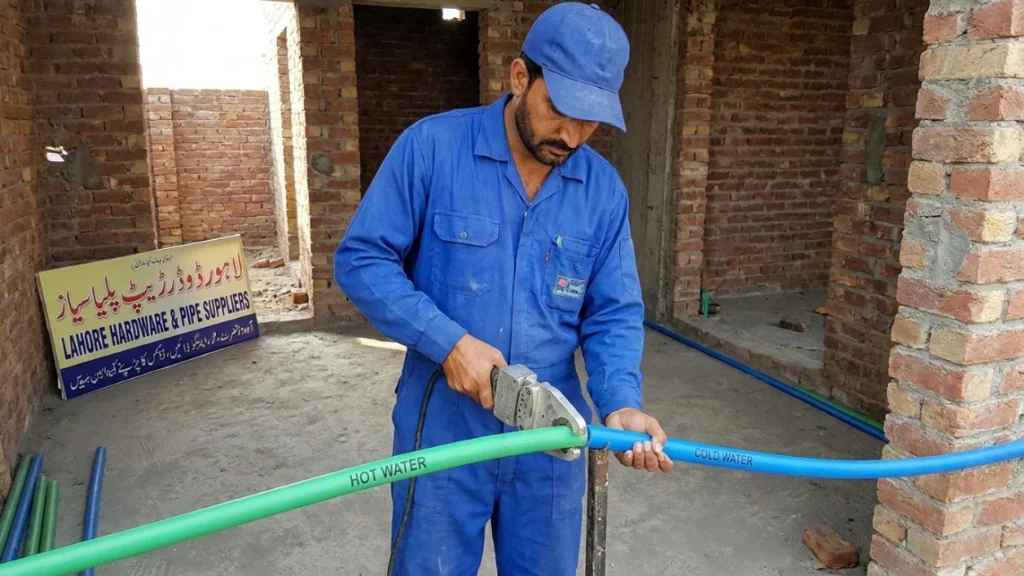
Heat fusion joins PPRC pipe by melting both the pipe end and fitting socket simultaneously, then pressing them together to form a monolithic joint. The critical variables:
- Heating temperature: 260°C ± 10°C at the welding iron surface
- Heating time: Varies by pipe diameter — 5 seconds for 20mm, up to 18 seconds for 63mm
- Joining time: Maximum 4 seconds for pipe sizes up to 40mm; 6 seconds for 50–63mm
- Cooling time: Minimum 2 minutes undisturbed for pipe up to 32mm; 4 minutes for 40–63mm
Common Installation Errors on Pakistani Projects
The single most frequent failure point NEWTECH’s technical team observes on-site is cold fusion — where the contractor heats the pipe end for the correct time but then delays the joining step beyond the allowable window (often due to distraction on a busy site). The result is a joint that appears sound but delaminates under first thermal cycle pressure.
Second most common: using a worn or contaminated welding iron that does not reach 260°C uniformly. Welding iron calibration is critical — and often ignored. If you’re managing a project in Faisalabad or Multan where the plumbing contractor is using a no-brand welding machine of unknown provenance, insist on a thermocouple temperature verification before work begins.
NEWTECH supplies HDPE butt-fusion welding machines and can advise on compatible equipment for PPRC socket-fusion work.
PPRC vs uPVC vs HDPE: Which Pipe for Which Application in Pakistan?
Contractors frequently ask whether to specify PPRC, uPVC, or HDPE for their project. The answer depends entirely on the application — not on price alone.
| Application | Recommended Pipe | Why |
|---|---|---|
| Hot water supply (residential) | PPRC PN20 | Rated to 95°C; heat fusion joints; no corrosion |
| Cold water supply (residential) | uPVC Class D or PPRC PN10 | uPVC lower cost for cold-only; PPRC if hot/cold mixed |
| Central heating system | PPRC PN25 | Handles sustained high temp + pressure cycles |
| Underground water main | HDPE PE100 | Flexible; impact resistant; suitable for burial |
| Agricultural irrigation | HDPE or uPVC | Depends on operating pressure and burial depth |
| Industrial chemical lines | HDPE PE100 or PPRC | Depends on chemical compatibility assessment |
| Gas distribution | MDPE (Yellow) | Mandatory — PPRC is not approved for gas |
NEWTECH manufactures across all these pipe categories. For a mixed-system project — such as a housing society in Bahria Town requiring both underground HDPE water mains and PPRC internal hot/cold plumbing — a single-supplier approach simplifies procurement, quality documentation, and technical accountability. View NEWTECH’s complete product range here.
How to Verify PPRC Pipe Quality Before Accepting Delivery in Pakistan
Accepting a delivery of PPRC pipe on-site without verification is how substandard material ends up installed in a project. Here is a practical site-level acceptance checklist:
Site Acceptance Checklist for PPRC Pipe
| Check | What to Look For | Reject If |
|---|---|---|
| Marking | Manufacturer name, PN rating, diameter, DIN/ISO standard, production date | Any marking absent or unclear |
| PSQCA Mark | Certification logo on pipe body | Mark absent |
| Wall thickness | Measure with vernier caliper at 3 points around circumference | Deviation > 0.3mm from spec |
| Roundness | Pipe should be circular, not oval | Visible distortion present |
| Color consistency | Uniform color throughout batch | Color variation between lengths |
| Inner bore | Smooth, no pitting or roughness | Surface defects visible |
| Batch documentation | Test certificate with batch number | Certificate unavailable |
| Fitting compatibility | Test-fit one fitting from the batch | Loose or overly tight engagement |
This level of incoming inspection is standard practice for WASA supply projects and PEC-supervised works. For private projects, contractors who skip this step are assuming personal liability for any failure post-installation.
PPRC Pipe Price in Pakistan 2026 by City: Lahore, Karachi, Islamabad Comparison
PPRC pipe price in Pakistan varies by city due to freight costs, dealer margins, and local demand levels. Here’s a general orientation:
Lahore: The largest concentration of pipe dealers and distributors in Pakistan. Competitive pricing, with multiple certified brands available. NEWTECH’s distribution network covers Lahore comprehensively.
Karachi: High demand from the construction and industrial sectors. Import-parallel products (Turkish and Chinese brands) are more prevalent here than in Punjab cities. Freight costs from Punjab manufacturers add PKR 8–15 per meter for bulk orders.
Islamabad/Rawalpindi: Premium pricing typical — 5–12% above Lahore list prices — due to logistics and lower dealer density. Projects in DHA Islamabad and the broader Rawalpindi cantonment area have strict material specification requirements, making PSQCA-certified product essential.
Faisalabad and Multan: Pricing closer to Lahore. Strong demand from textile and food processing plants for industrial hot water systems. Bulk purchase pricing available for factory-scale installations.
Gujranwala and Sialkot: Growing construction markets. Limited local distribution depth means lead times can be longer; ordering in advance of project need is advisable.
For project-specific pricing in any city, request a quote from NEWTECH’s sales team.
CONCLUSION
Your PPRC pipe specification decision comes down to three things: the right pressure class for your operating conditions, verified certification, and a supplier who can back their product with documentation and technical support.
Here are the actionable takeaways from this guide:
- Never specify PPRC by price alone. PN rating and wall thickness are the variables that determine performance — and they directly affect price. Compare specifications, not just numbers per meter.
- Insist on PSQCA certification for every batch. On WASA projects and PEC-supervised works, this is mandatory. On private projects, it’s the difference between a 25-year system and a 3-year problem.
- Budget 35–55% additional for PPRC fittings. Pipe-only pricing leaves a major cost gap that derails project budgets.
- Heat fusion quality determines system reliability. Verify welding iron temperature, enforce cooling times, and inspect joints on high-pressure circuits before concealment.
The right PPRC pipe price in Pakistan 2026 isn’t the lowest number on a quotation — it’s the price that reflects certified material, correct specification, and a supplier you can call when something needs resolving on-site.
FAQ SECTION
1: What is the current PPRC pipe price in Pakistan for 25mm PN20 in 2026?
PPRC pipe price in Pakistan for 25mm PN20 is approximately PKR 360–420 per meter from PSQCA-certified manufacturers as of 2026. Prices vary by city, dealer, and order quantity. Imported brands may cost PKR 480–620 for the same specification. Always request a formal quotation with batch certification included.
2: Which PPRC pipe brand is best in Pakistan?
The best PPRC pipe brand in Pakistan is one that holds active PSQCA certification, manufactures to DIN 8077/8078, and can provide traceable batch test certificates. NEWTECH Pipes, ISO 9001:2015 certified and established since 1998, is among Pakistan’s leading certified PPRC manufacturers with documented supply to major projects in Lahore, Islamabad, and Karachi.
3: What is the difference between PN10, PN16, PN20, and PN25 PPRC pipe?
PN (Pressure Nominal) indicates maximum operating pressure in bar at 20°C. At elevated temperatures — like 70°C hot water systems — safe pressure drops significantly. Use PN20 minimum for domestic hot water, and PN25 for central heating and solar circuits. PN10 is for cold water distribution only. Misspecifying pressure class is one of the most common installation errors in Pakistan.
4: How long does PPRC pipe last in a Pakistani residential building?
Correctly specified and installed PPRC pipe has a design service life of 50 years at standard operating conditions, per ISO 15874. In Pakistani residential applications — potable cold and hot water supply — expect 25–40 years of reliable service with certified pipe. Lifespan shortens significantly if non-PSQCA-certified pipe or incorrect PN class is used for the application.
5: What is the PPRC pipe rate list for 63mm and 90mm in Pakistan?
In 2026, PPRC pipe prices in Pakistan for larger diameters are: 63mm PN20 approximately PKR 1,420–1,650 per meter; 90mm PN20 approximately PKR 2,700–3,150 per meter. PN25 versions cost 25–35% more. These sizes are commonly used for main risers and floor distribution headers in commercial buildings and housing society pump rooms.
6: Is PPRC pipe approved for use on WASA projects in Lahore and Karachi?
PPRC pipe is approved for internal building hot and cold water systems on projects under WASA jurisdiction, provided the pipe carries PSQCA certification and the installation meets relevant national plumbing codes. For underground water mains and external distribution networks, WASA typically specifies HDPE PE100 or uPVC rather than PPRC. Always confirm the applicable specification with the relevant water authority before tendering.