Pick the wrong conduit pipe on a commercial project in Lahore or a housing society in Islamabad, and you’re looking at a WASA or PEC inspection failure — or worse, a rewire after occupancy. Pakistan’s construction sector grew at 6.5% in FY2023 according to the Pakistan Bureau of Statistics, and electrical infrastructure is one of the fastest-growing line items in both residential and industrial projects. Yet conduit selection still gets treated as an afterthought on many sites.
The decision is not simply PVC or HDPE. It comes down to route type, fire risk, burial depth, bend frequency, and the wiring standards your project must meet. Choose incorrectly and you face cracked conduit on a rooftop run, collapsed walls during WAPDA inspection, or fittings that don’t mate with your chosen system.
This guide breaks down every conduit type used in Pakistan today — rigid PVC, HDPE conduit, flexible conduit, and fire-resistant variants — covering technical specifications, price ranges in PKR, local standards, and when each type is the right call for your project. By the end, you will know exactly which electric conduit pipe fits your next job.
What Makes an Electric Conduit Pipe Different from a Plumbing Pipe?
Contractors switching between plumbing and electrical work sometimes assume a uPVC pressure pipe will do the job of a conduit. That assumption creates real problems on site.
Electric conduit pipe is engineered specifically for wire and cable protection, not fluid pressure. The internal bore is designed to allow cable pulling without damaging insulation — which means a smoother internal surface finish and consistent roundness across every metre. The wall thickness and impact resistance are calibrated to protect cables from physical damage during and after installation, not to hold fluid pressure at 6 or 10 bar.
Key Differences in Specification
Conduit pipe in Pakistan follows different standards than pressure pipe. Electrical conduit should comply with IEC 61386 (international) and, for local projects under PEC approval, align with BS EN 61386 Part 1 requirements. PSQCA-certified conduit must meet PS 3580:1994 for PVC conduit. Plumbing pipe does not meet these standards — the wall thickness, material additives, and UL flame ratings differ fundamentally.
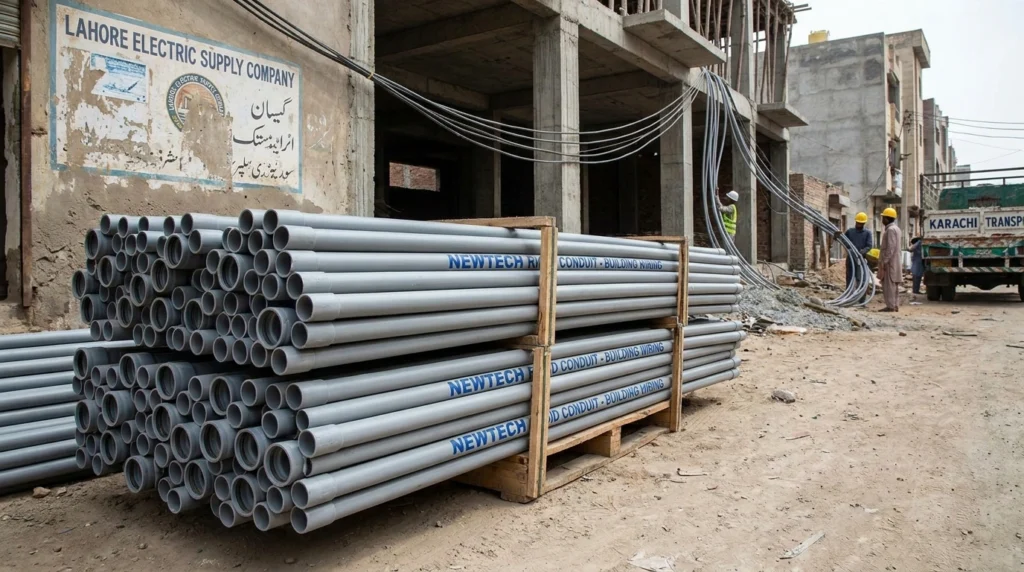
NEWTECH’s electric conduit range is manufactured under controlled quality processes certified to ISO 9001:2015, with both rigid PVC conduit and HDPE conduit options available for residential, commercial, and industrial wiring routes. Learn more on the Electric Conduit Pipes product page.
For industrial installations in Faisalabad’s textile sector or pharmaceutical plants in Karachi, using incorrect pipe as conduit is also a regulatory compliance issue — factory inspectors under the Factories Act and ISO-audited facilities will flag it.
Rigid PVC Conduit: The Standard Choice for Building Wiring in Pakistan
Rigid PVC conduit is the most widely used electric conduit pipe on Pakistani construction projects. From housing societies like Bahria Town and DHA to commercial towers in Gulberg, Lahore, rigid PVC forms the backbone of embedded and surface-run wiring systems.
Why Rigid PVC Dominates
The material’s advantages are straightforward: it is lightweight, easy to cut and join with solvent cement, corrosion-proof, and cost-effective. For embedded slab work, you bend it using a pipe bender or heat gun and cast it directly into concrete. For surface runs in factories and warehouses, it clips neatly to brackets.
Standard sizes available in Pakistan range from 16mm (½”) to 50mm (2″), covering single-phase residential loops up to multi-circuit industrial runs. Wall thickness falls between 1.5mm and 2.0mm depending on the class — Class A (light duty) for embedded applications, Class B (medium) for surface mounting, and Class C (heavy) for exposed and industrial use.
Temperature performance is adequate for most Pakistani climates: rigid PVC remains dimensionally stable from –5°C up to 60°C continuous service. On rooftop runs in Multan or Karachi, where summer ambient temperatures routinely exceed 45°C and surface temperatures can hit 70°C+, you need to verify the conduit spec or shift to HDPE.
Fire-Resistant PVC Conduit
PEC and PSQCA requirements for commercial and high-rise buildings in Islamabad and Karachi mandate fire-resistant (FR) conduit in escape routes, stairwells, and above false ceilings. FR-grade PVC conduit contains halogen-based flame retardants that self-extinguish when the ignition source is removed, per IEC 61386 classification “F” (flame-propagation restricted).
Standard PVC conduit will burn and propagate flame — never use it in fire-rated assemblies. NEWTECH supplies fire-resistant conduit specifically formulated for these applications.
HDPE Conduit: The Right Call for Underground and Outdoor Routes
HDPE conduit has moved from a specialist product to a mainstream choice across Pakistani infrastructure projects over the last decade. Telecom duct networks, WAPDA underground cable runs, and large housing society electrical infrastructure in developments like Green Gulberg now routinely specify HDPE.
Technical Advantages of HDPE Conduit
HDPE outperforms rigid PVC in three critical scenarios: underground burial, outdoor UV exposure, and high-impact risk routes. The material’s flexural strength allows it to absorb ground movement without cracking — a major issue with brittle materials in clay soils common around Lahore and Multan. It handles burial depths up to 1.5 metres without requiring concrete encasement in standard applications.
UV resistance is a genuine specification point. High-density polyethylene with UV stabiliser additives will not degrade on outdoor surface runs for 15–20 years under direct sunlight, unlike standard PVC which becomes brittle within 3–5 years of UV exposure without stabilisation.
HDPE conduit is available in corrugated single-wall and smooth-bore double-wall configurations. Double-wall HDPE (smooth inside, corrugated outside) is the preferred choice for cable pulling on long underground runs — the smooth bore reduces pulling friction significantly.
NEWTECH’s HDPE conduit is manufactured from PE100-grade resin with OD sizes from 20mm to 110mm, suitable for LV and HV cable protection. See the full HDPE Pipes & Fittings range for technical data sheets.
According to the Pakistan Telecommunication Authority’s annual infrastructure report (2023), over 60% of new fibre optic duct installation in urban Pakistan now uses HDPE microduct or conduit — a clear signal of where the industry is moving.
PVC vs HDPE Electric Conduit Pipe: Technical Comparison for Pakistan Projects
⚙️ Expert Insight from NEWTECH One of the most common mistakes we see on large housing society projects in Rawalpindi and Islamabad is specifying rigid PVC for underground service entry conduits running under driveways. The compressive load from vehicle traffic and the ground movement in clay soils cracks rigid PVC within 2–3 years, leading to cable damage and expensive excavation for repairs. Double-wall HDPE with a minimum SDR 11 rating is the correct specification for any buried route under vehicular traffic — it is more expensive upfront, but eliminates a predictable maintenance liability.
| Attribute | Rigid PVC Conduit | HDPE Conduit | Flexible PVC Conduit |
|---|---|---|---|
| Primary Application | Embedded slab, surface runs | Underground, outdoor | Short terminations, equipment connections |
| Sizes Available (Pakistan) | 16mm – 50mm | 20mm – 110mm | 16mm – 32mm |
| Temperature Range | –5°C to 60°C | –50°C to 80°C | –15°C to 60°C |
| Impact Resistance | Medium | High | Low |
| UV Resistance | Low (standard) / High (FR grade) | High (UV-stabilised) | Low |
| Burial Suitability | Light duty only | Full burial, vehicular traffic | Not suitable |
| Flame Performance | Standard: propagates / FR grade: self-extinguishing | Self-extinguishing (HDPE) | Standard: propagates |
| Joining Method | Solvent cement / push-fit | Butt fusion / coupling | Push-fit / hose clamp |
| Typical Price (PKR/metre) | Rs. 35 – Rs. 90 | Rs. 80 – Rs. 250 | Rs. 25 – Rs. 65 |
| Compliance Standard | PS 3580:1994, IEC 61386 | IEC 61386, ISO 4427 | IEC 61386 |
| Best For | Residential, commercial embedded wiring | Infrastructure, underground, industrial | Equipment hookup, flexible connections |
Prices are indicative market ranges as of mid-2025. Contact NEWTECH for current project pricing.
Electric Conduit Pipe Prices in Pakistan: What to Budget in 2025–2026
PVC conduit pipe price in Pakistan varies significantly by diameter, wall class, brand certification, and quantity. Uncertified product from unlicensed manufacturers is available at 20–30% below market — but fails inspection on PSQCA-required projects and carries real liability on safety-critical installations.
Price Ranges by Type and Size (PKR)
| Conduit Type | 20mm (¾”) | 25mm (1″) | 32mm (1¼”) | 40mm (1½”) | 50mm (2″) |
|---|---|---|---|---|---|
| Rigid PVC Class A (embedded) | Rs. 35–45/m | Rs. 45–60/m | Rs. 60–80/m | Rs. 75–95/m | Rs. 90–120/m |
| Rigid PVC Class B (surface) | Rs. 45–55/m | Rs. 55–70/m | Rs. 70–90/m | Rs. 85–110/m | Rs. 105–140/m |
| FR (Fire-Resistant) PVC | Rs. 55–70/m | Rs. 65–85/m | Rs. 85–110/m | Rs. 100–130/m | Rs. 125–160/m |
| HDPE Conduit (single-wall) | Rs. 80–100/m | Rs. 95–125/m | Rs. 120–155/m | Rs. 150–195/m | Rs. 185–250/m |
| Flexible PVC (corrugated) | Rs. 25–35/m | Rs. 30–45/m | Rs. 42–58/m | — | — |
Prices are wholesale/supply rates for PSQCA-certified product. Retail and small-quantity rates will be higher. Request a project quote at newtech-pipes.com/contact-us/.
The price differential between standard PVC and HDPE conduit is real — typically 2x to 2.5x per metre. But factor in installation labour savings on long underground runs (HDPE’s flexibility reduces the number of fittings and joints), and the 25–30 year service life versus 10–15 years for PVC in harsh environments. On a 500-metre underground cable route in a housing society, the total cost of ownership often favours HDPE.
Which Conduit Pipe Type Does Your Pakistan Project Need?
The right specification depends on five questions: Where does the cable run? What covers it? What is the fire risk? What voltage does it carry? And which authority approves the installation?
By Project Type
Residential (single-family, apartment blocks up to G+4): Rigid PVC Class A for all embedded slab and wall runs is standard practice and cost-effective. Use flexible PVC only at equipment termination points — panels, fixtures, and junction boxes where a rigid pipe cannot be used. In Karachi’s high-humidity coastal areas, check that your conduit supplier provides UV-stabilised PVC even for indoor surface runs that receive any indirect sunlight.
High-Rise Commercial and Residential (G+5 and above): PEC approval requirements for buildings above five storeys typically mandate FR-rated conduit in all fire-escape and stair lobby routes. Verify with your structural and MEP consultants — non-compliance is one of the top reasons for delayed occupancy certificates in Islamabad and Lahore.
Industrial Facilities (textile, pharma, food processing): HDPE conduit is preferred for underground cable routing between buildings, outdoor cable trays, and any route exposed to chemicals or process fluid splatter. Faisalabad’s textile sector, for example, involves high ambient heat and humidity that accelerates standard PVC degradation.
Infrastructure and Municipal Projects: WASA, LESCO, and FESCO underground distribution work almost exclusively specifies HDPE conduit for new cable installations. Double-wall smooth-bore HDPE is the standard for pulled cable; corrugated HDPE is used where direct burial protection without pulling is needed.
For uPVC Pipes and PPRC Pipes & Fittings for the water and gas services running alongside your electrical infrastructure, NEWTECH supplies the complete package for housing society and industrial projects.
Conduit Pipe Installation: Common Mistakes Pakistani Contractors Make
Technical specification is only half the battle. Incorrect installation is the reason correctly-specified conduit still fails on site.
The Five Installation Errors That Kill Conduit Systems
1. Skipping expansion joints on long surface runs. PVC expands at 0.06mm per metre per °C. On a 20-metre surface run in Multan where temperatures swing 40°C between winter night and summer afternoon, you have 48mm of thermal movement. Without expansion fittings every 6–8 metres, the conduit buckles or pulls at joints.
2. Exceeding bend angles on rigid PVC. The IEC 61386 standard limits conduit bends to a minimum bend radius of 6x the conduit OD. Forcing a 25mm conduit around a 60mm radius cracks the wall — usually not immediately, but within a season of thermal cycling.
3. Burying standard PVC under vehicle access routes. As noted in the Expert Insight above, this is a recurring and expensive error. Vehicular traffic requires HDPE conduit with adequate wall thickness.
4. Using non-PSQCA conduit on WAPDA or WASA work. Government-funded projects and utility infrastructure require certified material. Using uncertified conduit — even temporarily “to keep the project moving” — creates inspection failure and replacement cost. NEWTECH’s conduit is PSQCA-certified and PEC-approved, removing this risk entirely.
5. Gluing HDPE conduit with PVC solvent cement. HDPE is not compatible with solvent cement — it requires mechanical couplings or butt fusion for permanent joints. Many installers used to PVC make this error when switching to HDPE for the first time. The joint appears secure until the first thermal cycle, then fails.
PSQCA and PEC Compliance: What Pakistan’s Conduit Standards Actually Require
A contractor in Gujranwala or Bahawalpur who specifies conduit without knowing the regulatory requirement is taking on risk that belongs to the developer or project owner. Here is what compliance actually means.
PS 3580:1994 is PSQCA’s national standard for PVC conduit for electrical installations. It specifies dimensional tolerances, wall thickness minimums, impact resistance (tested at –5°C), tensile strength, and resistance to heat deformation. Conduit marked with the PSQCA licence number can be traced to a tested batch — uncertified conduit cannot.
PEC (Pakistan Engineering Council) approval requirements apply primarily at the project level. PEC-registered engineers who sign off on building electrical designs are responsible for specifying compliant material. On large commercial projects in Islamabad or Karachi, the PEC-registered MEP engineer will specify conduit type, class, and certification — the contractor’s job is to supply exactly what is specified.
IEC 61386 classifications are increasingly referenced in commercial project specifications, particularly for projects with international consultants or developers. Classification codes cover mechanical strength, temperature rating, UV resistance, and flame performance.
NEWTECH’s conduit products carry ISO 9001:2015 certification on the manufacturing process and PSQCA product certification — documentation you can present to project inspectors and consultants without hesitation. See the full Certifications & Standards page for verification documents.
Conclusion
The conduit decision shapes the long-term reliability of every cable run in your building. Get it right at the specification stage and you eliminate a predictable category of maintenance problems for the life of the structure.
Four takeaways to act on before your next project:
- Specify FR-rated conduit in all fire-risk zones on commercial and high-rise projects — PEC requirements are not optional, and inspection delays cost more than the material upgrade.
- Use HDPE conduit for any buried or outdoor route, especially under driveways, parking areas, or in high-UV environments like Multan, Karachi, or Bahawalpur.
- Verify PSQCA certification on every conduit delivery — ask for the batch certificate, not just the stamp on the pipe.
- Match conduit class to application: Class A for embedded concrete, Class B or C for surface and industrial runs.
For residential, commercial, or industrial projects anywhere in Pakistan, the right electric conduit pipe specification starts with the right supplier. NEWTECH supplies PSQCA-certified rigid PVC and HDPE conduit with full technical documentation, available for projects in Lahore, Karachi, Islamabad, Rawalpindi, Faisalabad, and across Pakistan.
FAQ SECTION
1: What is the price of electric conduit pipe per metre in Pakistan in 2025?
Rigid PVC conduit pipe price in Pakistan ranges from Rs. 35–45/m for 20mm Class A (embedded grade) up to Rs. 140–160/m for 50mm fire-resistant grade. HDPE conduit costs Rs. 80–250/m depending on diameter. Prices vary by supplier certification (PSQCA vs uncertified), quantity, and delivery location across Lahore, Karachi, or Islamabad.
2. Which is better for underground electrical wiring in Pakistan — PVC or HDPE conduit?
HDPE conduit is the correct choice for underground electrical wiring in Pakistan, particularly for any route under vehicular traffic, deep burial, or in clay soils prone to ground movement. HDPE handles burial depths to 1.5m without concrete encasement, resists cracking under compressive load, and lasts 25–30 years underground versus 10–15 years for rigid PVC in the same conditions.
3. Is PSQCA certification mandatory for electric conduit pipe on Pakistani construction projects?
PSQCA certification is mandatory for conduit used on government-funded projects, WAPDA/WASA infrastructure, and any project requiring PEC engineer sign-off. PS 3580:1994 is the relevant national standard for PVC conduit. Using uncertified conduit risks inspection failure, project delays, and replacement liability. Always request the batch certificate from your supplier, not just the stamp on the pipe.
4. What size electric conduit pipe do I need for residential building wiring in Pakistan?
For standard residential wiring in Pakistan, 20mm (¾”) conduit handles single-circuit loops up to 4mm² cable. Use 25mm (1″) for sub-distribution runs with 2–3 cables, and 32mm (1¼”) for larger feeders or where more than three cables share one route. PEC wiring practice guidelines restrict conduit fill to 40% of the bore’s cross-sectional area.
5. Can I use regular uPVC water pipe instead of conduit pipe for electrical wiring?
No — uPVC pressure pipe must not be used as electrical conduit. It does not meet IEC 61386 or PS 3580:1994 conduit standards: the internal finish is not optimised for cable pulling, the flame performance is untested for electrical applications, and it lacks the impact resistance classifications required for conduit. Using pressure pipe as conduit will fail PEC inspection and creates a genuine fire and safety risk.
6. How long does PVC electric conduit pipe last in Pakistan’s climate?
PSQCA-certified rigid PVC conduit lasts 20–25 years in embedded concrete applications with no UV exposure. Exposed outdoor surface runs degrade significantly faster — standard PVC becomes brittle within 3–5 years under direct sunlight in cities like Karachi or Multan. UV-stabilised or FR-grade PVC extends outdoor performance to 10–15 years. HDPE conduit with UV stabiliser additives performs reliably outdoors for 20+ years.