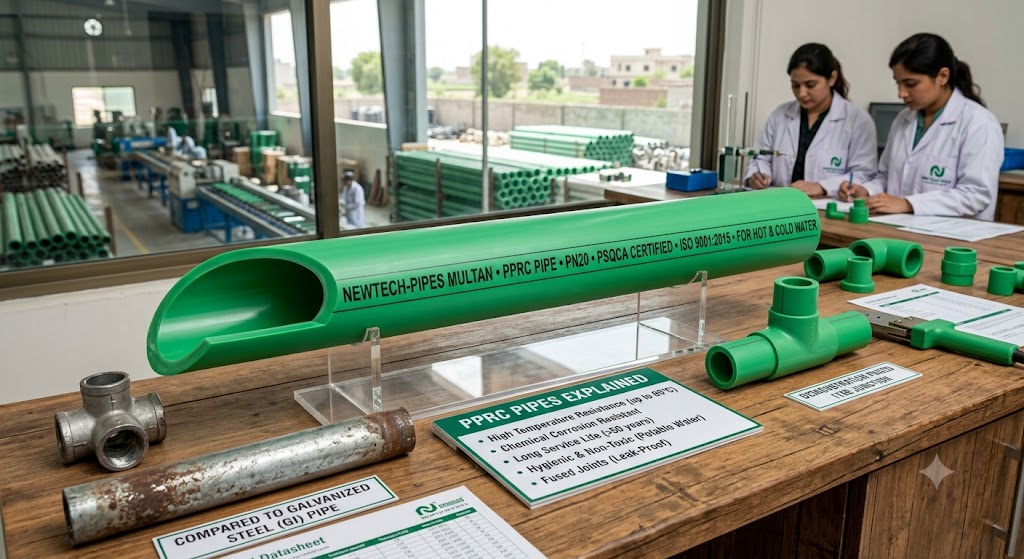
If you’ve ever renovated a bathroom or kitchen in Pakistan, you’ve likely heard plumbers recommend PPRC pipe. But what makes it so popular? Understanding the PPRC pipe uses advantages can help explain why it has become a common choice for hot and cold water plumbing in homes across Lahore, Karachi, and Islamabad.
PPRC (Polypropylene Random Copolymer) is a rigid plastic pipe engineered specifically to handle hot water reliably — something older materials like GI (galvanized iron) struggle with due to corrosion, and something standard PVC can’t handle at all due to heat sensitivity. This guide walks through what PPRC pipe is, its key advantages, where it performs best, and how to choose the right grade for your project.
What Is PPRC Pipe?
PPRC stands for Polypropylene Random Copolymer — a type of thermoplastic pipe joined using heat fusion rather than glue or threading. During installation, the pipe and fitting ends are heated with a specialized fusion tool until the material softens, then pressed together to form a single, seamless, molecularly bonded joint as they cool.
This fusion-welded joint is one of PPRC’s biggest structural advantages: unlike threaded or solvent-cement joints, there’s no separate joint material that can degrade, loosen, or leak over time. The pipe and fitting essentially become one continuous piece of plastic.
Key PPRC Pipe Advantages in Pakistan
The core PPRC pipe advantages in Pakistan’s climate and construction context include:
Handles hot and cold water equally well. PPRC pipe is rated for continuous hot water service — typically up to around 70–95°C depending on the pressure class — making it suitable for both hot water supply lines and cold water plumbing in the same system.
No corrosion, ever. Unlike GI pipe, PPRC never rusts, scales, or contaminates water with corrosion byproducts — a genuine concern in older Pakistani buildings still running galvanized lines.
Leak-proof heat-fused joints. Since joints are fused rather than glued or threaded, there’s no thread sealant or solvent-cement bond to fail over the years.
Low thermal conductivity. PPRC pipe stays cooler to the touch than metal pipe even when carrying hot water, and also reduces heat loss along the pipe run — relevant for households running geysers or centralized hot water systems.
Lightweight and easy to install. PPRC is significantly lighter than GI pipe, reducing labor time and structural load, especially useful in multi-story apartment construction common in Karachi and Lahore.
Good chemical resistance. PPRC resists most common household chemicals and doesn’t react with typical water treatment additives.
PPRC vs Other Pipe Materials: Where It Fits
It helps to see where PPRC sits relative to other common pipe types used in Pakistan:
| Pipe Type | Best For | Hot Water Rated? | Jointing Method |
| PPRC | Hot & cold indoor plumbing | Yes | Heat fusion |
| PVC | Drainage, cold water, sewerage | No | Solvent cement |
| HDPE | Pressurized water mains, tube wells, gas lines | Not typically for hot water | Butt-fusion/electrofusion |
| GI (steel) | Legacy plumbing, being phased out | Yes | Threaded |
This is really the core distinction buyers need to understand: PPRC is built specifically for indoor, pressurized hot-and-cold plumbing, while PVC pipe and HDPE serve different jobs entirely — PVC for drainage and low-pressure cold lines, HDPE for larger-diameter pressurized mains and gas distribution. None of these materials are direct substitutes for each other; each is engineered for a specific service condition.
Where Is PPRC Pipe Best Applied?
PPRC pipe is the standard choice for:
Hot and cold water supply lines within homes and apartments — from the geyser or water heater to bathroom and kitchen fixtures.
Centralized hot water distribution systems in hotels, hospitals, and commercial buildings, where consistent temperature performance over long pipe runs matters.
Compressed air lines in some industrial and workshop settings, since PPRC handles pressure well without corroding.
Solar water heating systems, where pipe needs to tolerate elevated water temperatures reliably over many years.
PPRC is generally not the right choice for underground water mains, drainage, or gas lines — those applications are better served by HDPE, PVC, or MDPE respectively, each engineered for those specific pressure and burial conditions.
PPRC Pressure Classes: PN10, PN16, PN20, PN25
PPRC pipe is manufactured in different pressure/temperature classes (PN ratings), and choosing the right one matters:
PN10 — general cold water plumbing, lower pressure and temperature tolerance
PN16 — most common grade for standard hot and cold residential plumbing
PN20 — higher-temperature hot water lines, suited to geyser and centralized hot water systems
PN25 — highest-rated class, used where both pressure and temperature are elevated, such as industrial or solar thermal applications
A practical example: for a typical home in Pakistan running both a gas geyser and cold water lines to the kitchen and bathrooms, PN16 or PN20 is generally the appropriate specification, since it comfortably handles typical household hot water temperatures with a safety margin.
Standards and Certification to Check
Before accepting PPRC pipe for a project, verify:
PSQCA certification mark stamped on the pipe, confirming compliance with the relevant Pakistan Standard.
DIN 8077/8078 or equivalent international standards, commonly referenced for PPRC pipe and fitting specifications.
PN rating printed on the pipe, matching your system’s actual operating pressure and temperature.
Manufacturer’s ISO 9001:2015 certification, reflecting consistent quality control across production batches — important since PPRC is often installed inside walls and floors where future replacement is difficult and costly.
You can review NewTech-Pipes’ own quality control and certification standards to see what documentation a reputable manufacturer should provide.
Installation Tips for PPRC Pipe
Always use a properly calibrated heat-fusion welding tool set to the correct temperature for the specific PPRC grade — under- or over-heating a joint weakens it significantly.
Allow the recommended cooling time before pressure-testing or disturbing a fresh joint.
Support horizontal runs adequately, since PPRC is more flexible than metal pipe and can sag over long unsupported spans if clips or brackets are skipped.
Avoid installing PPRC in direct, prolonged outdoor sun exposure without insulation or covering, since UV exposure over years can affect surface properties.
Pressure-test the completed system before closing up walls or flooring, since PPRC’s fused joints — while reliable — are far more expensive to access and repair after finishing work is complete.
Conclusion
PPRC pipe has become the standard for indoor plumbing in Pakistan because it does one job — handling hot and cold water reliably through fused, leak-resistant joints — better than the alternatives it replaced. Choosing the right PN rating and verifying PSQCA and ISO certification are the two things that matter most before installation. NewTech-Pipes manufactures PPRC pipes and fittings to these standards, giving contractors and homeowners a dependable option for both new construction and renovation projects.
Frequently Asked Question's
PPRC pipe is mainly used for indoor hot and cold water plumbing — bathroom and kitchen supply lines, centralized hot water systems in commercial buildings, and some compressed air or solar thermal applications. It is not typically used for drainage, underground mains, or gas lines.
They serve different purposes rather than one being universally “better.” PPRC is designed for hot and cold pressurized plumbing, while PVC is designed for drainage and cold-water, low-pressure applications. Using PPRC where PVC suffices adds unnecessary cost; using PVC for hot water isn’t safe, since it isn’t heat-rated.
Correctly installed PPRC pipe commonly lasts several decades — often cited around 50 years under normal residential conditions — since its fused joints don’t degrade the way threaded or glued joints can over time.
Yes. PPRC works perfectly well for cold-water-only plumbing, and many homeowners use it throughout a house for consistency of materials and joints, even where hot water isn’t involved on every line.
For typical residential hot and cold water plumbing in Pakistan, PN16 or PN20 is generally appropriate, comfortably handling normal geyser temperatures with a safety margin. Always confirm the exact rating against your water heater’s maximum output temperature and your system’s operating pressure.