Why Import Duty Matters When Comparing Imported vs Local Pipe
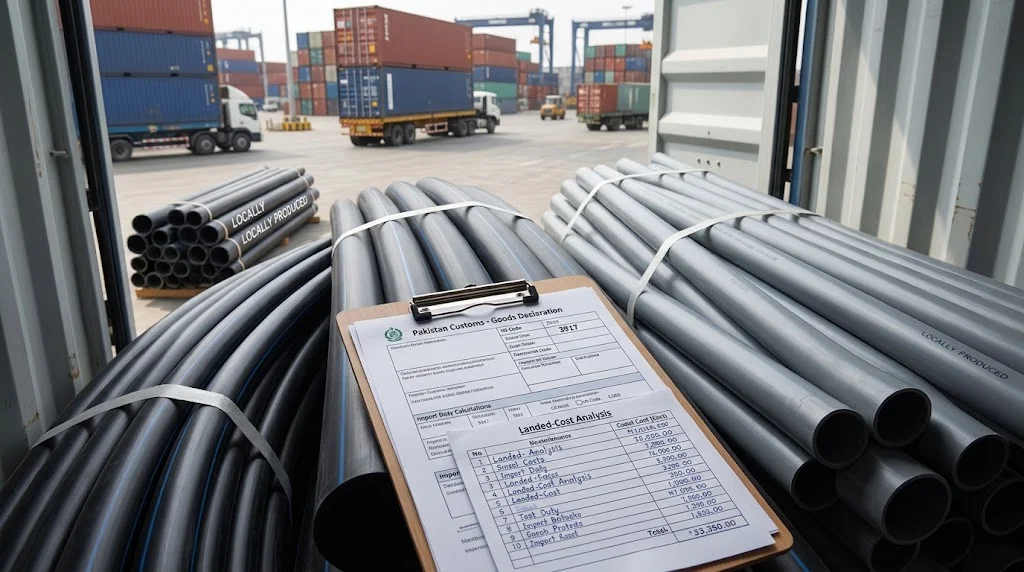
For large infrastructure, industrial, or municipal projects, it’s common to compare a locally manufactured quote against an imported alternative, particularly for specialized grades or larger diameters that not every domestic manufacturer stocks. But a factory price quoted in USD or EUR by an overseas supplier is only the starting point. By the time duty, sales tax, port handling, inland freight, and currency conversion are added, the landed cost in Pakistan can be substantially higher than the initial quote suggested — and that’s before accounting for lead time, demurrage risk if customs clearance is delayed, and the practical difficulty of getting warranty or after-sales support on pipe sourced from outside the country.
How Pakistan Customs Classifies Plastic Pipes (HS Codes)
Pakistan’s customs tariff, like most countries, follows the internationally harmonized system (HS) for classifying goods. Plastic tubes, pipes, and hoses — along with their fittings — generally fall under HS Chapter 39 (plastics and articles thereof), specifically heading 3917, which covers tubes, pipes, and hoses of plastics and fittings for them (such as joints, elbows, and flanges). Within that heading, the exact sub-classification can depend on factors like whether the pipe is rigid or flexible, reinforced or unreinforced, and its specific polymer type — HDPE and PVC pipe may fall under different sub-headings even though both sit under 3917. Because the applicable duty rate, sales tax treatment, and any regulatory or additional customs duty can vary by the precise sub-code, it’s worth confirming the exact classification with a licensed customs clearing agent or by checking Pakistan’s current Customs Tariff schedule on the FBR website rather than assuming one blanket rate applies to all plastic pipe.
NewTech PVC Pipes & Fittings
NewTech Pipes · PVC Piping Systems
See locally made PVC pipes and fittings for plumbing and drainage, with no customs clearance or port demurrage to plan around.
View ProductCost Components on an Imported Pipe Shipment
Several charges typically stack on top of the factory price for an imported shipment, and buyers evaluating total landed cost should account for each:
| Cost Component | What It Covers |
|---|---|
| Customs duty | A percentage of the assessed customs value, based on the HS code classification — rates vary by sub-heading and are revised periodically by FBR |
| Sales tax | Standard sales tax applied on the customs-assessed value plus duty, as with most imported goods |
| Additional customs duty / regulatory duty | Supplementary duties that may apply to specific HS codes depending on current government policy |
| Port handling and clearing charges | Terminal handling, demurrage (if clearance is delayed), and the clearing agent’s service fee |
| Inland freight | Transport from the port (typically Karachi) to the project site, which can be significant for bulky, low-value-per-kg goods like pipe |
| Currency and payment risk | Exchange rate movement between quotation and payment, plus any bank charges on international transfers |
Because several of these components are assessed as percentages of value rather than fixed amounts, the gap between the quoted factory price and the actual landed cost tends to widen on higher-value shipments — which is exactly when buyers are most likely to be considering an import order in the first place.
Do Duty Rates Differ Between HDPE and PVC Pipe?
Because HDPE and PVC are different polymers, they can fall under different HS sub-headings within Chapter 39, and the applicable duty rate, exemptions, or regulatory duty can differ between them depending on the current tariff schedule. This is one of the more common points of confusion for buyers comparing import quotes across materials — a rate that applies to one polymer type doesn’t necessarily carry over to the other. The safest approach is to get the exact HS sub-code confirmed for the specific product (including diameter and pressure class, where relevant) rather than assuming a single HDPE PVC customs HS code covers both materials uniformly.
Why Buyers Still Consider Importing — and the Hidden Costs
- Specialized grades or large diameters not readily available from local manufacturers’ standard stock
- A lower factory-quoted unit price before duty, tax, and freight are factored in
- Perceived quality or brand reputation of an international supplier
- Project specifications that explicitly name an international standard or brand
Each of these reasons can be legitimate, but each also comes with a real cost or risk that’s easy to underweight at the quotation stage: duty and tax can erase the price advantage, lead times for ocean freight plus customs clearance can run into months, and warranty or replacement support on a defective imported batch is far harder to obtain than from a local manufacturer with an in-country office and distribution network.
Why Locally Manufactured, Certified Pipe Avoids This Complexity
Pipe manufactured in Pakistan under ISO 9001:2015 and PSQCA certification sidesteps the entire import duty, customs classification, and clearance process. There’s no HS code to resolve, no customs valuation dispute risk, no port demurrage exposure, and no multi-week shipping lead time — the price quoted by a certified domestic manufacturer is close to the price actually paid, with far less variability between quotation and final cost. For most standard water supply, plumbing, sewerage, and even many industrial applications, domestically manufactured HDPE and PVC pipe meeting ISO 4427, PSQCA, and PEC-recognized standards performs to the same specifications international buyers are often seeking — without the landed-cost uncertainty that comes with importing.See our PSQCA & ISO 9001 Pipe Certification guide for a closer look at what these certifications cover and how to verify them.
What to Check Before Importing Pipe for a Project
- Confirm the exact HS code and current duty/tax rate for the specific product and polymer type with a licensed customs agent or the FBR tariff schedule, rather than relying on a general estimate
- Get a landed-cost quote — not just a factory price — that includes freight, duty, tax, and clearing charges before comparing against a local supplier’s quote
- Verify the exporter’s product certification meets Pakistani standards (PSQCA registration or equivalent) so the imported pipe isn’t held up or rejected at customs on compliance grounds — this is also the same diligence worth applying to any supplier, local or imported, since our guide on how to spot fake or substandard pipes in the Pakistani market covers the warning signs of pipe that doesn’t match its claimed specification
- Factor in realistic lead time, including ocean freight transit and customs clearance, against your project schedule
- Confirm what warranty or replacement process applies if a batch arrives damaged or doesn’t meet specification
Conclusion
Import duty, sales tax, and clearance charges can add significantly to the landed cost of imported PVC and HDPE pipe, often narrowing or eliminating the price advantage that made importing look attractive at the quotation stage. Confirming the correct HS code, getting a true landed-cost quote, and weighing realistic lead times against project schedules are essential steps before committing to an import order. Newtech Pipes, an ISO 9001:2015-certified and PSQCA-registered domestic manufacturer, offers Pakistani buyers a certified alternative without the customs classification, duty, and clearance uncertainty that come with importing.