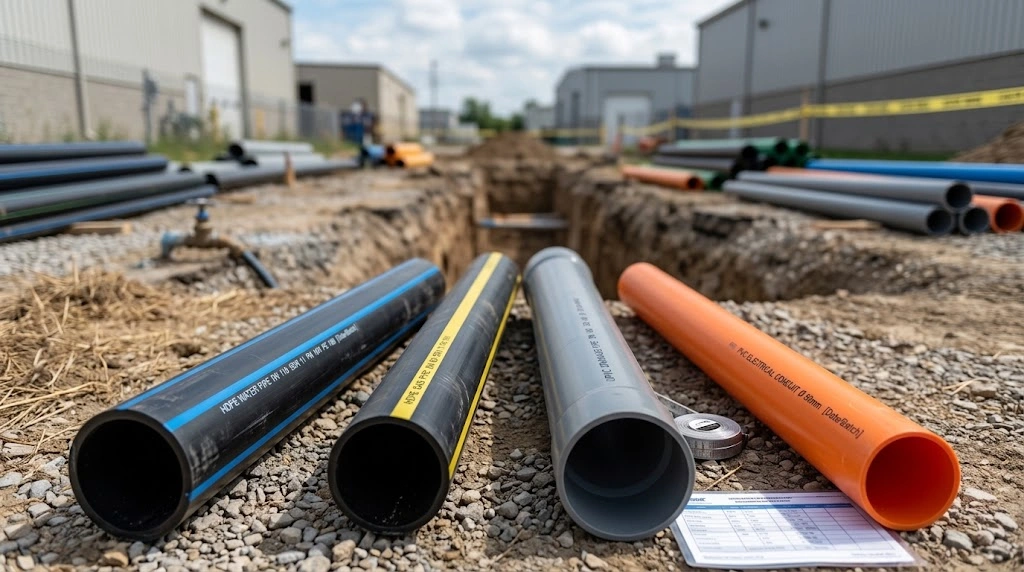
Walk onto almost any construction site in Pakistan and you’ll notice pipes in different colors — black with blue stripes, plain grey, white, and sometimes orange. While many people assume these colors are simply part of a manufacturer’s branding, pipe color code meaning is actually functional. Pipe colors and stripe markings can help contractors, excavators, and inspectors identify what a pipe is likely carrying before they cut into it or connect it to the wrong system. Misidentifying a pipe can lead to serious problems, such as connecting a water line to drainage or accidentally striking a buried gas line that was assumed to carry water. This guide explains what common HDPE and PVC pipe colors can indicate and, equally importantly, why color alone should not always be relied upon for identification.
These conventions are widely followed internationally, but they are not a single universal legal standard applied identically everywhere — some manufacturers and some countries follow slightly different stripe schemes. Treat the table above as a useful general guide, not a substitute for checking the pipe’s printed markings or asking the supplier directly what a specific batch is rated and intended for.

Why Pipes Are Color-Coded in the First Place
Color coding exists mainly for fast visual identification, especially where pipe is buried or run alongside other services. An excavator digging near a construction site needs to know at a glance whether the pipe in front of them likely carries water, gas, or waste, before equipment gets anywhere near it. On a finished building, color also helps a plumber or electrician trace which line does what without opening walls or tracing the run end to end. It’s a safety and efficiency tool first, and a branding detail a distant second.What HDPE Pipe Colors and Stripes Commonly Indicate
HDPE pipe is most often produced in black, sometimes with colored stripes running along its length to flag the intended application. The table below reflects widely used international convention for HDPE pipe striping.| Pipe Appearance | Commonly Indicates |
| Plain black, no stripe | General-purpose or industrial application, non-potable use in many markets |
| Black with blue stripe(s) | Water supply / potable water line |
| Black with yellow or orange stripe(s) | Gas distribution line |
HDPE Pipes & Fittings
NewTech Pipes · HDPE Piping Systems
Stripe color points to the application; the printed rating confirms it. Review PN ratings and SDR on NewTech HDPE pipes.
View ProductWhat UPVC and PVC Pipe Colors Commonly Indicate in Pakistan
UPVC and general-purpose PVC pipe in the Pakistani market typically follows a simpler pattern than HDPE’s striping system, based mainly on the pipe’s own body color rather than stripes:- White or light grey UPVC pipe: commonly used for water supply and plumbing lines.
- Darker grey PVC pipe: commonly used for drainage, waste, and sewerage lines.
- Orange PVC/UPVC conduit: commonly used for electrical or telecom cable protection, distinguishing it from plumbing pipe on a busy site with multiple trades running services at once.
Pressure Class Color Coding: Where It Applies and Where It Doesn’t
Some manufacturers additionally use a colored stripe to indicate a pipe’s PN (pressure) class — for example, using a different stripe color for a PN10 pipe than a PN16 pipe of the same diameter. This practice exists, but it is manufacturer- and standard-specific rather than something you can rely on across every brand of pipe you might buy. Two suppliers can use different stripe colors for the same PN class. For this reason, the pressure class marking printed directly on the pipe wall — not the stripe color — is the detail to actually rely on when specifying or accepting delivery of pressure pipe.Why Color Alone Isn’t Enough: Always Check the Printed Markings
A properly manufactured, standards-compliant pipe carries continuous printed markings along its length: the manufacturer’s name, the material (HDPE, UPVC, PPRC), the nominal diameter, the PN or SDR rating, and the standard it’s produced to. This printed information is the authoritative record of what the pipe actually is and is rated for — color and stripes are a fast visual aid layered on top of that, not a replacement for it. Before accepting a delivery, especially for a project combining supply from more than one source, it’s worth spot-checking that the printed markings match what was ordered rather than trusting color alone.Practical Safety Reasons This Matters on a Pakistani Job Site
On active construction sites in cities like Lahore, Karachi, and Faisalabad, water, drainage, gas, and electrical conduit are frequently run in close proximity, sometimes by different contractors working on the same schedule. Color coding reduces the chance that a plumbing team accidentally taps into what’s actually a gas line, or that a drainage connection gets mistaken for a supply line during a rushed fit-out. It also matters during future maintenance or renovation, when whoever opens a wall or trench years later relies on color as a first, fast clue about what they’re dealing with before probing further.What to Check When Ordering Color-Coded Pipe
- Confirm the intended application (water, gas, drainage, conduit) verbally and in writing, not just by the color the supplier shows you.
- Check that the printed markings on the pipe wall match the material, diameter, and rating you ordered.
- If sourcing pipe from more than one manufacturer for the same project, confirm both suppliers use compatible or clearly documented color conventions to avoid confusion on-site.
- Keep a copy of the manufacturer’s specification sheet on file for the project, so anyone doing future work has a reference beyond color alone.