If you ask about mdpe pipes uses in a hardware market in Pakistan, you’ll often hear a simple answer: “They’re used for gas lines.” While this is correct, it doesn’t tell the complete story. MDPE pipes are used for both gas and water distribution, with the required grade, size, and certification varying significantly depending on the type of service they are designed to carry.
This guide explains exactly what MDPE pipe is, where it’s used for gas and water applications, how it compares to HDPE, and what to check before buying — so you’re not left guessing whether the pipe in front of you is actually right for your project.
What Is MDPE Pipe?
MDPE stands for Medium-Density Polyethylene — a flexible thermoplastic pipe material that sits between HDPE (High-Density) and LDPE (Low-Density) polyethylene in terms of material density and rigidity. It’s joined by heat fusion (electrofusion or, for larger sizes, butt-fusion) rather than glue or threading, producing a continuous, leak-resistant pipeline.
MDPE’s defining characteristics — flexibility, crack resistance, and corrosion immunity — make it well suited to buried service connections where the pipe needs to bend around obstacles without extra fittings at every turn.
MDPE Pipe for Gas Lines
One of the most common MDPE pipes uses is gas distribution, and for good reason:
No corrosion risk: Unlike steel gas pipe, which can rust underground over decades, especially in humid coastal cities.
Fewer joints per meter: Since MDPE’s flexibility reduces the number of elbow fittings needed compared to rigid pipe.
Excellent resistance to slow crack growth: Critical for a buried pipe carrying pressurized gas over a long service life.
Faster installation: Since smaller diameters are supplied in coils rather than fixed lengths.
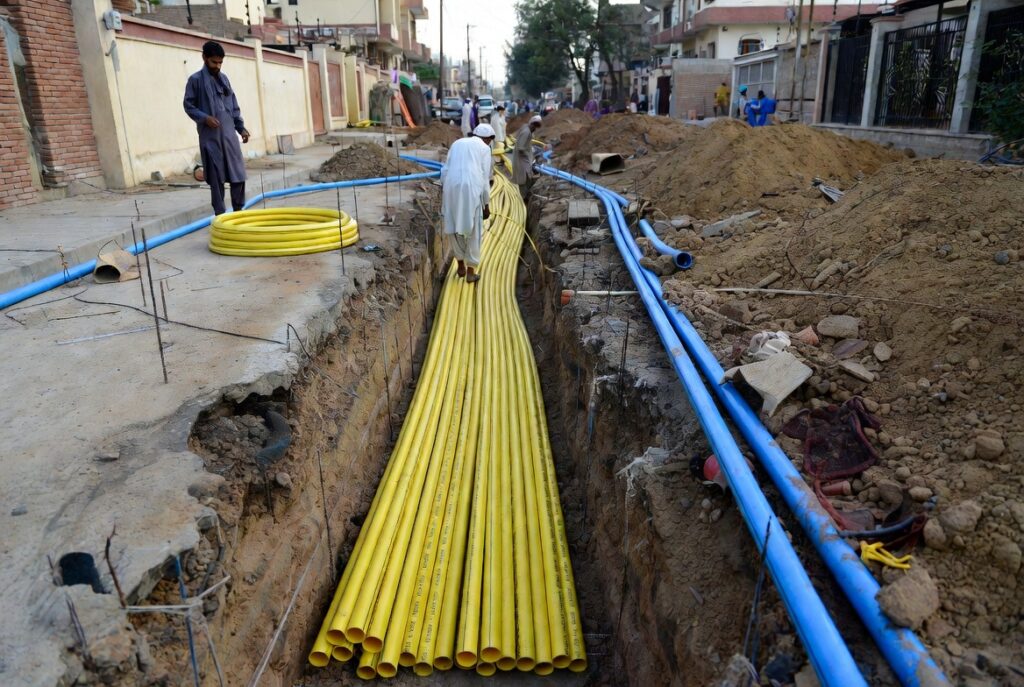
MDPE pipe for gas lines in Pakistan is typically manufactured from PE80 grade material, conforming to ISO 4437, the international standard specifically for polyethylene gas pipe systems. Gas-grade MDPE pipe carries a yellow identification stripe embedded in the pipe wall — a simple but essential field check, since gas and water pipe can otherwise look identical from the outside.
Common gas application sizes range from around 20mm for household service connections up to roughly 180mm for distribution branch lines, with SDR (Standard Dimension Ratio) selected based on the utility’s specified operating pressure — SDR 17.6 for lower-pressure networks, SDR 11 or SDR 9 for higher-pressure sections.
MDPE Pipe for Water Supply
MDPE is also used for smaller-diameter water service connections, particularly:
Household water supply connections from a main line
Smaller branch lines in housing society water networks
Some agricultural and tube well applications where flexibility around obstacles is valuable
Water-grade MDPE pipe conforms to ISO 4427 rather than ISO 4437, and carries a blue identification stripe instead of yellow. This distinction matters enormously — using gas-grade or water-grade pipe interchangeably is a genuine safety and compliance issue, not just a technicality.
MDPE vs HDPE Pipe: What’s the Real Difference?
This is one of the most searched comparisons, and the honest answer is that MDPE vs HDPE pipe is less about a hard boundary and more about density grade and typical application:
| Property | MDPE | HDPE |
| Density grade | Medium-density (often PE80) | High-density (often PE100) |
| Flexibility | More flexible | Less flexible, more rigid |
| Common diameter range | Smaller (20mm–180mm) | Wider, including large transmission mains |
| Typical use | Gas service lines, smaller water connections | Larger water mains, tube well risings, industrial lines |
| Impact resistance | Very good, especially in cold conditions | Very good, slightly more rigid overall |
| Pressure capacity | Lower long-term strength rating (MRS) | Higher long-term strength rating |
In practice, MDPE is generally chosen for smaller-diameter, more flexible service connections — especially gas — while HDPE takes over for larger-diameter, higher-pressure transmission and distribution mains. Both are polyethylene and both are joined the same way (heat fusion), so the real decision usually comes down to the specific diameter and pressure class your project calls for, rather than picking one material as universally “better.”
Choosing the Right MDPE Grade and Size
A practical checklist for sourcing MDPE pipe for your specific application:
Confirm the service first — gas or water — since this determines the correct ISO standard and colour-coded stripe.
Get the actual operating pressure from your utility (SNGPL, SSGC, or your local WASA) rather than guessing the SDR requirement.
Match diameter to load — a single household gas or water connection rarely needs more than 32mm–50mm; branch lines serving multiple connections scale up from there.
Verify fusion compatibility between pipe and fittings, especially for electrofusion joints where fusion parameters must match the material grade.
Check the certification mark and colour stripe physically, not just on the invoice or brochure.
Standards and Certification to Check
Whichever application you’re buying for, verify:
PSQCA certification mark, confirming compliance with the relevant Pakistan Standard (commonly referenced as PS 3580 for polyethylene pipe).
Correct ISO standard for the service — ISO 4437 for gas, ISO 4427 for water.
Colour-coded stripe matching the intended service — yellow for gas, blue for water.
Manufacturer’s ISO 9001:2015 certification, reflecting consistent quality control across production batches.
Batch-specific test certificate, tying the delivered pipe to documented test results rather than relying on a general brand reputation.
You can review NewTech-Pipes’ quality control standards as an example of the documentation a certified manufacturer should provide.
Installation and Handling Tips
Store coiled MDPE pipe out of prolonged direct sunlight before installation, since extended UV exposure can affect surface properties over time.
Ensure proper trench bedding with sand or fine fill to avoid point-loading the pipe against sharp stones.
Never drag pipe across abrasive surfaces during installation — surface scoring can reduce long-term pressure performance even if it looks purely cosmetic.
For electrofusion joints, confirm the control box settings match the specific pipe grade and diameter before fusing.
Maintain the utility’s specified depth of cover, which is typically deeper for gas lines than for water lines due to added safety margins.
Conclusion
MDPE pipe plays a specific, important role in both gas and water distribution — its flexibility and corrosion resistance make it the practical choice for smaller-diameter buried service connections, while HDPE typically takes over for larger, higher-pressure mains. Getting the grade, colour-coded stripe, and certification right isn’t optional when gas is involved — it’s a genuine safety requirement. NewTech-Pipes manufactures MDPE pipes to relevant ISO and PSQCA standards, giving contractors and utilities a certified option for both gas and water service connections.
Frequently Asked Question's
MDPE pipe is mainly used for gas distribution service connections and smaller-diameter water supply lines. Its flexibility and corrosion resistance make it well suited to buried connections that need to bend around obstacles without extra fittings.
Gas-grade MDPE conforms to ISO 4437 and carries a yellow identification stripe, while water-grade MDPE conforms to ISO 4427 and carries a blue stripe. The two should never be used interchangeably, even though the base material is similar.
Not exactly — MDPE and HDPE are both polyethylene, but MDPE is generally a medium-density grade (often PE80) used for smaller, more flexible service connections, while HDPE is typically a higher-density grade (often PE100) used for larger-diameter, higher-pressure mains.
MDPE can handle a range of pressure classes depending on its SDR rating, but very high-pressure transmission sections often shift to HDPE instead, since HDPE’s higher strength grade allows for either a thinner wall or a higher pressure rating at the same diameter.
Check for the PSQCA certification mark, the yellow gas identification stripe, and a batch-specific test certificate referencing ISO 4437. A generic company brochure or verbal assurance from a supplier isn’t a substitute for this documentation.