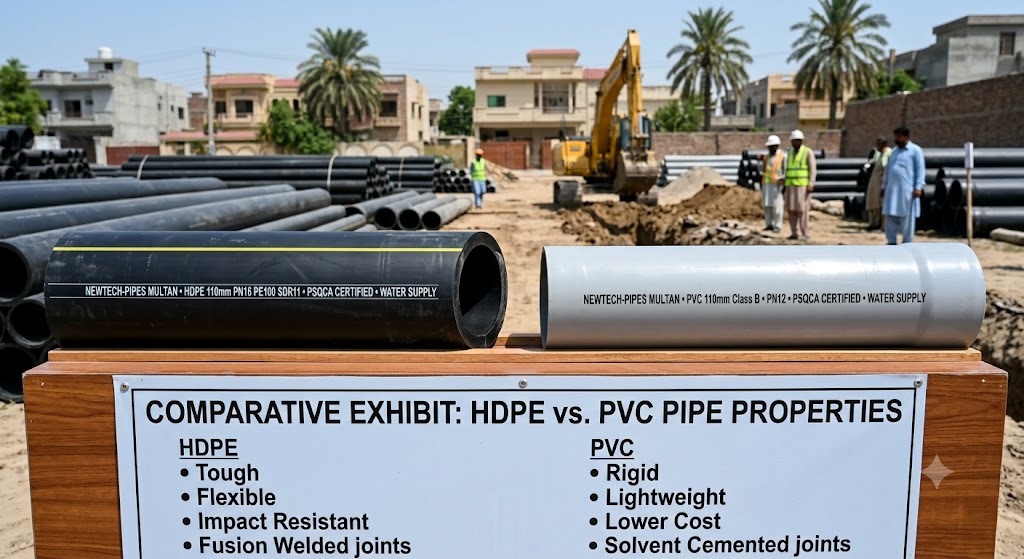
Standing at a hardware store or supplier’s counter with two pipe options in front of you is a common point of hesitation for homeowners, contractors, and site engineers across Pakistan. Both HDPE Vs PVC pipes are widely used, both are made from plastic, and both are known for their durability. As a result, the decision often comes down to guesswork or simply following the shopkeeper’s recommendation.
This guide breaks down the real, practical difference between HDPE and PVC pipes so you can make the right call for your specific project — whether that’s a tube well rising main, a housing society water network, or drainage lines for a new house. By the end, you’ll know exactly which pipe fits which job, and why.
What Is HDPE Pipe?
HDPE stands for High-Density Polyethylene. It is a flexible and durable plastic pipe material commonly used for pressurized water supply, gas distribution, and various industrial applications. An HDPE Pipe is typically connected using heat-based butt-fusion welding or compression and electrofusion fittings instead of glue. This creates a continuous, leak-resistant pipeline with significantly fewer joints compared with rigid pipe systems.
Common uses in Pakistan include:
Tube well rising mains for agricultural irrigation
Municipal and housing-society water supply networks
Gas distribution lines (in MDPE/HDPE grade)
Industrial process water and effluent lines
What Is PVC Pipe?
PVC (Polyvinyl Chloride) pipe is a rigid plastic pipe, typically joined using solvent cement (glue) or rubber-ring push-fit joints rather than heat fusion. It’s one of the most common materials for drainage, sewerage, and non-pressure or moderate-pressure water applications in residential construction.
Common uses in Pakistan include:
Sewerage and waste drainage lines
Rainwater and stormwater drainage
Cold water plumbing in homes
Electrical conduit (a separate uPVC product line)
HDPE vs PVC Pipe: The Core Differences
Understanding the difference between HDPE and PVC pipes starts with recognizing they were designed to solve different problems. HDPE prioritizes flexibility and joint integrity under pressure; PVC prioritizes rigidity, ease of installation, and cost-efficiency for gravity-fed or moderate-pressure systems.
| Property | HDPE Pipe | PVC Pipe |
|---|---|---|
| Flexibility | Highly flexible, bends around obstacles | Rigid, requires elbow fittings for turns |
| Jointing method | Heat/butt-fusion or electrofusion — fully fused joint | Solvent cement or rubber-ring — mechanical joint |
| Pressure handling | Excellent for high-pressure water and gas lines | Good for low-to-moderate pressure, drainage-grade use |
| Impact resistance | Very high; resists cracking under ground movement | More brittle; can crack under heavy impact or extreme cold |
| UV/sunlight exposure | More tolerant of some above-ground exposure | Degrades faster with prolonged direct UV exposure |
| Typical lifespan | 50+ years under correct conditions | Typically 25–50 years depending on grade and application |
| Cost per meter | Generally higher, especially in larger diameters | Generally lower for equivalent diameter |
| Best for | Pressurized water supply, tube wells, gas lines | Drainage, sewerage, low-pressure plumbing |
Flexibility and Ground Movement
This is one of the most practically important differences for Pakistani conditions. Areas with soil movement, agricultural land with tube wells, or terrain where pipe needs to curve around existing infrastructure benefit from HDPE’s flexibility — it can bend to a reasonable radius without needing extra fittings, reducing the number of joints (and potential leak points) in the line. PVC, being rigid, needs a fitting at every direction change, which means more joints and more places where a system can eventually fail if installation quality is inconsistent.
Jointing and Leak Resistance
HDPE’s butt-fusion or electrofusion joint effectively welds two pipe sections into one continuous piece of material — there’s no separate “joint” material that can degrade over time. PVC’s solvent-cement joint is a chemical bond between pipe and fitting, which is reliable when installed correctly but is more sensitive to installation technique, temperature during application, and cure time. For high-value, hard-to-access pressurized lines (like a tube well rising main buried several feet underground), the fused HDPE joint is generally the safer long-term choice.
Cost Considerations
PVC pipe is typically less expensive per meter than HDPE at equivalent diameter, which is why it remains the standard choice for drainage and non-pressure applications where its rigidity and jointing method are already sufficient. HDPE’s higher material and installation cost (butt-fusion equipment, skilled operators) is usually justified when the application involves sustained pressure, buried gas service, or ground conditions where flexibility reduces long-term maintenance costs.
Which Is the Best Pipe for Water Supply?
This is the single most common question buyers ask, and the honest answer depends on the type of water supply system:
For pressurized water mains, tube wells, and long-distance transmission lines, HDPE is generally the best pipe for water supply because it handles sustained pressure well, resists cracking from ground movement, and its fused joints eliminate a major source of long-term leaks. You can explore our certified HDPE pipes and fittings options for pressure applications.
For internal household plumbing (cold water lines within a house), PVC pipes for drainage and water supply (or PPRC for hot water lines) are practical, cost-effective, and widely accepted choices, since pressures are lower and the pipe run is shorter and more accessible for repairs.
For drainage and sewerage, PVC remains the standard — HDPE isn’t typically necessary here since these are gravity-fed, non-pressurized systems.
A useful rule of thumb used by engineers: if the pipe will be under continuous pressure and buried where repairs are difficult, lean HDPE. If the pipe is gravity-fed, non-pressurized, or easily accessible for future maintenance, PVC is usually the more economical and perfectly adequate option.
Standards and Certification to Check
Regardless of which material you choose, verify the following before accepting delivery:
PSQCA certification mark — the Pakistan Standards and Quality Control Authority certifies both HDPE and PVC pipe against the relevant Pakistan Standards.
ISO conformance — HDPE pressure pipe for water supply is typically manufactured to ISO 4427; PVC pressure pipe follows standards such as ISO 1452 (or the equivalent Pakistan Standard for uPVC pressure pipe).
SDR or pressure class stamped on the pipe — this tells you the pressure rating the pipe is designed for; always match this to your system’s actual operating pressure rather than assuming “thicker is always better”.
Manufacturer’s ISO 9001:2015 certification — this reflects consistent PSQCA and ISO 9001:2015 certified pipe standards across production batches, which matters especially for multi-phase projects where material delivered months apart needs to match.
Installation and Maintenance Considerations
HDPE requires butt-fusion or electrofusion equipment and a trained operator for larger diameters, which adds to upfront project cost but reduces the number of joints requiring future inspection.
PVC installation is generally faster and requires less specialized equipment, making it practical for smaller residential jobs handled by local plumbers.
Both materials require proper trench bedding and backfill to avoid point-loading against sharp stones, and both should be protected from prolonged direct sunlight exposure before installation.
Neither pipe type should be installed with incompatible fittings — always match jointing method and pressure class to the pipe’s certification.
How to Decide: A Quick Checklist
Ask yourself these questions before choosing between HDPE vs PVC pipe for your specific project:
Will this line carry continuous pressure (like a tube well or water main), or is it gravity-fed drainage?
Is the pipe route straight, or does it need to curve around obstacles or uneven terrain?
Will this be buried in an area difficult to access for future repairs?
Is your budget more sensitive to upfront material cost, or long-term maintenance cost?
Does your local WASA, housing society, or utility have a specific requirement for this application?
If most answers point toward continuous pressure, difficult access, or curved routing, HDPE is the stronger choice. If the answers point toward gravity drainage, straightforward routing, and easy future access, PVC is typically sufficient and more cost-effective.
Conclusion
Choosing between HDPE vs PVC pipe isn’t about which material is universally superior — it’s about matching the pipe to the job. HDPE earns its place in pressurized water supply, tube wells, and buried lines where flexibility and fused joints matter; PVC remains the practical, economical choice for drainage and low-pressure plumbing. Whichever material your project calls for, always verify PSQCA and ISO certification before installation. NewTech-Pipes, as an ISO 9001:2015-certified manufacturer, produces both HDPE and PVC pipe to these standards, giving contractors and homeowners a reliable option regardless of which material their project needs.
Frequently Asked Question's
Neither is universally “better” — they’re suited to different jobs. HDPE outperforms PVC for pressurized water supply, tube wells, and buried gas lines due to its flexibility and fused joints. PVC is better suited and more cost-effective for drainage, sewerage, and low-pressure plumbing.
PVC is sometimes used for shallow, low-pressure tube well casings, but HDPE is generally preferred for rising mains carrying pressurized water, since it handles ground movement and sustained pressure more reliably over a long service life.
Both can last several decades when installed correctly and matched to the right application. HDPE often has a slight edge in harsh underground conditions due to its flexibility and crack resistance, while PVC performs reliably for its full intended lifespan in drainage and low-pressure use.
Generally yes, per meter, especially in larger diameters — HDPE material and fusion equipment cost more than PVC pipe and solvent-cement fittings. However, HDPE’s fewer joints and long-term durability in pressurized applications can offset this over the system’s lifetime.
Both perform well when properly installed, but HDPE’s flexibility handles soil movement and temperature-driven expansion/contraction better in exposed or shifting ground, while PVC works reliably for indoor plumbing and drainage where these conditions are less of a factor.