If you’ve ever compared piping options for a construction project, tube well, or housing society’s water supply system, you’ve likely come across the term HDPE pipe. But what is hdpe pipe, exactly, and why has it become a preferred choice for engineers and contractors across Pakistan? In this guide, you’ll learn what HDPE pipe is made from, how it is manufactured, where it is commonly used, and how to determine whether it is the right material for your project. By the end, you’ll be able to speak confidently with suppliers and contractors and know exactly what questions to ask before making a purchase.
What is HDPE Pipe?
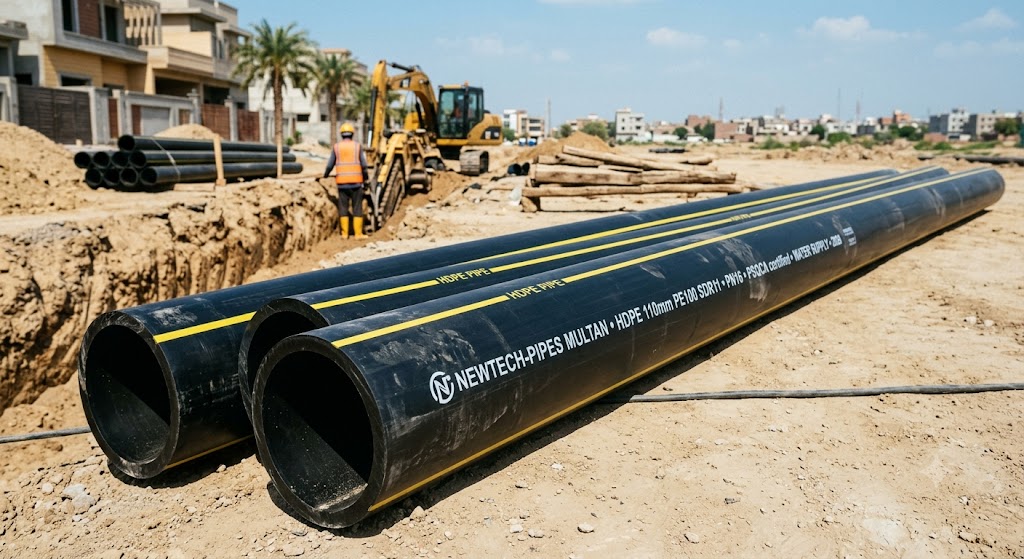
HDPE stands for High-Density Polyethylene, a thermoplastic material derived from petroleum. Unlike ordinary plastics, HDPE has a tightly packed molecular structure that provides exceptional strength while remaining lightweight. When this resin is melted and extruded into a pipe, it forms what the industry refers to as an HDPE pipe—a flexible, corrosion-resistant, and durable alternative to traditional galvanized iron (GI) or steel pipin
In Pakistan, HDPE pipe is manufactured to international standards such as ISO 4427, using PE-100 grade raw material — the same designation used globally for pressure-rated water and gas pipelines. This isn’t a generic plastic pipe; it’s engineered specifically to handle pressure, temperature swings, and years of underground or above-ground service without degrading.
HDPE Pipe Manufacturing Process
Understanding the HDPE pipe manufacturing process helps explain why quality varies so much between suppliers in the local market.
Raw material selection – Manufacturers start with PE-100 grade HDPE resin, usually imported in granule form. The grade of resin used is the single biggest factor in a pipe’s long-term durability, since lower-grade recycled plastic will crack and fail under pressure far sooner than virgin PE-100 material.
Extrusion – The granules are fed into an extruder, where they’re heated until molten and forced through a circular die to form a continuous pipe shape.
Sizing and cooling – As the pipe exits the die, it passes through a vacuum sizing tank and water cooling bath, which sets its exact diameter and wall thickness.
Cutting or coiling – Smaller diameters (typically 20mm–110mm) are coiled onto reels for easy transport and installation, while larger diameters (up to 630mm and beyond) are cut into straight lengths.
Quality testing – Reputable manufacturers test each production batch for wall thickness consistency, pressure resistance, and ovality (roundness) before the pipe is approved for sale.
This is where the HDPE pipe manufacturing process really separates trustworthy manufacturers from low-cost, uncertified producers. A pipe that looks identical on the outside can behave very differently once it’s buried underground and put under real water or gas pressure.
Key Properties That Make HDPE Pipe Popular
Several properties explain why HDPE has become the preferred piping material across so many sectors:
Corrosion resistance – Unlike GI or steel pipe, HDPE never rusts, which matters enormously in Pakistan’s variable water quality and soil conditions.
Flexibility – HDPE pipe can bend around obstacles without fittings, reducing the number of joints — and therefore the number of potential leak points — in a pipeline.
Long service life – Properly manufactured HDPE pipe is commonly rated for 50 years or more of service life under normal operating conditions.
Lightweight handling – A given length of HDPE pipe weighs a fraction of the equivalent steel pipe, cutting transport and installation costs, especially in remote or hilly areas.
Leak-free jointing – Through butt-fusion or electrofusion welding, HDPE sections can be joined into a continuous pipeline with a bond that is often stronger than the pipe itself.
Chemical resistance – HDPE resists most acids, alkalis, and salts found in wastewater, agricultural runoff, and industrial effluent.
HDPE Pipe Uses in Pakistan
The range of HDPE pipe uses in Pakistan spans nearly every sector that moves water, gas, or cable underground.
Water Supply and Distribution
Municipal water boards, housing societies, and private developers use HDPE pipes and fittings for both trunk lines and household connections. Its resistance to corrosion means water quality stays more consistent over the pipeline’s lifetime compared to older GI networks.
Agriculture and Tube Wells
Farmers across Punjab and Sindh increasingly rely on HDPE pipe for tube well discharge lines and field irrigation, since it withstands constant exposure to sun, soil chemicals, and rough handling in agricultural settings.
Natural Gas Distribution
HDPE pipe is widely approved for underground gas distribution because of its resistance to stress cracking and its ability to flex slightly with ground movement without failing — a serious safety advantage over rigid piping.
Sewerage and Drainage
Larger-diameter HDPE pipe is used in municipal and industrial drainage systems, where its smooth internal wall resists the buildup of solids and reduces the risk of blockages compared to rougher-surfaced materials.
Telecom and Cable Ducting
HDPE conduit is the standard choice for protecting underground fiber-optic and electrical cabling, since it’s non-conductive, resists moisture, and can be pulled through with cables in one continuous run.
Industrial and Mining Applications
Because of its chemical resistance, HDPE pipe is also used for slurry transport, chemical discharge lines, and dust suppression systems in Pakistan’s mining and industrial sectors.
HDPE Pipe Sizes and Pressure Ratings
HDPE pipe in Pakistan is typically manufactured from around 20mm up to 630mm in diameter, with fittings available across a similarly wide range. Pressure rating (denoted as PN, such as PN 6, PN 10, or PN 16) indicates the maximum working pressure the pipe can safely handle — a critical spec to check before buying, since using an under-rated pipe for a high-pressure application is a common and costly mistake.
As a general guide:
PN 6–PN 8: Suitable for low-pressure irrigation and non-pressurized drainage
PN 10: Common for general water supply lines
PN 16 and above: Used for higher-pressure municipal or industrial systems
Always confirm the pressure rating matches your project’s operating conditions, not just the diameter.
How to Choose the Right HDPE Pipe
When comparing suppliers, keep these factors in mind:
Certification – Look for ISO 9001:2015 certification and compliance with ISO 4427 or PSQCA standards. This is the clearest signal that a manufacturer follows consistent ISO 9001:2015 quality standards.
Raw material grade – Ask specifically whether the pipe is made from virgin PE-100 resin or recycled material blends.
Wall thickness consistency – Uneven wall thickness is one of the most common defects in low-quality HDPE pipe and is difficult to spot without proper testing equipment.
Jointing method compatibility – Confirm the pipe is compatible with standard HDPE butt-fusion welding equipment if you plan to join long runs.
After-sales technical support – A manufacturer that offers on-site guidance for welding and installation adds real value beyond the price of the pipe itself.
Frequently Asked Questions
What is HDPE pipe used for?
HDPE pipe is used for water supply, gas distribution, sewerage and drainage, agricultural irrigation, telecom cable ducting, and industrial fluid transport. Its corrosion resistance and flexibility make it suitable for both underground and above-ground installations across residential, commercial, and industrial projects in Pakistan.
Is HDPE pipe better than PVC pipe?
HDPE and PVC each have strengths. HDPE is more flexible and better suited to pressure applications like water and gas lines, while PVC is often preferred for drainage and sewerage due to its rigidity and cost. The right choice depends on your specific application and pressure requirements.
How long does HDPE pipe last?
Properly manufactured HDPE pipe using PE-100 grade material is typically rated for a service life of 50 years or more under normal operating conditions, making it one of the most durable piping materials available for underground use.
Can HDPE pipe be used for hot water?
Standard HDPE pipe is designed for cold water, gas, and general fluid transport rather than hot water systems. For hot and cold water plumbing lines, PPRC pipe is generally the more suitable and widely used material in Pakistan.
What sizes does HDPE pipe come in?
HDPE pipe is commonly available from 20mm up to 630mm in diameter, with fittings manufactured across a matching size range, allowing it to be used for everything from household connections to large municipal water mains.
Conclusion
So, what is HDPE pipe, in short? It’s a high-strength, corrosion-resistant polyethylene pipe that has become the standard choice for water, gas, drainage, and cable protection projects across Pakistan, thanks to its long service life and flexible installation. The real difference between a pipe that performs for 50 years and one that fails within a few comes down to raw material quality and manufacturing precision — which is why certification and supplier reputation matter as much as price. NewTech-Pipes manufactures HDPE pipe using PE-100 grade material under ISO 9001:2015 certification, giving builders and contractors across Pakistan a dependable option for pressure-rated piping projects.
Frequently Asked Question's
PVC pipe prices in Pakistan generally range from around Rs. 25 per foot for small household sizes up to roughly Rs. 2,000 per foot for large-diameter commercial drainage pipe, depending on diameter, wall thickness, and brand. Always confirm same-day rates directly with your supplier, since pricing shifts with resin costs.
Differences between major cities are usually modest for standard residential sizes, mainly reflecting transport distance from manufacturing hubs. Smaller towns and rural areas typically see a larger markup than major cities due to lower order volumes and higher freight costs.
Not always. Lower prices sometimes reflect thinner wall thickness or missing certification rather than genuine savings. Always confirm the pressure class and PSQCA certification match between competing quotes before assuming the cheaper option is better value.
Correctly installed, certified PVC pipe commonly lasts 30–50 years depending on application and installation quality. Drainage and low-pressure applications tend toward the longer end of this range, since they experience less operating stress than pressurized systems.
Use PVC for cold water supply, drainage, and conduit applications, since it’s more cost-effective for these uses. Choose PPRC for any hot water lines, since PVC isn’t rated for sustained hot water service and shouldn’t be substituted regardless of price.