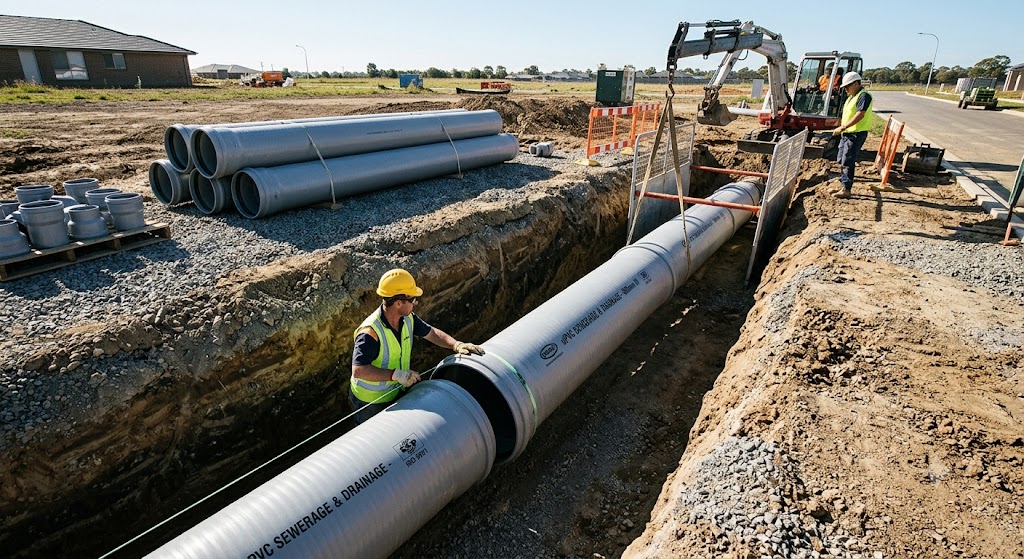
Drainage failures rarely start with the pipe itself — they usually start with poor bedding, wrong slope, or mismatched fittings during installation. Choosing uPVC pipes for drainage is only half the job; getting the installation right is what actually determines whether the system works for decades or backs up within a few years.
This guide covers what uPVC drainage pipe is, the sizes and classes used in Pakistan, and a practical, step-by-step drainage pipe installation guide — including the trench, slope, and jointing details that determine whether your system performs the way it should.
What Is uPVC Pipe, and Why Use It for Drainage?
uPVC (unplasticized Polyvinyl Chloride) is a rigid plastic pipe — no added plasticizers, which makes it stiffer and more chemically stable than plasticized PVC variants. This rigidity, combined with corrosion resistance, is exactly why uPVC has become the standard replacement for old clay and concrete sewer lines across Pakistan.
Key advantages for drainage and sewerage use:
No corrosion or scaling — unlike metal or concrete pipe, uPVC doesn’t degrade from wastewater chemistry over time.
Smooth internal bore — reduces friction, helping prevent solids buildup and blockages compared to rougher-surfaced materials.
Lightweight — significantly easier to handle and install than concrete or clay pipe of equivalent diameter.
Long service life — properly installed uPVC sewer pipe commonly lasts several decades with minimal maintenance.
uPVC Sewerage Pipe Pakistan: Sizes and Classes
uPVC sewerage pipe in Pakistan is typically available from around 2 inches (50mm) for internal waste lines up to 12 inches (300mm) or larger for main sewer trunk lines. Pipe is classified by its SDR (Standard Dimension Ratio) or pipe stiffness class, which determines how much load it can bear once buried:
| Application | Typical Size Range | Common Class |
| Internal waste/soil pipe (toilets, sinks) | 2″–4″ | Light-duty, non-pressure |
| House drainage connection to main sewer | 4″–6″ | SDR 35 equivalent |
| Housing society/commercial sewer mains | 6″–12″+ | SDR 35 or higher stiffness class |
Internationally, non-pressure sewer pipe is commonly referenced against EN 1401 or ASTM D3034, both of which define dimensional tolerances, impact resistance, and joint tightness requirements for gravity-flow PVC sewer pipe. Pakistani manufacturers typically certify uPVC drainage pipe against the equivalent Pakistan Standard alongside these international references.
Jointing Methods: Solvent Cement vs. Rubber Ring
Two jointing methods dominate uPVC drainage installation:
Solvent cement joints — a chemical weld between pipe and fitting, common for smaller internal waste lines where the joint won’t experience significant ground movement.
Rubber-ring (elastomeric gasket) joints — a push-fit joint using a rubber seal, standard for larger buried sewer mains since it allows slight flexibility and thermal movement without stressing the joint.
For most underground sewerage runs, rubber-ring joints are preferred precisely because buried pipe experiences some ground movement over its service life, and a rigid solvent-cement joint is more prone to stress cracking under that movement than a sealed, slightly flexible rubber-ring joint.
Step-by-Step Drainage Pipe Installation Guide
1. Plan the Slope Before Digging
Gravity does all the work in a drainage system, so slope (gradient) is the single most important design factor. A general rule of thumb used by plumbers is a minimum slope of around 1:60 to 1:100 (roughly 1–2% grade) for standard household waste lines, though larger-diameter mains may use a flatter gradient calculated by an engineer. Too little slope causes solids to settle and block the line; too much slope can cause liquids to outrun solids, leaving waste behind.
2. Excavate to the Correct Depth and Width
Trench depth should account for adequate cover above the pipe crown — enough to protect against surface loading (vehicle traffic, foot traffic) without over-burying the line unnecessarily. Trench width should give enough working room on both sides of the pipe for proper bedding material placement, typically pipe diameter plus a consistent margin on each side.
3. Prepare Proper Trench Bedding
This is the step most commonly done poorly. The trench base should be lined with a compacted bed of sand or fine granular fill — never let the pipe rest directly on rock, uneven soil, or construction debris. Point-loading against a sharp stone is one of the most common causes of premature pipe cracking in Pakistani drainage installations, and it’s entirely avoidable with proper bedding.
4. Lay Pipe to Line and Grade
Pipe should be laid starting from the downstream (outlet) end working upstream, checking slope continuously with a level or laser grade tool rather than eyeballing it. Each length should be fully supported along its barrel, not just at the joints.
5. Make Joints Correctly
For rubber-ring joints, ensure the rubber seal is properly seated and lubricated per the manufacturer’s instructions before pushing the spigot fully home, leaving the specified gap for thermal expansion. For solvent-cement joints, apply cement evenly to both surfaces and hold the joint firmly for the manufacturer’s specified set time before releasing.
6. Backfill in Layers
Backfill should be placed and compacted in layers, starting with fine material directly around the pipe (haunching and initial backfill) before introducing larger fill material higher in the trench. Backfilling too quickly with unscreened material risks damaging the pipe or leaving voids that cause settlement later.
7. Test Before Closing the Trench
Where possible, run water through the completed line and visually inspect joints before backfilling is finished or before the trench is closed permanently — this is far cheaper than diagnosing a leak after the ground is restored.
Standards and Certification to Check
Before accepting uPVC drainage pipe for a project, verify:
PSQCA certification mark, confirming compliance with the relevant Pakistan Standard for PVC drainage/sewer pipe.
Reference to EN 1401 or ASTM D3034, the common international benchmarks for non-pressure PVC sewer pipe dimensions and performance.
Pipe stiffness class printed on the pipe, matched to burial depth and expected surface loading.
Manufacturer’s ISO 9001:2015 certification, reflecting consistent quality control across production batches.
You can review NewTech-Pipes’ quality control standards as a reference for the documentation a certified manufacturer should provide.
Common Installation Mistakes to Avoid
Skipping proper bedding and laying pipe directly on rocky or uneven trench bottom.
Getting the slope wrong — either too flat (causing blockages) or too steep (causing solids to separate from liquid flow).
Backfilling too fast with unscreened material containing large stones or debris.
Mixing incompatible fittings — always match jointing method (solvent cement vs. rubber ring) to the pipe class being used.
Skipping a pressure/flow test before the trench is permanently closed, leaving no easy way to catch a leaking joint early.
Conclusion
uPVC pipe is a reliable, long-lasting choice for drainage and sewerage in Pakistan, but its performance depends heavily on installation quality — correct slope, proper bedding, and careful jointing matter as much as the pipe’s certification. Get these fundamentals right, and a uPVC drainage system should run trouble-free for decades. NewTech-Pipes manufactures uPVC pipes and fittings for drainage and sewerage applications to relevant certification standards, giving contractors and homeowners a dependable option for new construction and system replacement alike.
Frequently Asked Question's
Internal waste lines from toilets and sinks typically use 2″–4″ uPVC pipe, while the connection from the house to the main sewer line commonly uses 4″–6″, depending on the number of fixtures and local building code requirements.
A common minimum slope for household waste lines is around 1:60 to 1:100 (roughly 1–2% grade), though the icorrect figure depends on ppe diameter and expected flow volume. Larger sewer mains are typically slope-calculated by an engineer rather than using a fixed rule of thumb.
Yes — uPVC pipe is widely used for underground sewer mains in housing societies and municipal projects, provided the correct pipe stiffness class and rubber-ring jointing are used for the depth and loading conditions involved.
Properly installed uPVC drainage and sewerage pipe commonly lasts several decades — often several decades beyond 25 years — since it doesn’t corrode or degrade the way older clay or metal sewer pipe does over time.
Installation errors cause most failures, not the pipe material itself — poor trench bedding, incorrect slope, and fast backfilling with unscreened material are the most common causes of premature cracking or blockage in an otherwise properly rated pipe.