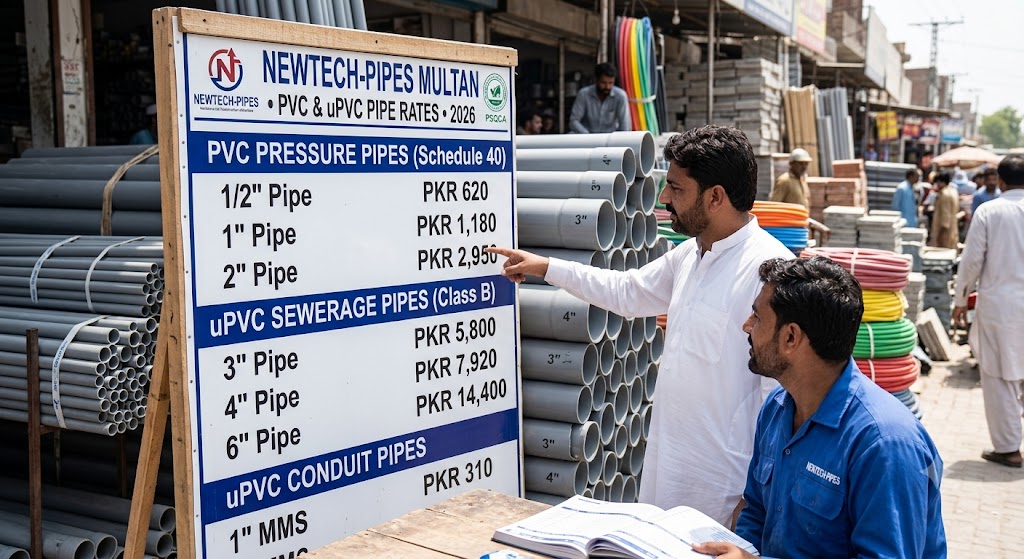
Before starting any plumbing, drainage, or construction project, one of the first things buyers want to know is the current PVC Pipe price in pakistan. Prices mainly vary based on factors such as pipe size, wall thickness, and brand, while the city where you purchase the pipes may also cause some price variation. Knowing the current price ranges can help you plan your budget accurately and avoid paying too much for pipes that are overpriced or underweight.
This guide breaks down the PVC pipe rate list 2026 by size category, explains what drives price differences between Lahore, Karachi, and Islamabad, and covers what to check before accepting delivery so you don’t end up with underweight or uncertified pipe.
What Determines PVC Pipe Price?
PVC pipe pricing in Pakistan isn’t random — it’s driven by a consistent set of factors:
Diameter and wall thickness. Larger diameter and thicker-walled pipe requires more raw PVC resin, which is the single biggest driver of price per foot.
Pressure class. Pipe rated for higher water pressure (used in pressurized supply lines) costs more than standard drainage-grade pipe of the same diameter.
Raw material (resin) cost. PVC resin is petroleum-derived, so global oil price movements and rupee-dollar exchange rate shifts directly affect local pipe prices.
Brand and certification. PSQCA-certified pipe from an ISO-certified manufacturer typically costs more than uncertified local pipe, reflecting consistent wall thickness and tested material quality.
Transportation and city. Since PVC pipe is manufactured in specific industrial zones and then distributed nationwide, cities farther from major manufacturing hubs (particularly smaller towns and rural areas) often see a modest price premium due to freight cost.
PVC Pipe Price List 2026: General Size Ranges
Based on the latest 2026 market data, the PVC pipe price in Pakistan generally falls within the following broad ranges, although actual prices may vary depending on the brand and dealer.
| Pipe Diameter | Typical Use | Approx. Price Range (per foot) |
| 1/2″ – 1″ | Household plumbing, small branch lines | Rs. 25 – 80 |
| 1.25″ – 2″ | General plumbing, drainage branch lines | Rs. 80 – 250 |
| 3″ – 4″ | Drainage, sewerage, larger residential lines | Rs. 250 – 700 |
| 5″ – 6″ | Commercial drainage, larger sewer mains | Rs. 700 – 2,000 |
These figures are indicative market ranges pulled together from current supplier listings, not fixed rates — always confirm same-day pricing directly with your supplier, since PVC pricing shifts with resin cost and currency movement more frequently than most construction materials.
PVC Pipe Price: Lahore, Karachi & Islamabad Compared
A common search is PVC pipe price Lahore Karachi Islamabad — buyers want to know if there’s a meaningful difference between major cities. In practice:
Karachi, being closer to import terminals and major manufacturing zones, often has slightly more competitive base pricing for larger commercial orders, though this varies by supplier and season.
Lahore typically sits close to Karachi pricing for standard sizes, with well-established dealer networks keeping rates competitive.
Islamabad and northern cities can see a small premium on bulkier or specialty items due to transport distance from major manufacturing hubs, though this gap has narrowed as more manufacturers have expanded distribution nationwide.
Smaller towns and rural areas generally see the largest markup, sometimes 10–15% above major-city rates, due to lower order volumes and added freight cost.
The takeaway: city-to-city differences are usually modest for standard residential sizes, but can add up on bulk commercial or industrial orders — always get a quote for your specific city and order volume rather than assuming a flat national rate.
PVC vs PPRC: A Quick Price Comparison
Buyers sometimes ask why PPRC pipe costs more than PVC of a similar diameter. The answer is straightforward: PPRC is rated for hot water service and uses heat-fusion jointing, which requires different raw material and manufacturing processes than standard PVC. If your project only involves cold water plumbing or drainage, PVC remains the more cost-effective choice; if hot water lines are involved, PPRC is the correct material regardless of the price difference, since PVC isn’t heat-rated and shouldn’t be substituted.
Standards and Certification to Check Before Buying
Regardless of price, always verify the following before accepting a PVC pipe delivery:
PSQCA certification mark stamped on the pipe body, confirming compliance with the relevant Pakistan Standard for PVC pipe.
Wall thickness matching the stated class — a common way underweight pipe is sold cheaply is by shaving down wall thickness below the certified spec. Measure the cut end against the stated pressure class if you’re unsure.
Batch or heat number linking the delivered pipe to a manufacturer’s test certificate, especially important for larger commercial orders.
Manufacturer’s ISO 9001:2015 certification, which reflects consistent quality control across production batches rather than a single good sample.
You can review NewTech-Pipes’ quality control and certification standards as an example of what documentation a certified manufacturer should be able to provide on request.
Why Cheaper Isn’t Always Better
It’s tempting to simply pick the lowest PVC pipe price in Pakistan you can find, but underweight or uncertified pipe carries real long-term costs:
Thinner-walled pipe is more prone to cracking under pressure or ground movement, leading to costly repairs after the pipe is already buried or embedded in a wall.
Uncertified pipe may not be accepted by WASA or housing society inspectors, delaying project approval.
Inconsistent batch quality on multi-phase projects can create mismatched material across a system installed over several months.
A useful rule: compare quoted prices only after confirming both parties are quoting the same wall thickness and pressure class — a “cheaper” quote is sometimes just a thinner pipe, not better value.
How to Get the Best Price Without Compromising Quality
Buy in bulk where possible — most suppliers offer meaningful discounts on container-load or bulk residential-project orders.
Confirm specifications in writing before comparing quotes, so you’re comparing equivalent pipe rather than different wall thicknesses.
Ask for a batch test certificate with any bulk delivery, particularly for commercial or WASA-linked projects.
Time large purchases around stable resin pricing periods if your project timeline allows flexibility, since PVC pricing tracks oil market movement fairly closely.
Work with an ISO-certified manufacturer for large or multi-phase projects, where consistency across delivery batches matters more than the lowest one-time quote.
Conclusion
PVC pipe price in Pakistan varies mainly by diameter, wall thickness, and brand — city location plays a smaller role than most buyers expect, except for bulk orders where freight cost adds up. The safest approach is comparing quotes only after confirming equal specifications, and always verifying PSQCA certification before accepting delivery. NewTech-Pipes manufactures PVC pipes and fittings to ISO 9001:2015 standards, giving contractors and homeowners a certified, consistent option across bulk and residential orders alike.
Frequently Asked Question's
PVC pipe prices in Pakistan generally range from around Rs. 25 per foot for small household sizes up to roughly Rs. 2,000 per foot for large-diameter commercial drainage pipe, depending on diameter, wall thickness, and brand. Always confirm same-day rates directly with your supplier, since pricing shifts with resin costs.
Differences between major cities are usually modest for standard residential sizes, mainly reflecting transport distance from manufacturing hubs. Smaller towns and rural areas typically see a larger markup than major cities due to lower order volumes and higher freight costs.
Not always. Lower prices sometimes reflect thinner wall thickness or missing certification rather than genuine savings. Always confirm the pressure class and PSQCA certification match between competing quotes before assuming the cheaper option is better value.
Correctly installed, certified PVC pipe commonly lasts 30–50 years depending on application and installation quality. Drainage and low-pressure applications tend toward the longer end of this range, since they experience less operating stress than pressurized systems.
Use PVC for cold water supply, drainage, and conduit applications, since it’s more cost-effective for these uses. Choose PPRC for any hot water lines, since PVC isn’t rated for sustained hot water service and shouldn’t be substituted regardless of price.