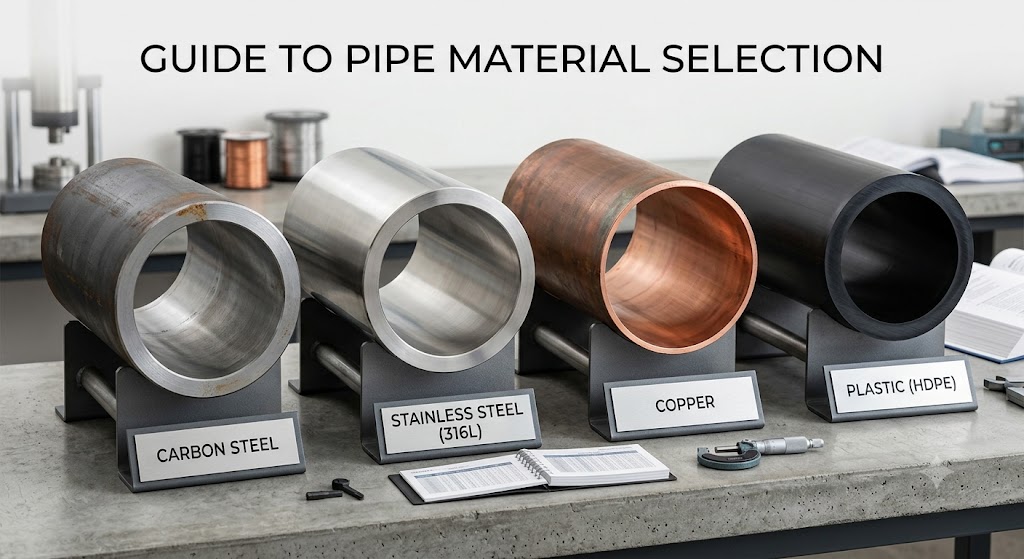
Every water supply project — whether it involves a household connection, a housing-society network, or a tube well main — ultimately depends on one important decision that can easily be made incorrectly: selecting the right pipe material for the application. Knowing How to Choose Pipe Material is not simply about choosing whatever the local market has available; it means considering pressure, temperature, burial conditions, and budget, then selecting a material specifically engineered to perform reliably under that particular combination of conditions from day one.
This guide walks through a practical pipe selection guide you can actually use — covering the main materials available in Pakistan, the questions that should drive your decision, and how to avoid the most common (and expensive) selection mistakes.
Start With the Application, Not the Material
The biggest mistake buyers make is picking a pipe material first and then trying to justify it. The better approach is to answer a few questions about the application before considering any brand or product:
Is the water hot or cold? Hot water rules out standard PVC immediately, since it isn’t heat-rated.
Is the line pressurized or gravity-fed? Pressurized transmission lines need a pipe rated for sustained pressure; gravity drainage doesn’t.
Is it buried, exposed, or indoors? Buried pipe needs to handle soil movement and long-term burial conditions; indoor pipe needs to fit within walls and floors without excessive flexing.
How accessible will it be for future repair? A line buried under a parking lot or foundation needs a more failure-resistant jointing method than an exposed, easily accessible run.
What’s the expected service life and budget? Some materials cost more upfront but reduce long-term maintenance; others are cheaper but suited only to lower-stress applications.
Once you’ve answered these, the best pipe for water supply lines in your specific case becomes much clearer.
The Main Pipe Materials Used in Pakistan
HDPE (High-Density Polyethylene)
HDPE is a flexible pipe material joined by heat fusion (butt-fusion or electrofusion), producing a continuous, leak-resistant pipeline. It’s the standard choice for:
Pressurized water transmission mains
Tube well rising mains in agricultural areas
Buried lines where flexibility around obstacles matters
Gas distribution (in MDPE grade specifically)
HDPE pipe conforming to ISO 4427 typically carries a design service life around 50 years at rated pressure, making it a strong long-term choice for buried, hard-to-access lines.
PVC (Polyvinyl Chloride)
PVC is rigid, joined by solvent cement or rubber-ring push-fit joints, and widely used for:
Drainage and sewerage systems
Cold water plumbing with moderate pressure requirements
Rainwater and stormwater lines
PVC is generally more economical than HDPE for equivalent diameter, making it the practical default wherever pressure and burial conditions don’t demand HDPE’s advantages.
PPRC (Polypropylene Random Copolymer)
PPRC is a heat-fused rigid pipe specifically engineered for hot and cold indoor plumbing:
Bathroom and kitchen hot/cold supply lines
Centralized hot water systems in commercial buildings
Solar water heating lines
PPRC pipe is not suited to underground water mains or drainage — its strength is specifically indoor pressurized plumbing where hot water resistance matters.
GI (Galvanized Iron)
GI is a legacy metal pipe material still found in older Pakistani buildings, but it’s increasingly being phased out due to:
Corrosion over time, which can affect water quality
Higher weight and installation labor
Threaded joints that can loosen or leak as they age
Most new construction now favors PPRC, PVC, or HDPE over GI specifically because of these long-term drawbacks.
A Quick Comparison Table
| Material | Best For | Hot Water? | Typical Joint | Relative Cost |
| HDPE | Pressurized mains, tube wells | Not typically | Heat/butt-fusion | Higher |
| PVC | Drainage, low-pressure cold water | No | Solvent cement | Lower |
| PPRC | Indoor hot & cold plumbing | Yes | Heat fusion | Moderate |
| GI | Legacy plumbing | Yes | Threaded | Moderate–High (with maintenance) |
How Pakistan’s Climate and Ground Conditions Affect Material Choice
Local conditions genuinely change which material performs best:
Soil movement and agricultural areas (Punjab, Sindh tube wells). HDPE’s flexibility handles ground shift better than rigid pipe, reducing the number of joints — and potential failure points — in long buried runs.
Coastal humidity (Karachi). Corrosion-prone materials like GI degrade faster in humid coastal conditions, making corrosion-resistant plastics a more durable long-term choice.
Temperature swings. Both HDPE and PPRC handle Pakistan’s seasonal temperature range well, but PPRC specifically is engineered for continuous hot water service that PVC cannot safely handle.
Water quality requirements. For potable water lines, always confirm the specific pipe grade is rated food-safe and certified accordingly, regardless of material type.
Standards and Certification to Check
Whichever material you choose, confirm before installation:
PSQCA certification mark, confirming compliance with the relevant Pakistan Standard for that specific pipe type.
Correct ISO reference — ISO 4427 for HDPE water pipe, DIN 8077/8078 commonly referenced for PPRC, and the equivalent Pakistan Standard for PVC pressure or drainage pipe.
Pressure/temperature class printed on the pipe (SDR for HDPE, PN rating for PPRC), matched to your system’s actual operating conditions.
Manufacturer’s ISO 9001:2015 certification, reflecting consistent quality control across production batches — particularly important on multi-phase projects.
You can review NewTech-Pipes’ quality control standards as an example of the documentation a certified manufacturer should be able to provide.
A Practical Decision Framework
Use this simplified logic when deciding how to choose pipe material for your next project:
Hot water involved? → PPRC.
Cold water, pressurized, buried, or hard to access? → HDPE.
Cold water, low pressure, easily accessible, or drainage? → PVC.
Existing GI system needing replacement? → Evaluate PPRC or PVC as a direct upgrade, depending on whether hot water is involved on that specific line.
This framework won’t cover every edge case — industrial process lines or specialized chemical resistance needs may require additional evaluation — but it correctly resolves the large majority of residential and general commercial water supply decisions.
Common Selection Mistakes to Avoid
Using PVC for hot water lines. It isn’t heat-rated and will fail prematurely under sustained hot water exposure.
Underspecifying pressure class to save cost upfront, risking failure once the system is pressurized and buried.
Ignoring certification in favor of the cheapest quote, which can mean accepting underweight or uncertified pipe that fails inspection or fails structurally.
Mixing incompatible fittings with a different pipe material or grade than what they were designed for.
Choosing based on habit rather than application — using GI simply because “that’s what’s always been used” even where a corrosion-resistant plastic is now the better option.
Conclusion
Choosing the right pipe material comes down to matching the application — temperature, pressure, burial conditions, and accessibility — to a material genuinely engineered for that combination, rather than defaulting to habit or the lowest quoted price. Get this decision right, and the system should perform reliably for decades with minimal maintenance. NewTech-Pipes, as an ISO 9001:2015-certified manufacturer, produces HDPE, PVC, and PPRC pipe to the relevant standards, giving contractors and homeowners certified options across each of these water supply applications.
Frequently Asked Question's
There’s no single best material for every situation — HDPE is generally best for pressurized, buried mains and tube wells, PPRC for indoor hot and cold plumbing, and PVC for lower-pressure cold water and drainage. The right choice depends on your specific application.
Yes — PPRC is rated for both hot and cold water, so many homeowners use it throughout for consistency. PVC works for cold-water-only lines but should never be used where hot water will pass through it.
HDPE is generally the stronger choice for pressurized underground water mains due to its flexibility and fused, leak-resistant joints. PVC remains suitable for lower-pressure or gravity-fed underground lines like drainage.
Confirm your system’s actual operating pressure with a plumber or engineer, then match that to the pipe’s SDR (for HDPE) or PN rating (for PPRC) rather than assuming a higher rating is automatically safer — overspecifying just adds unnecessary cost.
Generally no — most new construction has moved toward PPRC, PVC, or HDPE due to GI’s corrosion risk and higher long-term maintenance cost, though some buyers still use it for specific legacy-compatible repairs.