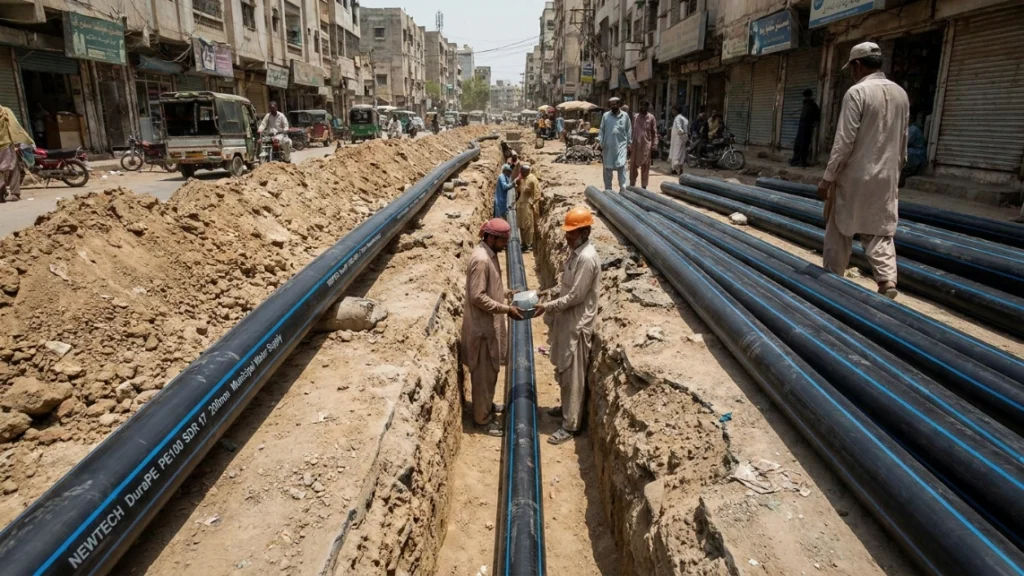
Karachi loses an estimated 35–40% of its treated water before it ever reaches a tap. According to the Karachi Water and Sewerage Corporation (KWSC), over 60% of the city’s distribution network is more than 40 years old — built on galvanized iron and asbestos-cement pipes that corrode, scale, and burst under the pressure swings of a 22-million-person metropolis. If you’re a contractor, developer, or municipal engineer planning a water infrastructure project in Karachi right now, the pipe material you specify will determine whether that network lasts five years or fifty.
HDPE pipes for Karachi’s water supply are not just a better option — in most project scenarios, they are the only technically defensible one. This post breaks down why PE100-grade HDPE outperforms every alternative, which specifications and sizes you need for different network zones, how WASA and KWSC standards apply to your project, and what real contractors across Karachi are doing differently on projects that last.
Why Is Karachi’s Water Infrastructure Failing — and What Does That Mean for Your Project?
| Karachi’s water infrastructure is failing due to aging galvanized iron and asbestos-cement pipes that corrode internally, lose pressure, and burst frequently. For contractors and developers, this means replacement projects must specify corrosion-proof, high-pressure-rated materials. HDPE pipes — specifically PE100, SDR 11 or SDR 17 — eliminate these failure modes and meet KWSC and WASA rehabilitation standards. |
The numbers behind Karachi’s water crisis are staggering. KWSC supplies roughly 650 million gallons per day (MGD) against a city demand exceeding 1,200 MGD — a shortfall of nearly 50%, according to the Asian Development Bank’s 2023 Urban Water Assessment for Pakistan. But even the water that is treated and pumped loses a massive portion to leakage before distribution. Pipe failures, illegal connections, and pressure-loss-driven siphoning all compound the problem.
The Root Cause: Material Failure in Legacy Pipes
Old GI and CI mains suffer from:
- Internal corrosion reducing bore diameter by up to 30% over 20 years, cutting flow rates and increasing pump energy consumption
- Joint failures at every coupling — galvanized joints fail under the pressure surges (water hammer) common in Karachi’s intermittent supply system
- Asbestos-cement pipe cracking under surface load from Karachi’s expanding road network
- No flexibility — rigid pipe materials fracture where soil subsidence or seismic micro-movement is present
For your project — whether it’s a housing society distribution network in Scheme 33, a water main replacement in Korangi, or a commercial complex feeder line in Clifton — specifying the right replacement material from the start is the difference between a network that performs and one that returns to you within five years for emergency repairs.
What Makes HDPE Pipes the Right Choice for Karachi Water Supply Projects?
| HDPE pipes solve Karachi’s water supply challenges because they are fully corrosion-resistant, pressure-rated up to PN16 (16 bar), and capable of withstanding pressure surges that destroy brittle pipe materials. PE100 grade HDPE conforms to ISO 4427 and PSQCA standards, carries a 50-year design life, and performs reliably under Karachi’s intermittent supply conditions and coastal salinity environment. |
Karachi presents a uniquely difficult environment for pipe materials. Coastal humidity and salt-laden groundwater accelerate corrosion in any ferrous or cementitious material. Ground temperatures in interior districts like SITE and Korangi can exceed 45°C in summer, stressing materials with low thermal tolerance. Water supply is intermittent — pipes regularly experience full depressurization followed by sudden re-pressurization, generating water hammer events that exceed static design pressures by 50% or more.
Key Technical Properties That Make HDPE the Right Fit
- Corrosion immunity: HDPE is chemically inert to chlorinated water, saline groundwater, and the aggressive soils found across much of Karachi’s coastal plain
- Pressure surge tolerance: PE100 HDPE absorbs water hammer through elastic deformation — it flexes rather than fractures, unlike uPVC or asbestos cement
- Leak-free butt-fusion joints: Properly fused HDPE joints are monolithic — the joint is as strong as the pipe wall itself, eliminating the primary failure point in flanged or mechanical-joint systems
- Temperature performance: HDPE performs continuously from -40°C to +60°C, comfortably covering Karachi’s seasonal range
- Flow efficiency: The smooth bore of HDPE pipe (Hazen-Williams C value of 150+) reduces friction loss versus corroded GI pipe, allowing smaller pump sets or longer network runs
NEWTECH’s DuraPE series (link: /hdpe-pipes/) covers both PE80 and PE100 grades in sizes from 20mm to 630mm, manufactured to ISO 4427 and PSQCA PS 3580:1994 standards — the two benchmarks that WASA Karachi and KWSC require on approved project submissions.
| ⚙️ Expert Insight from NEWTECH
One of the most common errors we see on Karachi water supply projects is specifying PE80 pipe on distribution mains that experience regular water hammer — typically in systems fed by intermittent municipal supply with high-lift pumps. For any main operating above 8 bar static pressure, or in any system prone to surge, specify PE100 SDR 11 as your minimum. The material cost difference over PE80 SDR 17 is roughly 18–22% — but the avoided repair cost over a 10-year maintenance cycle is multiples of that. After 27 years of manufacturing, we’ve seen both outcomes firsthand. |
HDPE vs Other Pipe Materials: Which Should You Specify for Karachi Water Supply?
| For Karachi water supply projects, HDPE PE100 outperforms uPVC, GI, and ductile iron on corrosion resistance, pressure surge tolerance, and total lifecycle cost. uPVC is acceptable for low-pressure domestic supply under PN10. GI and CI pipe should not be specified for new water infrastructure in Karachi due to corrosion failure rates. MDPE is reserved for gas distribution, not water. |
Understanding where each pipe material belongs in your network hierarchy saves you from both over-specification (paying for PE100 where uPVC is sufficient) and under-specification (the far more expensive mistake of using uPVC on a high-pressure main that fails in 3 years).
The table below compares NEWTECH’s pipe materials across the key parameters that matter for water infrastructure projects in Karachi and across Pakistan:
| Pipe Type | Diameter | Pressure Rating | SDR | Ideal Use Case | Lifespan | NEWTECH Series |
| HDPE PE100 | 63mm–630mm | PN10–PN16 | SDR 17/11 | Water supply, sewerage, mains | 50+ years | DuraPE PE100 |
| HDPE PE80 | 20mm–315mm | PN8–PN12.5 | SDR 17/13.6 | Irrigation, low-pressure water | 40–50 years | DuraPE PE80 |
| uPVC Class D | ½” – 6″ | PN10 | — | Domestic water supply | 25–30 years | NEWTECH uPVC-D |
| uPVC Class E | ½” – 6″ | PN12.5 | — | High-rise residential | 25–30 years | NEWTECH uPVC-E |
| PPRC PN20 | 63mm–110mm | PN20 @ 20°C | SDR 6 | Hot water, central heating | 30+ years | NEWTECH PPRC |
| MDPE PE80 | 20mm–160mm | PN4–PN8 | SDR 17/21 | Gas distribution (SNGPL/SSGC) | 40+ years | NEWTECH MDPE |
Note: SDR (Standard Dimension Ratio) = Pipe OD ÷ Wall Thickness. Lower SDR = thicker wall = higher pressure rating. For Karachi municipal mains, SDR 11 (PN16) is the standard KWSC specification for transmission lines. SDR 17 (PN10) is acceptable for secondary distribution.
What Sizes and Pressure Ratings of HDPE Pipes Does Karachi’s Water Network Require?
| Karachi’s water distribution network requires HDPE pipe ranging from 63mm (residential laterals) to 630mm (transmission mains). Pressure ratings must be PN10 minimum for distribution mains and PN16 for high-pressure transmission lines. KWSC’s standard for new HDPE installations specifies PE100 grade, SDR 17 for secondary mains and SDR 11 for primary transmission — conforming to ISO 4427. |
Getting pipe sizing right for a Karachi water project requires understanding the three tiers of a typical distribution network. Each tier has different pressure requirements, different consequence of failure, and different economic logic for pipe selection.
Transmission Mains (Bulk Water Transfer)
These are the arteries of the network — large-diameter pipes connecting pumping stations to storage reservoirs or district metering areas. In Karachi, sizes run from 315mm to 630mm, operating at pressures between 10 and 16 bar. Specification: PE100, SDR 11, PN16. Joints must be butt-fusion only — no compression or mechanical couplings on transmission mains per KWSC engineering standards.
Distribution Mains (District and Zone Supply)
Secondary mains that loop through residential and commercial zones. Typical sizes: 110mm–315mm. Operating pressure: 6–10 bar. Specification: PE100, SDR 17, PN10. For housing societies in Karachi (Bahria Town Karachi, DHA Karachi phases), most developers are now standardizing on PE100 SDR 17 at 160mm for internal ring mains, with 110mm laterals to building entry points.
Service Laterals (Last Mile to Consumer)
The final connection from distribution main to building water meter. Typically 20mm–63mm. These can use PE80 SDR 17 (PN8) in low-pressure zones, or PE100 SDR 17 where system pressure exceeds 8 bar. NEWTECH’s DuraPE PE100 range starts at 20mm — giving you a single-source supply from last-mile lateral to bulk transmission main.
How Do WASA and KWSC Standards Apply to HDPE Pipe Selection in Karachi?
| WASA Karachi and KWSC require HDPE pipes conforming to ISO 4427 and PSQCA PS 3580:1994 for all approved water infrastructure projects. Pipes must be PE100 grade for transmission and primary distribution mains. PSQCA certification is mandatory for material procurement on government-funded projects. PEC approval is required for contractors executing these works. |
If you’re tendering for KWSC or WASA-funded rehabilitation work in Karachi, your pipe procurement documentation will be scrutinized at submission. Three certification requirements are non-negotiable:
- PSQCA certification (PS 3580:1994 for HDPE) — the Pakistan Standards and Quality Control Authority mark is the minimum threshold for material acceptance on public projects
- ISO 4427 conformance — international standard for HDPE pipes for water supply, required by ADB and World Bank funded infrastructure projects (which fund a significant portion of Karachi’s KWSC rehabilitation programs)
- PEC-approved contractor status — the Pakistan Engineering Council requires registered contractors for all civil infrastructure works above a defined contract value
NEWTECH Pipes (link: /about/) holds ISO 9001:2015 quality management certification, PSQCA product certification, and PEC approval — making NEWTECH-supplied HDPE pipe immediately acceptable for submission on KWSC and WASA project documentation without additional third-party testing. This accelerates your tender qualification timeline by eliminating the most common cause of submission rejection: unverified material source.
According to the World Bank’s Pakistan Infrastructure Report (2022), Pakistan requires USD 2.8 billion in annual infrastructure investment to maintain and upgrade its water distribution systems — with Karachi accounting for approximately 28% of urban water infrastructure rehabilitation needs nationally. Projects funded under these programs increasingly mandate ISO 4427-compliant HDPE as the specified material for rehabilitation of networks with diameters above 110mm.
HDPE Pipe Installation for Water Supply in Karachi: What Contractors Get Wrong
| The most common HDPE pipe installation failures on Karachi water supply projects are improper butt-fusion temperatures (correct range: 200°C–230°C for PE100), inadequate pipe bedding in Karachi’s mixed soil conditions, and using compression fittings on transmission mains where butt-fusion is required. Following ISO 21307 fusion procedures and KWSC bedding specifications prevents 90% of post-installation failures. |
HDPE pipe’s performance advantages are real — but they are contingent on correct installation. Karachi’s construction environment adds specific challenges: high ambient temperatures affecting fusion quality, variable soil conditions from beach sand in coastal zones to clay fill in interior districts, and a skilled labor pool that varies dramatically between experienced HDPE fusion operators and workers retrained from GI plumbing.
Butt-Fusion: The Critical Joint
Butt-fusion is the standard joining method for HDPE mains above 63mm. The process — heat, align, fuse, cool — sounds simple. Execution errors are common and invisible until the joint fails under pressure. Key parameters for PE100 butt-fusion:
- Heater plate temperature: 200°C–230°C (verify with calibrated contact thermometer before every session — Karachi’s summer heat can affect equipment calibration)
- Fusion pressure: 0.15 MPa during heating, 1.0–1.2 MPa during fusion phase — determined by pipe SDR and diameter per ISO 21307
- Cooling time: minimum 11 minutes for 200mm PE100 at 20°C ambient — double this in winter installations when ambient drops below 10°C
- Bead geometry: a properly fused joint produces a double bead of equal width, symmetrical, and neither too flat nor too tall — visual inspection is your first quality gate
Trenching and Bedding
In Karachi’s coastal zone (Clifton, DHA Phase 1–8, Kemari), pipe bedding must account for sand subsidence and tidal groundwater. KWSC specifications require a 150mm compacted sand bed, 300mm sand cover above pipe crown, before backfilling with selected material. Failure to comply causes differential settlement that stresses fusion joints over time — not immediate failure, but a 7–10 year failure mode that looks like pipe quality and is actually installation quality.
NEWTECH supplies HDPE butt-fusion welding machines (link: /hdpe-pipes/) alongside pipe supply on major projects — ensuring that the equipment used on-site is calibrated and rated for the pipe sizes being installed. This is not a standard offering from every pipe supplier in Karachi.
What Is the Cost of HDPE Pipes for Water Distribution Projects in Karachi?
| HDPE pipe prices in Karachi vary by grade, diameter, and SDR rating. PE100 HDPE pipe ranges from approximately PKR 180 to PKR 2,800 per meter depending on size. While HDPE has a higher upfront cost than uPVC, its 50-year lifespan and zero maintenance requirements deliver a total cost of ownership 40–60% lower than uPVC or GI alternatives over a 30-year project horizon. |
Price transparency on HDPE pipe in Pakistan is limited — most suppliers don’t publish rates, which makes budget planning difficult for contractors preparing BOQs. The ranges below represent NEWTECH’s indicative 2025–2026 market range for PE100 HDPE pipe, SDR 17, in Karachi (exclusive of fittings, freight, and taxes). Actual rates are subject to petrochemical raw material pricing, which fluctuates with crude oil markets.
| Diameter (mm) | Grade | SDR | Approx. Price/m (PKR) | Typical Application |
| 63mm | PE100 | SDR 17 | PKR 180–240 | Service laterals |
| 110mm | PE100 | SDR 17 | PKR 380–500 | Housing society supply |
| 160mm | PE100 | SDR 17 | PKR 720–950 | Residential distribution main |
| 200mm | PE100 | SDR 17 | PKR 1,100–1,450 | Commercial / zone main |
| 250mm | PE100 | SDR 17 | PKR 1,650–2,100 | District distribution main |
| 315mm | PE100 | SDR 11 | PKR 2,400–3,100 | Primary transmission main |
| 400mm | PE100 | SDR 11 | PKR 3,800–4,900 | Bulk transmission |
| 630mm | PE100 | SDR 11 | PKR 9,500–12,000 | Major trunk main |
For current, project-specific pricing and quantity discounts, contact NEWTECH’s sales team (link: /contact-us/) directly. BOQ-based pricing with material certification documentation is available for contractors tendering on KWSC and WASA projects.
Which NEWTECH HDPE Products Are Approved for Karachi Water Infrastructure Projects?
| NEWTECH’s DuraPE series — PE80 and PE100 HDPE pipes from 20mm to 630mm — meets ISO 4427, PSQCA PS 3580:1994, and DIN 8075 standards required for WASA and KWSC project approvals in Karachi. PLAST-1 brand butt-fusion fittings (63mm–630mm) and NEWTECH compression fittings complete the system for a fully certifiable installation. |
A fully certifiable HDPE water supply installation requires not just the pipe but a compatible fittings system that meets the same standards. Mixing pipe from one manufacturer with fittings from another — a common cost-cutting move on Karachi projects — creates certification complications and can result in incompatible fusion parameters that weaken joints.
NEWTECH offers a complete, single-source HDPE system for water supply projects:
- DuraPE PE100 HDPE Pipe — 20mm to 630mm, ISO 4427 and PSQCA certified, black with blue stripes (water identification per international standard)
- DuraPE PE80 HDPE Pipe — 20mm to 315mm, suited for lower-pressure irrigation and secondary distribution
- PLAST-1 HDPE Butt-Fusion Fittings — 63mm to 630mm, manufactured in-house under the same ISO 9001:2015 quality system (link: /hdpe-pipes/)
- NEWTECH Compression Fittings — for service connections and small-diameter installations where butt-fusion is impractical
- HDPE Butt-Fusion Welding Machines — available for project-specific supply alongside pipe orders
Download NEWTECH’s complete pipe catalogue (link: /pipe-catalogue-pakistan/) for full technical datasheets, pressure ratings, and dimensional standards for every product in the DuraPE range. NEWTECH has supplied HDPE pipe systems on completed projects in DHA Karachi, Bahria Town Karachi, and multiple KWSC contractor supply contracts — references available on request.
The Bottom Line: Specify Right, Build Once
Karachi’s water supply challenge is not going to be solved by adding more pumps or drilling more wells. It requires replacing the 40-year-old distribution infrastructure with materials that will last the next 50 years without corroding, cracking, or leaking. That is exactly what HDPE pipes for Karachi’s water supply projects are engineered to do.
If you take four things from this post, make it these:
- Specify PE100 HDPE (not PE80, not uPVC) for any main operating above 8 bar or in a surge-prone system — the pressure rating difference is not a minor spec, it’s a failure or no-failure decision
- Require PSQCA and ISO 4427 certification from your pipe supplier — this protects your KWSC and WASA project submissions and eliminates substandard material risk
- Plan butt-fusion joints from day one — have calibrated equipment and trained operators on-site before pipe arrives, not after
- Total lifecycle cost, not unit price per meter, is the metric that matters — HDPE PE100 at 20% higher upfront cost pays back in year 3 through eliminated maintenance and zero corrosion-related pressure loss
FAQ
1. What is the price of HDPE pipe per meter in Karachi in 2026?
HDPE PE100 pipe prices in Karachi range from approximately PKR 180 per meter for 63mm diameter to PKR 12,000 per meter for 630mm diameter (SDR 17 and SDR 11 respectively). Prices vary with raw material costs and order quantity. Contact a PSQCA-certified supplier like NEWTECH for current BOQ-based project pricing with documentation.
2. Which HDPE pipe grade should I use for KWSC and WASA water supply projects in Karachi?
KWSC and WASA Karachi require PE100-grade HDPE pipes conforming to ISO 4427 and PSQCA PS 3580:1994. Specify SDR 11 (PN16) for transmission mains and SDR 17 (PN10) for secondary distribution. PE80 is not acceptable for primary mains under KWSC’s current engineering guidelines for HDPE pipes Karachi water supply networks.
3. How long do HDPE water supply pipes last in Karachi’s climate?
PE100 HDPE pipes have a design service life of 50+ years under continuous operating conditions per ISO 9080 extrapolation data. Karachi’s coastal salinity, high summer temperatures, and intermittent pressure cycles do not degrade HDPE, as the material is chemically inert to chlorinated water and fully corrosion-resistant — unlike GI or asbestos-cement alternatives currently failing across the city.
4. Can I use compression fittings instead of butt-fusion on HDPE water mains in Karachi?
Compression fittings are acceptable for service laterals (20mm–63mm) and domestic connections. For distribution mains (110mm and above), KWSC specifications require butt-fusion joints only. Compression fittings on large-diameter mains are not rated for sustained pressures above PN10 and are a known failure point in Karachi’s intermittent water supply system. Always match fitting type to pipe size and operating pressure.
5. Is NEWTECH HDPE pipe PSQCA certified for water supply projects in Pakistan?
Yes. NEWTECH Pipes holds PSQCA product certification for its DuraPE HDPE pipe range, along with ISO 9001:2015 quality management certification and PEC approval. This makes NEWTECH-supplied HDPE pipe suitable for direct submission on KWSC, WASA, and government-funded infrastructure projects across Karachi, Lahore, Islamabad, and all major Pakistani cities without additional third-party testing.
6. What diameter HDPE pipe do I need for a housing society water supply network in Karachi?
For a typical housing society in Karachi (200–500 units), specify 160mm PE100 SDR 17 for the internal ring main, 110mm for secondary loops serving clusters of 40–80 units, and 63mm for service laterals to building entry. Trunk connection from KWSC or WASA mains should be assessed based on flow demand — NEWTECH’s engineering team can prepare a hydraulic sizing recommendation for your project on request.