Ask three different suppliers for an HDPE pipe quote for the same project, and you may receive three different prices. This does not necessarily mean that one supplier is overcharging; HDPE pricing is influenced by several factors that buyers often overlook. Pipe diameter, wall thickness (SDR), raw material grade, and certification status can all significantly affect the price per meter, even when the pipes appear identical from the outside. For an accurate hdpe pipe price list in pakistan, it is important to consider these specifications rather than comparing prices based only on appearance.
This guide walks through a practical HDPE pipe rate list, explains exactly what drives cost up or down, and gives you a checklist to verify before accepting delivery — so you can compare quotes on equal terms instead of guessing why one supplier’s number is half another’s.
What Determines HDPE Pipe Price?
Four factors do most of the work in HDPE pipe pricing:
Diameter (mm). HDPE pipe is available from around 20mm (small household branch lines) up to 630mm and beyond (large transmission mains). Price scales with cross-sectional material volume, not diameter directly — so jumping from 110mm to 160mm is a bigger cost increase than the size difference suggests.
SDR (Standard Dimension Ratio) or wall thickness. A lower SDR number means a thicker wall relative to diameter, which means a higher pressure rating — and a higher price. SDR 17 is common for standard domestic pressure; SDR 11 or SDR 13.6 is used for higher-pressure tube wells and industrial lines.
Material grade — PE80 vs PE100. PE100 has higher long-term strength, allowing a thinner wall at the same pressure rating compared to PE80, which affects the raw material cost calculation per meter.
Certification status. PSQCA-certified pipe, backed by ISO 9001:2015 manufacturing certification, typically carries a premium over uncertified pipe — but this is generally mandatory on WASA and PEC-regulated projects regardless of the cost difference.
HDPE Pipe Price Per Meter: Indicative 2026 Ranges
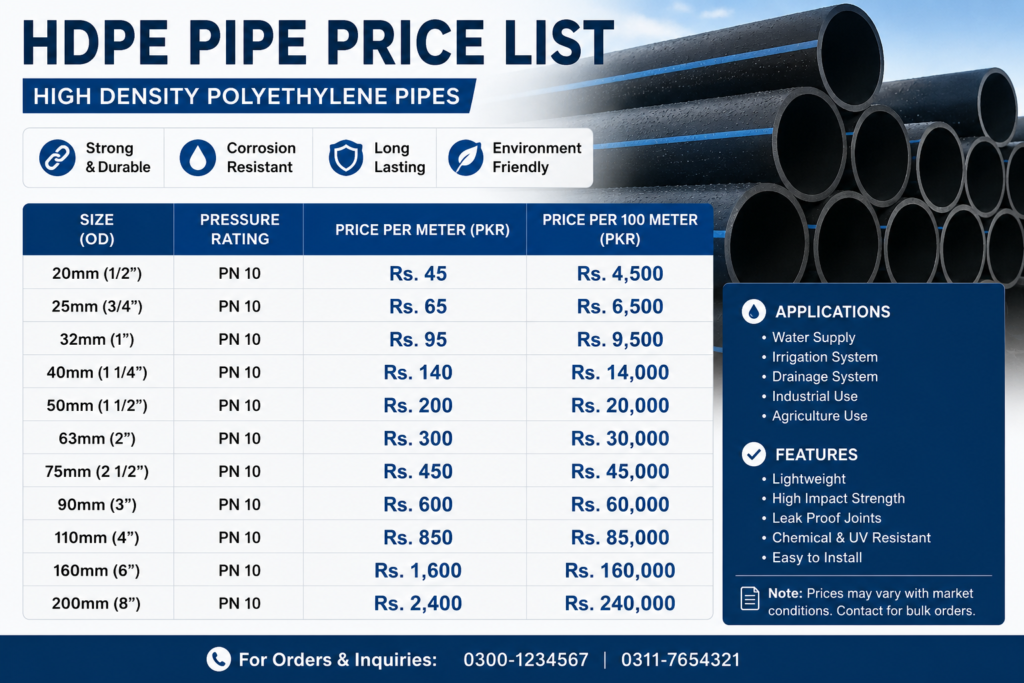
Based on current 2026 market listings, the following provides a practical reference for HDPE pipe price per metert across common PN10/SDR17 sizes used in residential and small commercial projects.
:
| Diameter | Approx. Price Per Meter (PN10) |
| 25mm | Rs. 95 |
| 32mm | Rs. 132 |
| 40mm | Rs. 200 |
| 50mm | Rs. 307 |
| 63mm | Rs. 489 |
| 75mm | Rs. 690 |
| 90mm | Rs. 992 |
| 110mm | Rs. 1,475 |
| 160mm | Rs. 3,083 |
| 250mm | Rs. 7,480 |
For tube well rising mains — one of the most common HDPE applications in Punjab and Sindh — the typical size range of 75mm to 110mm in PE100 SDR17 runs roughly Rs. 1,100 to Rs. 2,900 per meter ex-factory, with larger diameters and higher pressure classes (SDR 13.6) costing proportionally more. These figures move with resin cost and currency, so always request a same-day quote rather than relying on last month’s number.
Why HDPE Costs More Than PVC (And Why That’s Often Worth It)
Buyers comparing an HDPE pipe price to a PVC quote of similar diameter sometimes assume HDPE is simply overpriced. In reality, the two materials aren’t interchangeable for pressurized applications:
HDPE’s butt-fusion or electrofusion joints create a continuous, leak-resistant pipeline with far fewer failure points than PVC’s solvent-cement joints.
HDPE handles ground movement, temperature swings, and sustained pressure better, which matters directly for tube wells and buried water mains.
Over a system’s full lifecycle — accounting for lower leakage and near-zero joint maintenance — HDPE frequently costs less in total than its higher per-meter price suggests, especially for hard-to-access buried lines.
PVC remains the more economical choice for drainage and low-pressure applications where HDPE’s advantages aren’t needed — the right material depends on the application, not just the sticker price.
Common Mistakes That Distort Price Comparisons
Buyers often compare quotes that aren’t actually equivalent. Watch for:
Comparing different SDR ratings. A cheaper quote might simply be a thinner-walled, lower pressure-rated pipe — not better value.
PE80 vs PE100 mismatch. Confirm which grade each quote is based on before comparing numbers directly.
Missing fittings and fusion cost. Ask for a system quote — pipe, fittings, and fusion labor bundled — since pipe-only quotes can look artificially low.
No batch or test certificate. A quote without documented batch traceability is a red flag, regardless of how competitive the price looks.
Overspecifying pressure class. Paying for SDR 11 when your project’s actual operating pressure only needs SDR 17 wastes money without adding real value.
Standards and Certification to Verify Before Buying
Before accepting any HDPE pipe delivery, check:
PSQCA certification mark embossed on the pipe body, confirming compliance with Pakistan Standard PS 3580 or the equivalent ISO reference.
ISO 4427 conformance for water supply applications (ISO 4437 applies to gas-grade pipe instead).
Pipe identification stripe — blue for water, yellow for gas — matching the application you’re buying for.
Wall thickness at the cut end, checked against the stated SDR to confirm you’re getting the pressure rating you paid for.
Batch or heat number, linking the delivered pipe to the manufacturer’s test certificate.
You can review NewTech-Pipes’ quality control and certification standards as a reference for what documentation a certified manufacturer should provide on request.
How to Get Better Pricing Without Cutting Corners
Be spec-consistent across quotes — suppliers give sharper, more comparable pricing when your exact diameter, SDR, and grade are clearly stated upfront.
Batch your order into full coil lengths or truckloads where possible, since per-unit pricing generally improves with volume.
Ask for a bundled system quote — pipe, fittings, and fusion service together — since this often beats piecing quotes together separately.
Time large purchases with resin market conditions in mind if your project timeline allows flexibility, since HDPE resin is globally traded and tracks oil price and currency movement.
Request a validity period on any quote (7–15 days is typical), since resin-linked pricing can shift before you’re ready to place the order.
Conclusion
HDPE pipe price in Pakistan depends far more on diameter, SDR rating, and certification than on which supplier you call — the key is comparing quotes on truly equal specifications rather than assuming a lower number means better value. Always verify PSQCA certification and batch documentation before accepting delivery, especially for buried or hard-to-access lines. NewTech-Pipes manufactures HDPE pipes and fittings across the full size range to ISO 4427 standards, giving contractors and housing societies a certified, consistent option for both residential and large-scale projects.
Frequently Asked Question's
HDPE pipe prices vary widely by diameter — from roughly Rs. 95 per meter for small 25mm PN10 pipe up to several thousand rupees per meter for large-diameter transmission mains. Always confirm same-day pricing directly with your supplier, since resin cost and currency movement shift rates regularly.
Quotes often aren’t comparing the same specification — differences in SDR rating, PE80 vs PE100 grade, and certification status can all shift price significantly even at the same diameter. Always confirm these details are matched before comparing numbers.
Generally yes, per meter, particularly in larger diameters. However, HDPE’s fused joints and long service life in pressurized applications like tube wells and water mains often offset the higher upfront cost over the system’s full lifecycle.
Most tube well rising mains in Punjab and Sindh use 75mm to 110mm HDPE pipe in PE100 SDR17, with SDR13.6 used for deeper wells operating at higher pressure. Always match pipe pressure rating to your pump’s shutoff head rather than just its normal operating pressure.
Yes — PSQCA-certified pipe typically costs more but is required on WASA and PEC-regulated projects regardless of price. It also ensures consistent wall thickness and tested material quality, reducing the risk of premature failure that costs far more to fix later.