Pakistan ranks among the ten countries most vulnerable to climate change impacts, yet its construction sector — growing at 8.2% annually per the Pakistan Bureau of Statistics FY2023-24 data — still specifies steel, ductile iron, and conventional PVC for the majority of buried and exposed piping on new projects. Each of those choices carries an embedded carbon cost, a corrosion liability, and a replacement cycle that compounds the environmental burden over the asset’s lifetime.
The question facing civil engineers and developers in Lahore, Islamabad, and Karachi right now is not whether green construction matters — Pakistan’s own National Climate Change Policy 2021 mandates a shift toward sustainable infrastructure — it’s whether eco-friendly pipes in Pakistan actually deliver technical performance equal to conventional alternatives, or whether “green” means accepting a compromise.
They don’t. HDPE and PPRC pipes are not sustainability gestures — they are 50-year buried assets with lower lifecycle carbon, zero corrosion replacement cycles, and full recyclability at end of life. This post gives you the technical case, the environmental data, and the procurement specifics to make the right material choice on your next project.
What Makes HDPE and PPRC Pipes Eco-Friendly for Pakistan’s Construction Sector?
HDPE and PPRC pipes qualify as eco-friendly pipes for Pakistan’s construction sector because they are fully recyclable at end of life, have 50-year service lives that eliminate replacement cycles, require no corrosion protection coatings or chemical treatments, and have a substantially lower embodied carbon footprint than steel, ductile iron, or concrete pipes of equivalent capacity and pressure rating.
The environmental credentials of a pipe material are not determined by what it looks like — they are determined by a full lifecycle assessment (LCA) that accounts for raw material extraction, manufacturing energy, transport, installation, service life, maintenance requirements, and end-of-life recyclability.
On every stage of that lifecycle, HDPE PE100 outperforms conventional alternatives in Pakistan’s infrastructure context:
Raw material extraction: Polyethylene is derived from natural gas feedstock. At PE100 compound production, energy intensity runs approximately 70–80 GJ per tonne — compared to 25,000–35,000 MJ per tonne for steel pipe production, per the Plastics Europe Environmental Product Declaration (EPD) data for HDPE pipe systems.
Service life: A PE100 HDPE buried water main certified to ISO 4427 carries a 50-year design life. A steel main in Pakistan’s soil conditions — particularly in the high-chloride coastal zones of Karachi or the aggressive groundwater chemistry of parts of Sindh — requires cathodic protection and achieves 20–25 years before first major intervention. Every replacement cycle resets the embedded carbon cost.
End of life: Post-consumer HDPE pipe is technically recyclable into lower-grade polyethylene products — agricultural drainage, cable ducting, non-pressure applications. The Pakistan Plastics Manufacturers Association (PPMA) reports that HDPE recycling infrastructure is active in Lahore, Karachi, and Faisalabad, with industrial-grade regrind HDPE traded as a commodity raw material.
How Does HDPE Pipe’s Lifecycle Carbon Compare to Steel and Ductile Iron in Pakistan?
HDPE PE100 pipe produces approximately 1.9–2.3 kg CO2-equivalent per kg of pipe material over its full lifecycle, compared to 2.5–3.1 kg CO2e/kg for uPVC, 4.0–6.0 kg CO2e/kg for ductile iron, and 6.0–9.0 kg CO2e/kg for carbon steel pipe. Over a 50-year asset life, HDPE’s carbon advantage compounds further because it eliminates coating replacement, cathodic protection systems, and mid-life pipe replacement cycles entirely.
| Pipe Material | Embodied Carbon (kg CO2e/kg) | Design Life (Years) | Corrosion Protection Required | End-of-Life Recyclability |
|---|---|---|---|---|
| HDPE PE100 | 1.9–2.3 | 50+ | None | 100% technically recyclable |
| PPRC (PP-R) | 2.1–2.6 | 50+ | None | Recyclable (PP stream) |
| uPVC | 2.5–3.1 | 20–25 | None | Limited (chlorine content) |
| Ductile Iron | 4.0–6.0 | 20–30 | Cathodic protection required | Recyclable (high energy) |
| Carbon Steel | 6.0–9.0 | 15–25 | Painting + cathodic protection | Recyclable (high energy) |
| Asbestos Cement | Legacy only | 30–40 | None | Hazardous waste — not recyclable |
| Concrete (RCC) | 3.5–5.0 | 40–60 | None | Recyclable as aggregate only |
Source: Plastics Europe Environmental Product Declaration (EPD) for PE pipe systems; World Steel Association lifecycle data; ISO 14040 LCA methodology.
This comparison becomes even more decisive when you account for Pakistan-specific conditions. Lahore’s groundwater in many zones is mildly corrosive to ferrous metals, requiring active cathodic protection on all buried steel and ductile iron mains — adding both capital cost and ongoing maintenance energy consumption. HDPE eliminates that entirely. In Karachi’s coastal industrial zones, where groundwater salinity accelerates corrosion dramatically, the difference in real-world service life between HDPE and metallic alternatives widens to the point where ductile iron rarely achieves its rated design life without intervention.
For developers pursuing LEED certification (Leadership in Energy and Environmental Design) or Green Star Pakistan building ratings on housing society or commercial projects, material-level LCA documentation is a prerequisite for points in the Materials and Resources category. HDPE pipe EPD documentation — available from Plastics Europe and verifiable against manufacturer certifications — directly supports these submissions.
PPRC Pipes and Sustainable Plumbing: What Pakistani Developers Need to Know
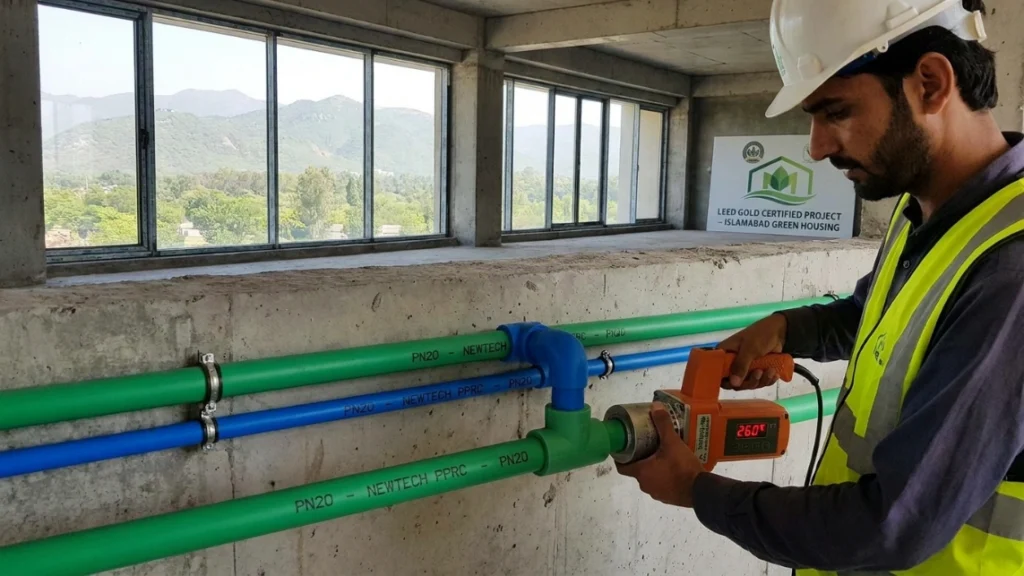
PPRC (polypropylene random copolymer) pipes deliver sustainable plumbing in Pakistan because they contain no lead, no cadmium, no BPA, and no chlorine — eliminating the leachate risk of older metallic and PVC plumbing systems. Their socket-fusion jointing system requires no chemical adhesives or flux, and the material itself is fully recyclable into polypropylene industrial products at end of life.
For any developer in Islamabad, Lahore, or Rawalpindi building housing society units, apartments, or commercial blocks and seeking green building endorsement from the relevant development authority, PPRC’s material composition is a clean story across every environmental metric:
No hazardous additives: Lead was used as a heat stabiliser in conventional PVC pipe manufacturing for decades. Modern uPVC formulations use calcium-zinc stabilisers, but PPRC contains no lead or cadmium at any stage — a fact independently verifiable under RoHS (Restriction of Hazardous Substances) compliance documentation.
No solvent cement emissions: uPVC push-fit and solvent-cement systems emit VOCs (volatile organic compounds) during installation — a measurable indoor air quality concern during building fit-out, particularly relevant for hospitals, schools, and residential buildings where occupants may be present. PPRC socket-fusion requires only heat — no chemicals, no VOC emissions, no solvent waste disposal.
Temperature performance without environmental penalty: PPRC PN20 pipe carries potable water at up to 70°C continuous service, making it the correct material for solar water heater circulation loops — a growing application in Pakistan’s expanding solar rooftop sector. Running a hot water system through copper (subject to corrosion in high-pH Lahore water supply) or galvanised steel (corrodes and leaches) adds both environmental and health costs that PPRC eliminates.
NEWTECH’s PPRC pipes and fittings cover 20mm to 110mm with full PN20 socket-fusion compatibility. For green building documentation, NEWTECH provides material safety data sheets and composition certificates confirming the absence of hazardous additives — the documentation your green building consultant will ask for at project certification stage.
⚙️ Expert Insight from NEWTECH A common oversight on green-rated projects in Islamabad and Karachi is specifying PPRC pipes but sourcing fittings from uncertified suppliers to save 8–12% on fitting cost. When the pipe and fitting carry different polypropylene batch designations, the socket-fusion joint can show micro-voids at the fusion zone — invisible on inspection but detectable only under sustained 70°C service over 3–5 years. On a green building project, a hot water system leak behind a finished wall is not just a maintenance issue — it’s a mould risk, an air quality issue, and a warranty claim. Specify both pipe and fittings from the same certified manufacturer.
Green Building Standards in Pakistan: How Pipe Material Selection Contributes to LEED and NEQS Compliance
In Pakistan, pipe material selection contributes to green building compliance under LEED (Materials and Resources credits), NEQS (National Environmental Quality Standards), and the Pakistan Green Building Council’s Green Star rating system. HDPE and PPRC pipes support these certifications through verified LCA data, absence of hazardous substances, reduced water loss from leak-free joints, and documented recyclability — all areas where metallic and conventional PVC pipes score significantly lower.
Pakistan formally joined the World Green Building Council network in 2013, and the Pakistan Green Building Council (PGBC) has been active in promoting green construction standards across housing societies, commercial developments, and industrial facilities. As of 2024, the PGBC reports over 300 registered LEED projects in Pakistan, concentrated in Islamabad, Lahore, and Karachi — per PGBC annual membership and project registration data.
LEED Materials Credits
Under LEED v4.1, the Building Product Disclosure and Optimization (BPDO) credit set rewards projects that specify materials with published Environmental Product Declarations (EPDs), demonstrate responsible sourcing, and avoid materials on the Red List of hazardous substances (which includes lead stabilisers found in some uPVC formulations). HDPE and PPRC pipe systems with manufacturer EPD documentation and RoHS compliance contribute directly to these credits.
NEQS and Water Loss Reduction
Pakistan’s NEQS (National Environmental Quality Standards) for water supply focus on water quality preservation — which HDPE and PPRC satisfy through their inert material composition and absence of corrosion byproducts. Beyond quality, the PCRWR’s documented 35–40% non-revenue water (NRW) loss rate in Pakistani urban systems represents an enormous environmental burden: energy consumed to pump water that is then lost before it reaches a consumer. Leak-free HDPE butt-fusion mains reduce NRW by eliminating the joint failure modes that drive the majority of distribution losses — a measurable environmental improvement that also reduces the operational carbon footprint of the water supply system.
For green-rated housing society projects in Bahria Town, DHA, or Green Gulberg, the materials documentation package for HDPE and PPRC pipes from NEWTECH includes ISO 9001:2015 quality certificates, PSQCA compliance documentation, and material composition reports — the full set required for a LEED Materials and Resources submission.
HDPE Pipes for Irrigation: Reducing Water Waste in Pakistan’s Agricultural Sector
HDPE pipes for drip and pressurised irrigation in Pakistan reduce agricultural water waste by 40–60% compared to open channel or earthen canal systems, per the Pakistan Agricultural Research Council (PARC) field data on micro-irrigation adoption. HDPE’s flexibility, chemical inertness, and leak-free butt-fusion or compression jointing make it the sustainable choice for tube well distribution networks, canal lining replacements, and farm-level pressurised irrigation systems.
Agriculture consumes approximately 93% of Pakistan’s total water withdrawals, per the World Bank Pakistan water sector data. With Pakistan facing increasing water stress — the World Resources Institute classifies Pakistan as a “high” water stress country — the efficiency of agricultural water delivery is not an environmental nicety, it is an economic survival issue for farming communities in Punjab, Sindh, and Balochistan.
Replacing open earthen channels with buried HDPE PE100 distribution pipes on a typical Punjab tube well farm with 10–15 acres under cultivation eliminates the 30–45% conveyance losses that earthen channels routinely suffer through seepage and evaporation. The capital cost of an HDPE buried distribution system for a 10-acre farm — using 63mm–110mm PE100 SDR 17 pipe at PKR 850–1,500 per metre — is typically recovered within 2–3 irrigation seasons through water savings and reduced pumping costs.
Beyond water efficiency, buried HDPE irrigation mains eliminate soil waterlogging from channel seepage — a major cause of soil salinity degradation in the lower Punjab and Sindh. The Pakistan Land and Water Conservation Centre has documented yield improvements of 15–25% on farms transitioning from open channel to closed HDPE pipe irrigation — a sustainability outcome that combines water conservation, soil health, and agricultural productivity.
For farmers and agri-businesses in Bahawalpur, Multan, and Faisalabad sourcing irrigation pipe, NEWTECH’s DuraPE HDPE range covers 20mm–630mm with full PSQCA certification and PARC-compatible pressure specifications. The compression fitting range provides a field-serviceable connection system that does not require heat fusion equipment — practical for on-farm repair and extension work.
Recyclable Plastic Pipes in Pakistan: What Happens to HDPE and PPRC at End of Life?
HDPE pipe is classified as PE (polyethylene) in Pakistan’s waste stream and is actively collected and recycled by industrial regrind processors in Lahore, Karachi, and Faisalabad. Post-consumer HDPE pipe is granulated and reprocessed into non-pressure polyethylene products — cable ducting, agricultural pipe, industrial containers. PPRC recycling follows the PP (polypropylene) stream. Neither material generates hazardous waste during demolition or disposal, unlike asbestos cement or lead-stabilised PVC.
The recyclable plastic pipes Pakistan market is more developed than most construction professionals realise. Industrial HDPE regrind commands a market price of PKR 180–280 per kg in Lahore and Karachi’s secondary plastics markets (Q1 2026 market rates), meaning post-use HDPE pipe has positive residual value — unlike steel pipe, which requires transport to a scrap yard and price negotiation, or concrete pipe, which goes to a landfill.
What the Recycling Process Covers
Post-consumer HDPE pipe from demolished buildings, replaced water mains, or construction offcuts goes through three stages: mechanical size reduction (granulation), contaminant removal, and re-extrusion into regrind pellets. The resulting material carries MFI (melt flow index) and density specifications that determine its fit for second-generation applications. A properly granulated HDPE from PE100 pressure pipe will typically yield regrind suitable for PE80-equivalent applications — cable ducting, drainage pipe, irrigation accessories.
What It Does Not Cover — Be Clear with Your Clients
Regrind HDPE cannot be used back in pressure pipe manufacturing. This is a technical limitation, not a regulatory one — the degradation in molecular weight during reprocessing reduces the long-term hydrostatic strength below PE100 certification thresholds. NEWTECH manufactures only from virgin PE100 compound for all DuraPE pressure pipes — this is the correct position, and any manufacturer claiming to produce certified-pressure pipe from regrind should be challenged for independent third-party confirmation.
For demolition contractors in Islamabad handling building strip-out that includes PPRC plumbing, the pipework can be segregated as clean PP scrap — separable from contaminated mixed plastics — and sold to polypropylene regrind processors. This supports Pakistan’s circular economy objectives under the National Environmental Policy framework and reduces the volume of construction waste going to unmanaged disposal sites on the outskirts of Lahore and Rawalpindi.
How to Specify Eco-Friendly Pipes on Green Construction Projects in Pakistan
To specify eco-friendly pipes on a green construction project in Pakistan, your material schedule should state: pipe material (HDPE PE100 or PPRC PP-R), applicable standard (ISO 4427 or ISO 15874), PSQCA certification requirement, the manufacturer’s Environmental Product Declaration (EPD) or equivalent LCA documentation, and RoHS compliance for PPRC systems. These four elements together constitute a defensible green material specification under LEED, Green Star Pakistan, or PGBC criteria.
Specifying “eco-friendly” without documentation is a statement, not a specification. Green-rated projects in Pakistan — and increasingly, developer-led housing societies in Islamabad and Lahore that use “sustainable” as a marketing credential — need material-level evidence that holds up to audit.
What your green pipe specification must include:
- Material grade: PE100 (not just “HDPE”) or PP-R PN20 (not just “PPRC”) — grade determines both performance and recyclability classification
- Standard reference: ISO 4427-2 for HDPE pressure pipes; ISO 15874 for PPRC
- PSQCA certification: required for locally manufactured pipes and verifiable at psqca.com.pk
- EPD or LCA summary: manufacturer-issued or sourced from Plastics Europe’s published EPD database for PE pipe systems
- Hazardous substance declaration: RoHS compliance confirming no lead, cadmium, or restricted substances — particularly relevant for PPRC in potable water service
- End-of-life instruction: specify segregated collection of HDPE and PPRC scrap at demolition — this supports LEED Construction Waste Management credit claims
For procurement managers at major housing societies or commercial developers working with sustainability consultants in Karachi, Lahore, or Islamabad, NEWTECH provides a complete green procurement documentation pack on request — covering ISO 9001:2015 certification, PSQCA licenses, material composition reports, and product technical data sheets aligned to international EPD methodology.
Conclusion
Material selection is where sustainability either gets built into a project or gets left out of it. Specifying eco-friendly pipes for Pakistan’s construction projects is not about paying a premium for a greener label — HDPE and PPRC typically match or beat conventional alternatives on total installed cost while delivering a 50-year service life, zero corrosion maintenance, and documented recyclability that steel, ductile iron, and older PVC systems cannot match.
Four things to take forward to your next project specification:
- Specify PE100 or PP-R grade explicitly — not just “HDPE” or “PPRC.” The grade designation is what links your material choice to certified environmental performance data.
- Request EPD or LCA documentation from your supplier — this is now a realistic ask for ISO-certified manufacturers and a prerequisite for LEED Materials credits.
- Include end-of-life segregation instructions in your demolition spec — HDPE and PPRC have positive residual scrap value; capturing it costs nothing and supports your project’s waste management documentation.
- Match pipe and fitting supplier — particularly for PPRC systems where socket-fusion joint integrity depends on batch-matched polypropylene compound.
Ready to source the right eco-friendly pipes for your project? Request a free quote from NEWTECH’s expert team today — we supply ISO 4427-certified HDPE and ISO 15874-compliant PPRC to green-rated projects, housing societies, municipal authorities, and industrial clients across Pakistan.
FAQ SECTION
1. Are HDPE pipes eco-friendly and safe for potable water supply in Pakistan?
HDPE PE100 pipes are both eco-friendly and fully safe for potable water supply. They contain no lead, no cadmium, and no harmful plasticisers, and are inert to chlorinated water treatment used in Pakistani municipal supply systems. Their 50-year service life, 100% recyclability, and zero corrosion byproducts make HDPE one of the most environmentally responsible pipe choices available for water infrastructure in Pakistan.
2. What is the carbon footprint of HDPE pipe compared to steel pipe for construction in Pakistan?
HDPE PE100 pipe produces approximately 1.9–2.3 kg CO2-equivalent per kg of material over its full lifecycle, compared to 6.0–9.0 kg CO2e/kg for carbon steel pipe, per Plastics Europe Environmental Product Declaration (EPD) data. Over a 50-year service life — accounting for steel’s required cathodic protection and mid-life replacement — HDPE’s total lifecycle carbon advantage over steel pipe is typically 60–70% lower on a per-metre basis.
3. Can HDPE and PPRC pipes contribute to LEED certification on construction projects in Pakistan?
Eco-friendly pipes including HDPE and PPRC contribute to LEED v4.1 certification under the Building Product Disclosure and Optimization (BPDO) credit, which awards points for materials with published Environmental Product Declarations (EPDs) and absence of Red List hazardous substances. Both materials also support the Construction Waste Management credit through their end-of-life recyclability. NEWTECH provides EPD-compatible documentation for green building submittals on request.
4. Are PPRC pipes recyclable at end of life in Pakistan?
PPRC pipes are recyclable as polypropylene (PP) scrap in Pakistan’s secondary plastics market, active in Lahore, Karachi, and Faisalabad. Post-consumer PPRC is granulated and reprocessed into PP-grade regrind for non-pressure industrial applications. Unlike lead-stabilised PVC, PPRC generates no hazardous waste during demolition and can be cleanly segregated from mixed construction waste — making it fully compatible with sustainable construction waste management plans.
5. Which eco-friendly pipe is best for irrigation in Pakistan — HDPE or uPVC?
For pressurised irrigation distribution in Pakistan, HDPE PE100 outperforms uPVC on every sustainability metric. HDPE’s flexibility tolerates ground movement without cracking, its butt-fusion or compression joints are leak-free over 50+ years, and it handles the variable pressure cycles of pump-driven irrigation without fatigue. The Pakistan Agricultural Research Council (PARC) field data shows 40–60% water savings on farms using closed HDPE pipe distribution compared to open channel systems — making HDPE the clear sustainable choice for tube well and drip irrigation networks.
6. What documentation should I request for eco-friendly pipes on a green construction project in Pakistan?
For green construction compliance in Pakistan, request from your pipe supplier: an ISO 4427 or ISO 15874 compliance certificate, a current PSQCA license number (verifiable at psqca.com.pk), a material composition report confirming RoHS compliance and absence of lead or cadmium, and either a manufacturer-issued EPD or reference to the Plastics Europe published EPD for PE pipe systems. For LEED or PGBC Green Star submissions, these four documents together constitute a complete green material evidence package for sustainable plumbing Pakistan requirements.