Walk onto almost any modern construction site in Pakistan today, and you’ll notice something that wasn’t true a decade ago — GI pipe is quietly disappearing from water supply installations. HDPE pipes are replacing GI pipes across residential, commercial, and agricultural projects nationwide. This isn’t a passing trend driven by marketing; it’s a practical response to problems GI pipe has always had but that buyers simply tolerated for lack of a better alternative.
This guide explains exactly why this shift is happening, what specific advantages are driving it, and what it means for your next plumbing or water supply project — whether you’re renovating an old house still running galvanized lines or planning a new tube well installation.
The Core Problem With GI Pipe
GI (galvanized iron) pipe was the default choice for water supply in Pakistan for generations, but it comes with structural limitations that only become obvious with time:
Corrosion from the inside out: The zinc galvanized coating that protects GI pipe degrades over years of water contact, eventually exposing the underlying steel to rust.
Water quality impact: As corrosion progresses, rust particles and scale can enter the water supply, affecting taste and overall water purity.
Reduced flow over time: Internal corrosion buildup narrows the effective pipe diameter, gradually reducing water pressure and flow rate even when the pipe hasn’t fully failed.
Heavy, labor-intensive installation: GI pipe’s heavy weight and threaded joints make installation slower and more physically demanding than modern plastic alternatives.
Threaded joints that loosen: Over years of thermal expansion and contraction, threaded connections can loosen, becoming a common source of slow leaks.
HDPE Pipe Advantages Over Steel Pipe
The HDPE pipe advantages over steel pipe that are driving this replacement trend come down to a few structural differences:
Fused joints instead of threaded ones: HDPE pipe is joined using butt-fusion or electrofusion, creating a continuous, seamless connection that doesn’t loosen the way threaded joints do over time.
Flexibility: HDPE bends around obstacles and accommodates ground movement without the extra elbow fittings rigid steel pipe requires at every direction change.
Lighter weight: HDPE is significantly lighter than GI pipe of equivalent diameter, reducing both material handling effort and structural load on buildings.
Consistent internal bore: Since HDPE doesn’t corrode or scale internally, its flow capacity stays consistent over the pipe’s service life rather than gradually narrowing.
Long design life: HDPE pipe conforming to ISO 4427 typically carries a design service life around 50 years at rated pressure — a meaningful improvement over the practical lifespan of galvanized steel before corrosion-related replacement becomes necessary.
Corrosion-Free Pipes: Why This Matters So Much in Pakistan
Corrosion-free pipes aren’t just a nice-to-have feature — in Pakistan’s specific conditions, corrosion resistance solves a genuinely expensive problem:
Coastal humidity (Karachi and surrounding areas) accelerates corrosion in metal pipe significantly compared to drier inland climates.
Buried tube well rising mains in agricultural areas are difficult and costly to access for repair once corrosion sets in, making HDPE’s corrosion immunity especially valuable for these installations.
Older housing stock across major cities still runs galvanized lines that are now reaching or exceeding their practical service life, creating a genuine replacement need rather than just a preference shift.
Water quality concerns around corrosion byproducts are increasingly part of how buyers evaluate materials, not just pressure and flow performance.
Side-by-Side: HDPE vs GI Pipe
| Property | HDPE Pipe | GI Pipe |
| Corrosion resistance | Complete — never rusts | Degrades over years, especially in humid areas |
| Joint type | Fused (butt-fusion/electrofusion) | Threaded |
| Weight | Lightweight | Heavy |
| Flexibility | Highly flexible | Rigid |
| Flow consistency over time | Stays consistent | Narrows as corrosion/scale builds |
| Typical design life | ~50 years at rated pressure | Shorter practical lifespan due to corrosion |
| Installation labor | Faster, fewer joints | Slower, more joints and threading |
Where This Shift Is Happening Fastest
The replacement of GI with HDPE is most visible in:
Tube well rising mains across Punjab and Sindh, where HDPE’s flexibility and corrosion resistance directly address the biggest historical failure points of GI in agricultural use.
Housing society water supply networks, where developers increasingly specify HDPE for new distribution mains rather than GI, partly driven by long-term maintenance cost considerations.
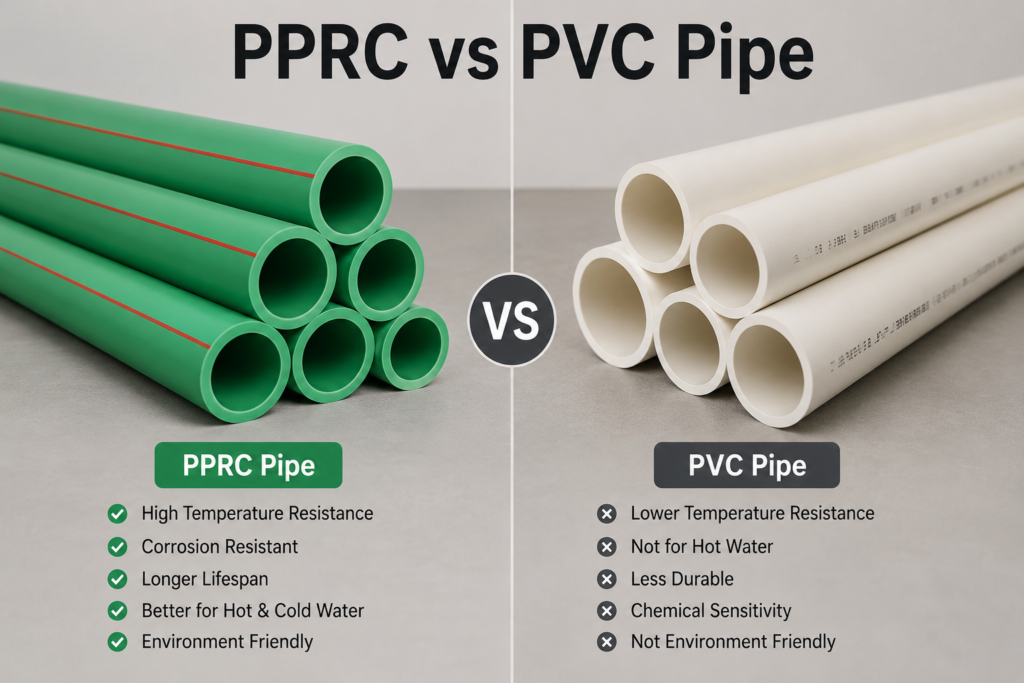
Renovation projects in older homes and buildings, where failing galvanized lines are being replaced with HDPE or, for indoor plumbing specifically, PPRC pipe for hot water applications.
Gas distribution networks, where MDPE and HDPE (in gas grade) have already largely replaced steel pipe for underground service lines, for many of the same corrosion-related reasons.
Is HDPE Always the Right Replacement for GI?
Not universally — the decision depends on the specific application:
Pressurized water supply and buried mains — HDPE is generally the stronger replacement choice.
Indoor hot water plumbing — PPRC, not HDPE, is the correct GI replacement, since HDPE isn’t typically rated for sustained hot water service.
Drainage and low-pressure lines — PVC often remains the more cost-effective choice over both GI and HDPE for these specific applications.
The broader point is that GI is being replaced by whichever plastic material is actually engineered for the specific application — HDPE for pressurized cold water, PPRC for hot water, and PVC for drainage — rather than one single material replacing GI everywhere.
Standards and Certification to Check
When choosing HDPE pipe as a GI replacement, verify:
PSQCA certification mark, confirming compliance with the relevant Pakistan Standard for polyethylene pipe.
ISO 4427 conformance, the international standard for PE water supply pipe.
SDR rating matched to your system’s operating pressure, since overspecifying or underspecifying both carry cost or safety implications.
Manufacturer’s ISO 9001:2015 certification, reflecting consistent quality control across production batches.
You can review NewTech-Pipes’ quality control standards as a reference for the documentation a certified manufacturer should provide.
FAQs
Q: Why are HDPE pipes replacing GI pipes in Pakistan?
HDPE pipes are replacing GI pipes mainly due to corrosion resistance, fused leak-free joints, lighter weight, and consistent flow performance over decades, compared to GI’s tendency to rust, narrow internally, and develop loose threaded joints over time.
Q: Is HDPE pipe stronger than GI pipe?
HDPE isn’t necessarily “stronger” in a rigid structural sense, but it offers better long-term performance for pressurized water applications due to its flexibility, corrosion immunity, and fused joints, which avoid GI’s common long-term failure points.
Q: Can I replace old GI pipes with HDPE pipes in my house?
Yes, for cold water supply lines this is a common and effective upgrade. For hot water lines specifically, PPRC pipe is the more appropriate GI replacement, since HDPE isn’t typically rated for sustained hot water service.
Q: Is HDPE pipe more expensive than GI pipe?
Per meter, costs vary by size and grade, but HDPE often works out more cost-effective over the system’s full lifecycle due to lower maintenance, no corrosion-related replacement, and fewer joint failures compared to GI pipe.
Q: How long does HDPE pipe last compared to GI pipe?
HDPE pipe conforming to ISO 4427 typically carries a design service life around 50 years at rated pressure. GI pipe’s practical lifespan is generally shorter due to progressive corrosion, particularly in humid or coastal conditions.
Conclusion
The shift from GI to HDPE pipe across Pakistan’s construction industry reflects a genuine, practical improvement — corrosion resistance, fused joints, and consistent flow performance solve real problems that galvanized steel pipe has always carried. For pressurized water supply and buried mains specifically, HDPE is generally the stronger long-term choice. NewTech-Pipes manufactures HDPE pipes and fittings to ISO 4427 and PSQCA standards, giving contractors and homeowners a certified, corrosion-free option for replacing aging GI installations.