Pakistan’s municipal water utilities collectively lose between 30 and 42 percent of treated water to undetected leakage, illegal tapping, and pressure failures — a figure the World Bank’s 2023 Pakistan Water Sector Report places at an annual economic cost of USD 1.2 billion. If you manage a distribution network in Lahore, operate a housing society in Islamabad, or run a process plant in Faisalabad, that loss comes directly out of your operational budget and your infrastructure’s lifespan.
The shift toward smart pipe system IoT Pakistan implementations is not a future trend — it is already reshaping how forward-thinking contractors, water utilities, and industrial operators design, install, and manage pipe networks. This post gives you a practical, engineering-level breakdown of how IoT integration works with different pipe materials, which HDPE pipe specifications work best with sensor systems, what the real costs and payback periods look like in the Pakistani market, and where smart infrastructure is headed across Karachi, Lahore, and beyond.
If you’ve been looking at sensor retrofits, SCADA integration, or smart metering for your next project and aren’t sure where to start with pipe compatibility — this is the guide you need.
What Is a Smart Pipe System and How Does IoT Integration Work?
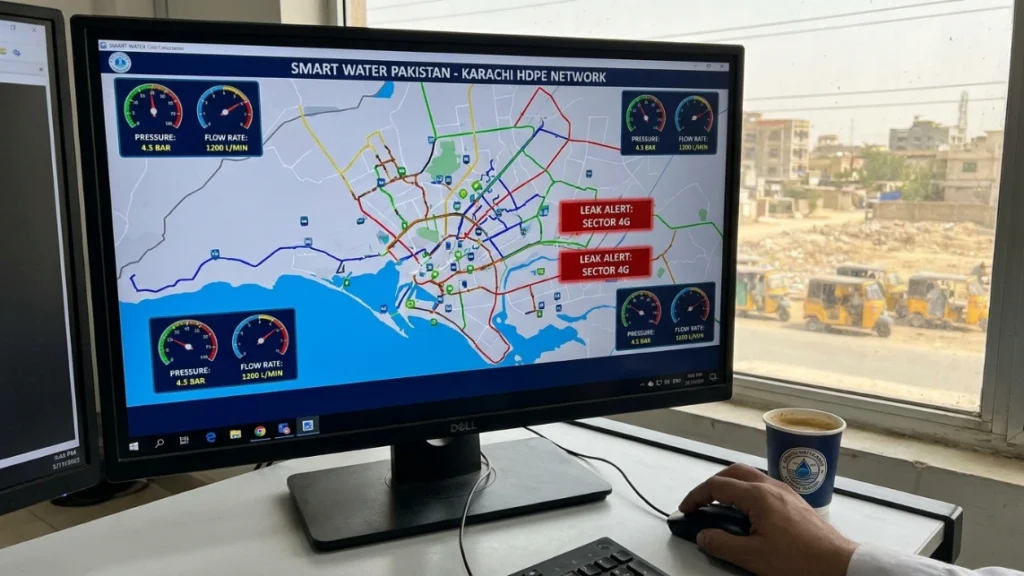
| A smart pipe system combines physical pipe infrastructure with embedded or clamp-on IoT sensors that measure flow rate, pressure, temperature, and water quality in real time. Data transmits wirelessly — via LoRaWAN, NB-IoT, or GSM — to a SCADA platform where operators monitor network performance, detect anomalies, and trigger automatic responses like valve closure or maintenance alerts. |
Traditional pipe networks are fundamentally passive — water moves through them, and you find out something is wrong when a pipe bursts, a bill spikes, or a customer complains about low pressure. Smart pipe systems flip that model. Every critical node in the network becomes a data point, continuously reporting to a central dashboard.
The Core Components of an IoT Pipe Network
- Flow meters (ultrasonic or electromagnetic): Mounted inline or clamped externally on the pipe, these measure volumetric flow. Ultrasonic clamp-on types work on HDPE, uPVC, and steel without cutting into the pipe — critical for retrofit applications
- Pressure transducers: Installed at tee points, branch connections, or pump discharge headers, they log real-time pressure and generate alerts when readings deviate outside programmed thresholds — catching valve failures or surge events within seconds
- Acoustic leak detectors: These listen for the distinctive frequency signature of water escaping through a micro-crack or joint failure. A sensor array can triangulate a leak’s location to within 1–2 meters along a buried main
- Water quality sensors: pH, turbidity, chlorine residual, and conductivity probes validate treatment efficacy at distribution points — increasingly required on World Bank and ADB-funded projects in Pakistan
- SCADA / RTU gateways: The local intelligence layer that aggregates sensor data and pushes it upstream over LoRaWAN (up to 15 km range), NB-IoT (nationwide coverage on Jazz/Zong networks), or GSM
Pakistan’s telecom infrastructure — particularly the rollout of NB-IoT on Jazz and Zong networks in Lahore, Karachi, and Islamabad — has significantly lowered the connectivity barrier for smart pipe deployments. A sensor installed on a buried main in a Bahria Town water ring main can push data to a cloud dashboard in Rawalpindi without any wired infrastructure.
Why HDPE Pipes Are the Best Fit for Smart Pipe System IoT Integration in Pakistan
| HDPE pipes are the optimal material for smart pipe system IoT integration because their non-conductive, chemically inert polymer walls do not generate electromagnetic interference, do not corrode sensor mounting hardware, and maintain consistent inner bore geometry over time — ensuring accurate flow meter readings. PE100 HDPE’s smooth bore (Hazen-Williams C=150) eliminates the signal scattering that corroded GI pipes cause for ultrasonic flow sensors. |
The choice of pipe material is not independent of your IoT strategy — it directly affects sensor accuracy, installation method, data reliability, and long-term maintenance burden. Here’s why HDPE outperforms the alternatives in a smart pipe context:
Ultrasonic Flow Meter Compatibility
Ultrasonic clamp-on flow meters work by transmitting sound waves through the pipe wall and fluid. For accurate readings, the pipe wall must be homogeneous, free of internal deposits, and dimensionally stable. HDPE PE100 delivers all three. By contrast, a GI main with 10mm of internal rust scale scatters the ultrasonic signal, inflating flow readings by 8–15% — a systematic error that makes leak detection calculations meaningless. Internal scaling is simply not possible in HDPE.
Corrosion-Free Sensor Mounting
Clamp-on sensors and saddle-mounted tapping points require hardware that makes consistent contact with the pipe surface over years of service. On GI or ductile iron, external surface corrosion degrades the clamp-sensor interface within 3–5 years in Karachi’s coastal humidity environment. HDPE’s surface remains chemically stable — stainless steel clamp sensors installed on HDPE PE100 in DHA Karachi water networks have maintained calibration accuracy across 8+ year inspection cycles.
Pressure Sensor Accuracy
Pressure transducers require stable, known pipe geometry at the tapping point. HDPE pipe manufactured to ISO 4427 maintains dimensional tolerances of ±0.2mm on outside diameter across the production run. This consistency means tapping saddles fit precisely, pressure connections are leak-free, and sensor calibration remains valid over the pipe’s 50-year service life. NEWTECH’s DuraPE PE100 HDPE pipe (link: /hdpe-pipes/) is manufactured to ISO 4427 with full dimensional traceability — giving your sensor supplier the consistent pipe geometry they need for accurate calibration.
| ⚙️ Expert Insight from NEWTECH
We’ve been asked repeatedly by contractors retrofitting IoT sensors onto existing networks whether they need to replace their uPVC distribution mains to get accurate ultrasonic flow data. The honest answer: it depends on the age and condition of the uPVC. Class B uPVC older than 15 years often has hairline crazing on the outer surface that disrupts clamp-on sensor contact. If you’re planning a smart metering upgrade, budget for pipe replacement on sections older than 15 years — the sensor accuracy you lose on degraded pipe makes the entire IoT investment less reliable. On HDPE, this is not a concern across the full 50-year pipe life. |
IoT Sensor Components for Smart Pipe Networks: Specifications, Costs, and Pakistan Availability
| IoT components for a smart pipe system in Pakistan include ultrasonic flow meters (PKR 35,000–120,000), pressure transducers (PKR 8,000–40,000), acoustic leak detectors (PKR 150,000–600,000), smart actuated valves (PKR 60,000–250,000), and SCADA gateways (PKR 45,000–180,000). Most components are available through Lahore and Karachi importers; water quality sensors and acoustic leak systems typically require direct import. |
The table below maps every major IoT component category to its function, compatible pipe materials, data output type, indicative 2025–2026 cost in PKR, and current availability in the Pakistani market. Use this as your starting point for BOQ preparation and supplier sourcing:
| IoT Component | Function | Compatible Pipe Material | Data Output | Retrofit Cost (PKR Est.) | Pakistan Availability |
| Flow Meter (Ultrasonic) | Measure water volume in real time | HDPE, uPVC, PPRC, Steel | Litres/min, cumulative flow | PKR 35,000–120,000 | Lahore, Karachi importers |
| Pressure Sensor (Transducer) | Monitor line pressure continuously | HDPE PE100, uPVC PN16 | Bar/PSI, pressure wave log | PKR 8,000–40,000 | Available locally + import |
| Leak Detection (Acoustic) | Detect pinhole and joint leaks | HDPE, GI, CI, uPVC | dB variance, GPS location | PKR 150,000–600,000 | Import required (Karachi port) |
| Smart Valve (Actuated) | Remote on/off and flow throttle | HDPE, uPVC, SS flanges | Open/close status, flow % | PKR 60,000–250,000 | Karachi, Islamabad suppliers |
| Water Quality Sensor | pH, turbidity, chlorine residual | HDPE (inert — best match) | PPM, NTU, pH value | PKR 90,000–350,000 | Limited — mostly import |
| SCADA Gateway / RTU | Collect and transmit sensor data | N/A (electronic unit) | MQTT/Modbus to cloud | PKR 45,000–180,000 | Available via IT suppliers |
| LoRaWAN / NB-IoT Module | Long-range wireless data transmission | N/A (comms layer) | Sensor data over 5–15 km | PKR 12,000–35,000 | Growing availability Lahore |
Important note on costs: The PKR ranges above reflect 2025–2026 import pricing inclusive of customs duty but exclusive of installation, cabling, civil works for sensor chambers, and commissioning. A complete IoT retrofit on a 5 km HDPE distribution main with 8 monitoring points — flow, pressure, and leak detection — typically costs PKR 3.5–8 million depending on sensor quality tier and SCADA software licensing. Payback through reduced non-revenue water losses is typically achieved within 18–30 months on networks losing more than 20% of throughput.
How Are WASA and Municipal Authorities in Pakistan Adopting Intelligent Pipeline Management?
| WASA authorities in Lahore and Karachi are actively piloting intelligent pipeline management systems through ADB and World Bank co-funded programs. Lahore WASA’s Smart Water Metering project, initiated in 2022, targets 50,000 smart meter installations across District Town zones. KWSC Karachi is piloting pressure zone monitoring with SCADA integration on selected bulk transmission mains as part of the Karachi Water and Sewerage Services Improvement Project. |
Municipal adoption of smart pipe technology in Pakistan is accelerating — not because water authorities have suddenly become technology enthusiasts, but because donor funding bodies (ADB, World Bank, USAID) are making IoT monitoring a condition of infrastructure loan disbursement. If your firm is tendering for WASA or KWSC contracts in 2025–2026, understanding these requirements gives you a competitive edge in technical proposal preparation.
Lahore WASA’s Smart Metering Initiative
Lahore WASA’s smart water metering program, supported under the ADB-funded Punjab Intermediate Cities Improvement Investment Program, targets installation of 50,000+ smart meters with real-time consumption data transmission. The pilot zones — launched across Cantonment and Gulberg areas in 2022–2023 — demonstrated a 22% reduction in non-revenue water in instrumented zones within 18 months, according to ADB project monitoring reports. The program requires HDPE or uPVC service laterals for accurate meter-to-pipe interface — GI laterals are being progressively replaced as part of meter installation.
Karachi KWSC Pressure Zone Monitoring
The Karachi Water and Sewerage Services Improvement Project (KWSSIP), funded under a World Bank USD 100 million program, includes SCADA-based pressure zone management across 6 district metering areas. Pressure transducers are being installed at key nodes on HDPE transmission mains — specifically calling out PE100 pipe as the preferred material at all instrumented sections. Contractors working on KWSSIP supply chains need PSQCA-certified PE100 HDPE pipe with traceable batch documentation for sensor saddle tapping points.
NEWTECH’s DuraPE PE100 HDPE pipe (link: /hdpe-pipes/) includes batch-level material certification aligned with ISO 9001:2015 traceability requirements — exactly the documentation chain that ADB and World Bank project monitors require during implementation review. Download NEWTECH’s pipe catalogue (link: /pipe-catalogue-pakistan/) for full technical data sheets with MRS (Minimum Required Strength) classification and pressure rating tables for each diameter.
Smart Pipe System IoT Pakistan: Real-World Applications Across Industries
| Smart pipe system IoT technology in Pakistan applies across municipal water supply, textile factories in Faisalabad, pharmaceutical process plants, housing societies in Lahore and Karachi, agricultural irrigation networks, and gas distribution utilities like SNGPL. Each application requires different sensor types, pipe material compatibility, and data transmission architecture depending on fluid type, pressure, and network scale. |
Textile Industry — Faisalabad and Sialkot
Pakistan’s textile sector — concentrated in Faisalabad, Lahore, and Sialkot — consumes enormous volumes of process water and generates significant effluent. Smart flow monitoring on process water intake lines (typically HDPE PE100, 110mm–315mm) gives plant managers real-time data on water consumption per production batch, enabling compliance with NEQS effluent standards and identification of wastage points. Several Faisalabad dyeing units have installed ultrasonic clamp-on meters on HDPE process lines achieving 15–20% water use reduction per tonne of fabric output.
Pharmaceutical and Food Processing — Karachi and Lahore
Pharma and food processing facilities in Karachi’s SITE industrial area and Lahore’s Sundar Industrial Estate require water quality monitoring at multiple points — chlorine residual at intake, pH at process connections, turbidity at treatment output. HDPE pipes are mandated in pharma process water systems for their chemical inertness (no leaching into ultra-pure water) and smooth bore that meets FDA and WHO process water guidelines. IoT water quality sensors integrated with HDPE process piping give batch-level compliance data without manual sampling.
Housing Society Distribution Networks — DHA, Bahria Town
Premium housing developments in Lahore, Karachi, and Islamabad are increasingly installing smart water management systems from the network design stage rather than as retrofits. DHA Islamabad’s newer phases and Bahria Town Karachi’s water distribution networks use HDPE PE100 ring mains with pressure loggers at zone boundary valves. Residents receive consumption data via smartphone apps. Network managers detect and locate leaks within hours rather than weeks — a major operational improvement over conventional distribution management.
Agricultural Irrigation — Punjab and Sindh
Pakistan’s irrigation sector accounts for approximately 94% of total freshwater withdrawals, according to FAO’s Pakistan water profile (2022). Smart flow monitoring on tube well output mains and canal distribution laterals — typically HDPE 110mm–200mm PE100 — allows Punjab’s irrigation departments to measure actual delivery against allocation, reducing water theft and improving equitable distribution across watercourses.
What HDPE Pipe Specifications Work Best with IoT Sensors and Smart Monitoring Systems?
| For IoT sensor integration, specify HDPE PE100 pipe with consistent OD tolerance (±0.2mm per ISO 4427) and smooth bore (SDR 11 or SDR 17). PE100 black pipe with blue stripe (ISO 4427 water identification) is the standard specification. Avoid PE80 on transmission mains where pressure transducer accuracy matters — PE100’s higher MRS (10 MPa) provides better dimensional stability under pressure fluctuation cycles. |
Getting the pipe specification right for a smart network is not just about pressure rating and diameter — it’s about matching physical pipe properties to sensor requirements. Here are the specific HDPE specifications that matter when you’re designing for IoT integration:
- Outside diameter tolerance: ISO 4427 specifies ±0.2mm OD tolerance for PE100 pipes from 63mm to 630mm. This matters for clamp-on flow meters, which calculate flow velocity using pipe OD as input — an out-of-tolerance pipe introduces a systematic measurement error that accumulates across the metering network
- Wall thickness consistency: SDR 17 (PN10) and SDR 11 (PN16) give you known, consistent wall thickness for ultrasonic signal transit time calculations. Non-standard wall thicknesses from uncertified manufacturers throw off ultrasonic meter calibration
- Surface finish: HDPE PE100 pipe should have a smooth, matte black outer surface without drag lines, sink marks, or surface crazing. Clamp-on sensors require full circumferential contact — surface defects reduce contact area and degrade signal quality
- Minimum required strength (MRS): PE100 carries an MRS of 10 MPa versus PE80 at 8 MPa. On transmission mains with pressure transducers logging real-time surge events, PE100’s higher creep resistance ensures the pipe maintains dimensional stability during measurement — an elastic deformation event in PE80 during water hammer registers as a false pressure spike
NEWTECH’s manufacturing technology (link: /technolgy/) for DuraPE PE100 pipe maintains ISO 4427 dimensional tolerances through continuous online gauging during extrusion — every pipe section is measured in real time, not by periodic sampling. This matters for IoT integration because it eliminates the dimensional variability that compromises sensor accuracy on pipes from manufacturers without inline quality control.
What Is the Future of Smart Plumbing Pakistan and Intelligent Pipe Networks by 2030?
| By 2030, smart plumbing Pakistan will shift from pilot projects to mainstream specification on government water infrastructure, large housing developments, and industrial facilities. Key drivers include ADB and World Bank loan conditionalities, WASA non-revenue water reduction targets, NB-IoT network expansion by Jazz and Zong, and declining sensor costs — expected to fall 35–40% by 2028 per McKinsey Global Institute infrastructure technology projections. |
The trajectory of smart pipe technology in Pakistan is clear. Three converging forces are accelerating adoption faster than most engineers expect:
1. Falling Sensor Costs
Ultrasonic flow meters that cost PKR 180,000 in 2020 are now available in the PKR 35,000–80,000 range for standard municipal applications. McKinsey Global Institute’s 2023 infrastructure technology report projects a further 35–40% cost reduction in IoT water management hardware by 2028. At those price points, smart monitoring stops being a premium option and becomes the default specification on any project above PKR 50 million.
2. NB-IoT Network Coverage Expansion
Jazz and Zong have committed to NB-IoT coverage in all 23 of Pakistan’s major cities by 2026 under their 5G spectrum deployment plans. NB-IoT allows a pressure sensor buried 1.5 meters underground to transmit readings every 15 minutes for 5–10 years on a single battery — eliminating the power and connectivity barriers that previously made remote monitoring impractical on buried pipe networks.
3. Regulatory and Donor Requirements
Pakistan’s commitments under the National Water Policy (2018) include a target of 50% non-revenue water reduction in urban systems by 2030. WASA bodies in Lahore, Karachi, Faisalabad, and Multan face performance benchmarks tied to provincial and federal funding releases. Meeting those benchmarks without real-time monitoring data is no longer possible — which means smart pipe systems are moving from desirable to mandatory on funded projects.
NEWTECH’s MDPE pipe range (link: /mdpe-pipes/) — used extensively in gas distribution by SNGPL and SSGC — is already seeing smart pressure monitoring integration requirements on new pipeline extensions. The shift from passive to monitored infrastructure is happening across both water and gas networks simultaneously.
Build Smart from the Ground Up — Pipe Material Is the Foundation
Every smart pipe decision you make in 2025 or 2026 will be living with you for the next 30–50 years. The sensors will be upgraded. The SCADA platform will change. But the pipe in the ground stays. Get the foundation right.
Four things to carry forward from this guide:
- Specify PE100 HDPE for any pipe section that will carry IoT sensors — its dimensional consistency, inert surface, and pressure stability directly improve sensor accuracy and longevity
- Use clamp-on ultrasonic flow meters on HDPE PE100 — they install without cutting the main, calibrate accurately against HDPE’s known wall geometry, and avoid the signal noise that corroded GI or aged uPVC generates
- Design for NB-IoT or LoRaWAN data transmission from day one — wired SCADA infrastructure is expensive to retrofit; wireless sensor networks are now cost-competitive and nationally available
- Require PSQCA and ISO 4427 certification on every pipe section at a monitored node — donor-funded projects and WASA contracts are increasingly requiring traceable material documentation to sensor installation points
A smart pipe system IoT Pakistan implementation is only as reliable as the pipe it monitors. NEWTECH supplies the HDPE PE100 infrastructure that smart networks are built on — PSQCA certified, ISO 9001:2015 quality managed, with full dimensional traceability.
FAQ
1. What is a smart pipe system and how does IoT integration work in water networks in Pakistan?
A smart pipe system uses IoT sensors — flow meters, pressure transducers, acoustic leak detectors — mounted on or embedded in pipe infrastructure to transmit real-time performance data to a central SCADA platform. In Pakistan, smart pipe system IoT deployments are active in Lahore WASA’s smart metering zones and KWSC Karachi’s SCADA pressure monitoring program, with NB-IoT and LoRaWAN as primary data transmission protocols.
2. Which pipe material works best with IoT flow meters and pressure sensors in Pakistan?
HDPE PE100 pipe is the best material for IoT sensor integration in Pakistan. Its non-conductive, smooth bore maintains accurate ultrasonic flow meter readings without signal interference. PE100’s dimensional consistency to ISO 4427 tolerances (±0.2mm OD) ensures clamp-on sensor calibration remains valid. Corroded GI or aged uPVC disrupts ultrasonic signals and reduces pressure transducer accuracy — making HDPE the engineered choice for smart pipe networks.
3. How much does a smart pipe IoT monitoring system cost in Pakistan in 2025–2026?
A basic IoT monitoring point — pressure sensor plus wireless gateway — costs PKR 55,000–220,000 per installation. A complete 5 km HDPE distribution main retrofit with 8 monitoring points (flow, pressure, leak detection) ranges PKR 3.5–8 million including sensors, SCADA software, and commissioning. Payback through non-revenue water reduction is typically 18–30 months on networks losing over 20% of throughput.
4. Is NB-IoT available in Pakistan for underground pipe sensor data transmission?
Yes. Jazz and Zong have deployed NB-IoT coverage across Lahore, Karachi, Islamabad, Faisalabad, and Rawalpindi, with national coverage targeting all 23 major cities by 2026. NB-IoT allows buried sensors to transmit pressure and flow readings every 15 minutes for 5–10 years on a single battery — making it the most practical wireless option for underground smart pipe monitoring in Pakistan without wired infrastructure.
5. Are WASA and KWSC water projects in Pakistan now requiring smart monitoring systems?
Yes. ADB-funded projects through Lahore WASA and World Bank-funded KWSSIP in Karachi include smart pressure zone monitoring and SCADA integration as project deliverables. Contractors tendering for these contracts must source PSQCA-certified PE100 HDPE pipe with full batch traceability for sensor tapping points. Pakistan’s National Water Policy (2018) targets 50% non-revenue water reduction in urban systems by 2030 — achievable only with real-time monitoring infrastructure.
6. Can I retrofit IoT sensors onto existing uPVC or GI pipes in Pakistan, or do I need HDPE?
Ultrasonic clamp-on flow meters can be retrofitted onto uPVC and GI pipes, but accuracy degrades significantly on pipes older than 15 years due to internal scaling (GI) or surface crazing (uPVC). For reliable smart pipe system IoT data on retrofitted networks in Pakistan, replace aged pipe sections at monitored nodes with HDPE PE100 before sensor installation. New smart pipe installations should specify HDPE PE100 from design stage.