A pipe system is only as reliable as its weakest fitting. Pakistan’s construction sector grew at 6.2% in FY2023–24 (Pakistan Bureau of Statistics), and that growth has flooded the market with fittings — some manufactured to ISO standards, many not. On a typical housing society project in Lahore or Islamabad, fittings account for 15–25% of total piping system cost but represent over 60% of all field failures — joint leaks, pressure losses, and burst connections.
If you’re procuring fittings for a residential plumbing system, an HDPE water main, a PPRC hot water network, or an industrial process line, you’re making decisions about material compatibility, pressure rating, and joining method that will define system performance for 20–50 years. Get the fitting specification wrong and you won’t know for 18 months — until a buried joint fails under a finished road.
This pipe fittings Pakistan buyer guide covers every major fitting type, the right material for each application, what specifications to demand from your supplier, and 2026 price ranges — so you can procure with confidence, not guesswork.
What Types of Pipe Fittings Are Used in Pakistan?
The pipe fittings used in Pakistan’s plumbing, water supply, drainage, and industrial piping systems fall into six functional categories: directional fittings (elbows), branching fittings (tees and wyes), diameter-change fittings (reducers), termination fittings (end caps), connection fittings (couplings and unions), and flow-control fittings (valves and stoppers). Each category comes in multiple materials matched to different pipe systems.
Pakistan’s construction and infrastructure sector uses four primary pipe materials — HDPE, PPRC, uPVC, and MDPE — and each demands its own fitting type, joining method, and pressure class. Mixing material systems (PPRC fittings on HDPE pipe, brass fittings on PPRC without transition couplings) is the single most common source of joint failure on residential and commercial projects across Karachi, Faisalabad, and Rawalpindi.
The Six Functional Fitting Categories
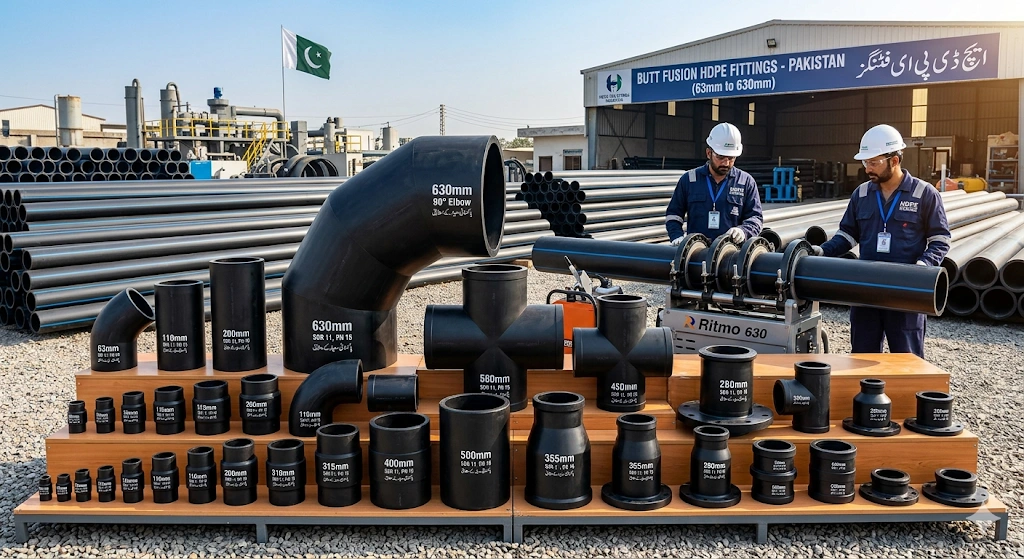
1. Elbows (Directional Change) 45° and 90° elbows change pipe direction. Long-radius elbows reduce turbulence at bends; short-radius elbows are more compact but create higher pressure loss. HDPE butt-fusion elbows are available from 63mm to 630mm; PPRC socket-weld elbows cover 20mm to 110mm.
2. Tees (Flow Branching) Equal tees split one inlet to two equal-diameter outlets. Reducing tees branch to a smaller diameter outlet — critical on distribution networks where sub-mains branch from a main supply. Both are available in all four materials.
3. Reducers (Diameter Transition) Concentric reducers centre both pipe axes. Eccentric reducers offset the bottom of both pipes to the same level — essential when you need to maintain pipe invert level on gravity drainage or prevent air entrapment in horizontal water mains.
4. Couplings and Unions Straight couplings join two pipe lengths of the same diameter. Repair couplings (double-socket, slip-type) allow mid-pipe repair without cutting out long sections — a valuable fitting for WASA maintenance contractors in Lahore and Multan.
5. End Caps Terminate dead-end pipe runs. Available with flat or domed ends. On pressure systems, end caps must be pressure-rated to the same PN class as the pipe.
6. Valves Gate valves, ball valves, butterfly valves, and check valves control flow. Material selection here depends on fluid type, temperature, and whether actuation is manual, electric, or pneumatic.
NEWTECH’s HDPE butt-fusion fittings range under the PLAST-1 brand (link: /hdpe-pipes/) covers all six categories from 63mm to 630mm, manufactured to ISO 4427 standards.
HDPE and PPRC Fittings Types: Which System for Which Application?
HDPE butt-fusion fittings (DN 63–630mm) are the correct choice for buried water mains, pressurised force mains, industrial process lines, and any application requiring a fully leak-free jointed system. PPRC socket-weld fittings (20mm–110mm) are designed for above-ground hot and cold water distribution inside buildings — they handle up to 95°C and PN 20 pressure at room temperature.
The application boundary between HDPE and PPRC is clear in Pakistan’s construction practice, and crossing it causes problems. PPRC is a building services material; HDPE is an infrastructure material. A DHA Lahore housing project uses HDPE for the underground water supply from the overhead tank room to the building boundary, PPRC for internal hot and cold distribution, and uPVC for gravity drainage — three separate systems with three separate fitting types.
HDPE Butt-Fusion Fittings: Key Specifications
HDPE fittings under the ISO 4427 standard are manufactured in PE100 compound with pressure ratings matching the connected pipe:
- SDR 11 fittings (PN 16): For pump outlet connections, force mains, and high-pressure buried mains
- SDR 17 fittings (PN 10): For standard water supply and irrigation mains
- SDR 26 fittings (PN 6.3): For low-pressure gravity-assisted water transfer
Joining method is butt-fusion at 220–235°C (ISO 21307). The fused joint is stronger than the pipe wall itself — a correctly made butt-fusion elbow or tee will never be the failure point in your system.
PPRC Socket-Weld Fittings: Key Specifications
PPRC fittings (polypropylene random copolymer) are heat-fusion joined using an 260°C socket welding tool. They are pressure-rated at:
- PN 20 at 20°C: Full cold water rating
- PN 10 at 60°C: Hot water distribution
- PN 5 at 95°C: Central heating / radiator circuits
NEWTECH’s PPRC pipes and fittings (link: /pprc-pipes-and-fittings-in-pakistan/) cover 20mm to 110mm in PN 20 class, used across residential projects in Bahria Town, Green Gulberg Islamabad, and commercial developments in Gulberg Lahore.
⚙️ Expert Insight from NEWTECH One of the most persistent quality issues we see on multi-storey residential projects in Karachi and Islamabad is the use of non-branded PPRC fittings purchased from hardware markets, paired with branded PPRC pipe. The fitting manufacturer’s polypropylene compound often has a different melt-flow index than the pipe compound — the socket weld forms a superficially clean joint, but thermal bond strength is 30–40% lower than a matched-compound joint. Insist on fittings and pipe from the same manufacturer with the same PP-R compound specification. On a 10-storey building, the cost difference is PKR 15,000–30,000 total. The cost of chasing a leaking joint behind finished plasterwork is five to ten times that.
Pipe Elbow, Tee, and Reducer Selection: What Pakistani Contractors Get Wrong
Selecting the right elbow, tee, or reducer for a Pakistani construction project requires matching four parameters: material (HDPE, PPRC, uPVC, or brass), nominal diameter (DN in mm or inches), pressure rating (PN class), and joining method. The most common procurement mistake is buying fittings by size alone, without specifying the pressure class — which fails on high-rise and industrial projects where line pressure exceeds the fitting’s rating.
According to a Pakistan Engineering Council technical bulletin (PEC, 2022), fitting and joint failures account for approximately 45% of all plumbing system defects identified during building completion inspections across Pakistan’s major cities. The majority trace to material mismatch or incorrect pressure class — not installation error.
When to Use Each Elbow Type
90° Short-Radius Elbow: Space-constrained routing inside buildings, vertical risers. Use PPRC for hot/cold plumbing; HDPE butt-fusion for underground or industrial.
90° Long-Radius Elbow (1.5D radius): Pressurised water mains, irrigation sub-mains, any system where hydraulic efficiency matters. Long-radius elbows reduce head loss at bends by 40–60% vs. short-radius equivalents.
45° Elbow: Gradual directional change on buried mains, underground drainage systems, and cases where two 45° elbows replace a 90° at wider radius — preferred on HDPE force mains running at 8 bar+ to minimise water hammer effect at bends.
Reducing Tee vs. Equal Tee — and Why It Matters
An equal tee connects three pipes of the same diameter. A reducing tee has a smaller-diameter branch outlet. Using an equal tee where a reducing tee is specified — and using a separate reducer to make up the size difference — adds one extra joint to the system. On a buried HDPE network, every joint is a potential failure point. Specify reducing tees to ISO 4427 dimensions and eliminate the extra connection.
Compression Fittings vs. Butt-Fusion Fittings for HDPE in Pakistan
Compression fittings are the correct choice for HDPE pipe connections where hot-fusion tools are unavailable, where pipe is regularly connected and disconnected (agricultural laterals, drip irrigation), or where the pipe diameter is below 63mm. Butt-fusion is mandatory for all permanent pressurised joints on DN 63mm and above — compression fittings at those sizes do not provide equivalent joint integrity under sustained pressure.
Compression fittings for HDPE use a stainless steel gripper ring and EPDM O-ring seal inside a polypropylene or brass body. They are rated to PN 16 in sizes up to 63mm (per ISO 14236) — adequate for farm irrigation, domestic service connections, and light industrial use. Above 63mm, butt-fusion is the industry standard for buried water mains and sewer force mains across Pakistan.
Compression Fitting Price Guide — Pakistan 2026
| Fitting Type | Size | Material | Approx. Price (PKR each) |
|---|---|---|---|
| Straight coupling | 20mm | HDPE compression | 45–65 |
| Straight coupling | 32mm | HDPE compression | 85–120 |
| Straight coupling | 50mm | HDPE compression | 190–260 |
| 90° elbow | 20mm | HDPE compression | 55–80 |
| 90° elbow | 32mm | HDPE compression | 110–155 |
| Equal tee | 20mm | HDPE compression | 70–100 |
| Equal tee | 32mm | HDPE compression | 130–180 |
| End cap | 25mm | HDPE compression | 35–55 |
| Reducing tee | 32mm × 20mm | HDPE compression | 140–195 |
| Male threaded adaptor | 25mm × ¾” | HDPE/brass | 90–130 |
| Female threaded adaptor | 25mm × ¾” | HDPE/brass | 85–125 |
Prices are indicative 2026 Lahore market rates. Volume pricing available from NEWTECH for bulk project procurement.
NEWTECH’s compression fittings range (link: /hdpe-pipes/) is compatible with all HDPE and MDPE pipe in PE80 and PE100 grades, covering 20mm to 63mm — the full range needed for drip irrigation laterals, domestic service connections, and small-diameter process lines.
Plumbing Fittings Price Guide Pakistan 2026: HDPE Butt-Fusion & PPRC
HDPE butt-fusion fittings in Pakistan cost PKR 350–1,200 for DN 63–110mm elbows and tees, rising to PKR 3,500–12,000 for DN 250–315mm. PPRC fittings range from PKR 60–180 for 20–32mm standard elbows and tees up to PKR 450–900 for 90–110mm. Prices reflect PE100 compound and ISO 4427 manufacturing — non-certified fittings sell cheaper but fail material and pressure testing.
2026 HDPE Butt-Fusion Fittings Price — Pakistan (PLAST-1 brand, PKR each)
| Fitting | DN 63mm | DN 90mm | DN 110mm | DN 160mm | DN 200mm | DN 250mm |
|---|---|---|---|---|---|---|
| 90° Elbow (LR) | 420–580 | 750–980 | 1,050–1,350 | 2,200–2,900 | 3,800–5,000 | 6,500–8,500 |
| 45° Elbow | 380–520 | 680–880 | 950–1,200 | 1,900–2,500 | 3,400–4,400 | 5,800–7,600 |
| Equal Tee | 550–720 | 980–1,280 | 1,400–1,800 | 2,900–3,800 | 5,000–6,500 | 8,500–11,000 |
| Reducing Tee | 480–650 | 880–1,150 | 1,250–1,600 | 2,600–3,400 | 4,500–5,800 | 7,500–9,800 |
| Concentric Reducer | 350–480 | 620–810 | 880–1,150 | 1,800–2,400 | 3,100–4,100 | 5,300–7,000 |
| End Cap | 200–280 | 350–480 | 500–660 | 1,050–1,400 | 1,800–2,400 | 3,100–4,100 |
| Straight Coupling | 280–380 | 500–660 | 700–920 | 1,450–1,900 | 2,500–3,300 | 4,200–5,600 |
Prices are ex-factory Lahore, PE100 grade, ISO 4427 compliant. Contact NEWTECH for DN 315–630mm pricing on large-scale projects.
Pakistan’s butt-fusion fittings market is dominated by imports and a small number of domestic manufacturers. NEWTECH manufactures its PLAST-1 brand fittings in Lahore — a domestic manufacturer with full traceability on compound batches, which matters when PSQCA inspectors audit government water supply projects.
Valves for Plumbing and Pipe Systems in Pakistan: What to Specify
Gate valves, ball valves, butterfly valves, and check valves each serve a different function in Pakistani plumbing and water distribution systems. Ball valves handle on/off control for domestic and small commercial lines. Gate valves are standard on municipal water mains. Butterfly valves manage large-diameter industrial and municipal lines. Check valves prevent backflow on pump discharge lines.
Pakistan’s valve market runs from quality-certified ductile iron and brass units to low-grade zinc alloy (zamak) products that corrode internally within 12–24 months in Pakistan’s water quality conditions. WASA Lahore’s procurement guidelines specify ductile iron gate valves to BS 5163 for mainline isolation and brass ball valves to BS 2279 for service connections.
Valve Selection by Application — Pakistan
| Application | Recommended Valve | Size Range | Pressure Class | Notes |
|---|---|---|---|---|
| Domestic water supply | Ball valve (brass) | ½”–2″ | PN 16–25 | Full-bore preferred for minimal head loss |
| Housing society mains | Gate valve (ductile iron) | 2″–12″ | PN 16 | WASA standard; needs valve box for buried installation |
| HDPE force main | Ball valve (HDPE socket) | 20–110mm | PN 16 | Fusion-jointed to HDPE main |
| Pump discharge | Swing check valve | 1.5″–6″ | PN 10–16 | Prevents backflow on pump stop |
| Large water mains | Butterfly valve (ductile iron) | 4″–24″ | PN 10–16 | Wafer or lug type; lever or gearbox actuated |
| PPRC hot water | Ball valve (PP-R body) | 20–63mm | PN 20 | Must match PPRC system — no brass in hot lines unless rated |
For complete valve and fitting specifications, NEWTECH’s pipe catalogue (link: /pipe-catalogue-pakistan/) covers all product ranges with dimensional drawings and pressure ratings.
How to Verify Fitting Quality in Pakistan: What Certified Looks Like
Certified pipe fittings in Pakistan carry permanent markings including nominal size (DN), pressure rating (PN class), material designation (PE100, PP-R, PVC-U), manufacturing standard (ISO 4427, ISO 15874, ISO 1452), and manufacturer code. PSQCA-certified fittings for government projects must show the PS mark. Any fitting without visible permanent markings should be rejected — remarked or unbranded fittings are one of the most common sources of substandard material entering Pakistan’s construction supply chain.
According to PSQCA’s 2022–23 market surveillance report, approximately 28% of plumbing fittings sampled from wholesale markets in Lahore, Karachi, and Rawalpindi failed to meet minimum pressure testing requirements under their declared standards. The failure rate on unmarked or loosely branded fittings was over 50%.
Five-Point Fitting Quality Check for Pakistani Procurement
1. Visible Permanent Markings: DN size, PN rating, standard reference, material, and manufacturer code must be moulded or printed permanently — not stickered.
2. Wall Thickness: Measure with a digital calliper. Fitting wall at the thinnest point must equal or exceed the connected pipe wall thickness for the same SDR/PN class.
3. Bead Uniformity (butt-fusion): Inspect the fusion bead on butt-fusion fittings. A continuous, uniform bead on both sides of the joint indicates correct welding temperature and pressure. Irregular or missing beads indicate cold fusion — the joint will fail under sustained load.
4. Gate Valve Body Integrity: Cast iron and ductile iron gate valves should show no surface porosity (small holes or sand inclusions) on the body casting. Porosity is a stress concentration point that propagates to failure under water hammer.
5. Supplier Certification: Request the PSQCA certificate number and ISO 9001:2015 certificate from your supplier. NEWTECH’s ISO 9001:2015 and PSQCA certifications are available on request — see the about page (link: /about/) for full certification details.
CONCLUSION
Fitting specification is where pipe projects succeed or fail quietly — the damage shows up months after installation, behind walls and under roads, at exactly the worst time for your project schedule and budget.
Your four decisions before any fittings procurement in Pakistan:
- Match material and joining method to the pipe system — PPRC socket-weld fittings for above-ground hot and cold, HDPE butt-fusion for all buried pressurised mains, compression fittings only for DN 20–63mm non-permanent connections.
- Specify PN class explicitly — never order fittings by size alone. A DN 90mm PE100 SDR 17 (PN 10) main line needs PN 10-rated fittings. Mixing in PN 6.3 fittings because they’re cheaper creates a hidden failure point.
- Insist on permanent markings and PSQCA certification for any government-funded project — and make it standard practice on private work too.
- Buy fittings and pipe from the same manufacturer where possible — compound compatibility is the factor that determines actual joint strength vs. the theoretical value on a data sheet.
Whether you’re specifying a PPRC plumbing system for a housing tower in Lahore, an HDPE main for an irrigation scheme in Bahawalpur, or a municipal valve installation for WASA, the right pipe fittings Pakistan buyer approach is the same: prioritise specification over price, and demand documentation.
FAQ SECTION
1. What are the most common pipe fittings used in plumbing systems in Pakistan?
The most common pipe fittings used in Pakistani plumbing are 90° and 45° elbows, equal and reducing tees, straight couplings, concentric reducers, end caps, and ball valves. PPRC socket-weld fittings dominate above-ground hot and cold water plumbing in residential buildings. HDPE butt-fusion fittings are standard for buried water supply mains and industrial process piping from DN 63mm to DN 630mm.
2. What is the price of HDPE butt-fusion fittings in Pakistan in 2026?
HDPE butt-fusion fittings in Pakistan cost approximately PKR 350–720 per piece for DN 63mm elbows and couplings, PKR 980–1,800 for DN 110mm tees and elbows, and PKR 5,000–11,000 for DN 250mm fittings. Prices reflect PE100 compound and ISO 4427 manufacturing. Non-certified fittings are cheaper by 20–35% but regularly fail pressure testing on government project inspections.
3. What is the difference between HDPE butt-fusion fittings and compression fittings in Pakistan?
Butt-fusion HDPE fittings are heat-joined at 220–235°C and form a permanent joint stronger than the pipe wall — mandatory for buried pressurised mains DN 63mm and above. Compression fittings use mechanical grippers and O-ring seals for pipe connections DN 20–63mm; they are removable and ideal for farm irrigation laterals, domestic service connections, and locations where fusion equipment is unavailable.
4. Can I use PPRC fittings on HDPE pipes in Pakistan?
No — PPRC and HDPE are chemically incompatible materials with different melting temperatures and joining methods. Connecting them requires a transition fitting (e.g., a metal-threaded or flanged adaptor) rated for the system pressure. Using PPRC socket-weld fittings directly on HDPE pipe will not form a structural bond and will fail immediately under pressure. Always specify fittings in the same material as the pipe system.
5. How do I identify quality pipe fittings in the Pakistan market?
Quality pipe fittings in Pakistan carry permanent moulded or printed markings showing: nominal size (DN), pressure rating (PN), material designation (PE100, PP-R, PVC-U), manufacturing standard (ISO 4427, ISO 15874), and manufacturer code. According to PSQCA’s 2022–23 market surveillance report, over 28% of fittings sampled from wholesale markets failed minimum pressure testing — reject any fitting without full, permanent markings.
6. Which pipe fitting brand is best for HDPE systems in Pakistan?
For HDPE butt-fusion fittings in Pakistan, NEWTECH’s PLAST-1 brand is one of the domestically manufactured options covering DN 63mm to DN 630mm in PE100 compound to ISO 4427. Domestic manufacture ensures compound batch traceability and PSQCA certification compliance — both required on government water supply and sewer contracts under PPRA procurement rules. Request certificate documentation from any supplier before placing a large order.