Agriculture drives 22.7% of Pakistan’s GDP and employs 37.4% of its labour force (Pakistan Economic Survey 2023–24). Yet water losses in the country’s farm irrigation networks — through leaking joints, burst PVC mains, and corroded steel pipes — run at 30–40% of total pump output on many private farms (Pakistan Council of Research in Water Resources, 2022). That loss is pure cost: wasted electricity, wasted water, reduced crop yield.
If you’re setting up or upgrading a farm water supply system in Pakistan — whether you’re running a 20-acre wheat farm in Bahawalpur, a vegetable operation in Multan, or a large-scale mango orchard in Rahim Yar Khan — the pipe material decision determines how much water reaches your crop and how much disappears before it gets there.
HDPE irrigation pipe Pakistan farms have been adopting steadily since the early 2010s, and for good reason: no corrosion, no joint leakage, no annual maintenance season. This guide walks you through the right pipe sizes, pressure ratings, system design logic, 2026 prices, and installation steps — everything you need to spec your next irrigation project correctly.
Why HDPE Irrigation Pipe Is the Right Choice for Pakistan’s Farms
For farm water supply systems in Pakistan, HDPE pipe outperforms PVC, steel, and asbestos-cement alternatives across every meaningful metric: it handles higher operating pressure, survives Pakistan’s extreme soil temperature swings (from 5°C in January fields near Islamabad to 55°C surface soil in Sindh summer), and its fused or compression-jointed connections produce a leak-free network that gravity-threaded GI pipe simply cannot match.
Pakistan’s agricultural belt — the canal-fed plains of Punjab and Sindh — has soil chemistry that actively attacks metals. Saline groundwater in districts like Khanewal, Lodhran, and Mirpur Khas corrodes mild steel within 5–7 years. HDPE is chemically inert to soil salinity, pH extremes (2–14 per ISO 10358), and the fertiliser residues that migrate through irrigated soils.
Three Reasons Pakistani Farmers Are Switching from PVC to HDPE
1. Pressure Rating at Higher Temperatures uPVC’s pressure rating drops sharply above 25°C — a significant problem when surface-laid pipes in Punjab’s summer sun reach 40°C+. HDPE PE100’s pressure rating derate is far less severe. A PE100 SDR 11 pipe rated PN 16 at 20°C still holds PN 12.5 at 40°C — adequate for most pump-fed farm systems.
2. Flexibility for Agricultural Terrain Farm irrigation networks cross uneven terrain, travel around tree lines, and get disturbed by seasonal tillage equipment. HDPE’s bend radius (25 × OD for PE100) means you can change direction without fittings — fewer joints, fewer failure points, faster installation.
3. Long Coil Lengths HDPE pipes up to 63mm are available in 100-metre coils. A single coil replaces 16 standard 6-metre PVC pipe sections with 15 joints between them. Across a 500-metre main line, that’s the difference between 8 fusion connections (HDPE) and 83 push-fit joints (PVC) — 83 chances for leakage vs. 8.
NEWTECH’s HDPE DuraPE series (link: /hdpe-pipes/) is manufactured to ISO 4427, available in PE80 and PE100 grades from 20mm to 630mm, and covers every scale of agricultural irrigation from single tube well to multi-channel canal distribution.
What Agricultural HDPE Pipe Size Do You Need for Your Farm System?
For a tube well–fed farm irrigation system in Pakistan, main supply pipes typically use DN 63mm–DN 160mm HDPE in PE100 SDR 17 (PN 10 rating). Sub-main distribution lines run DN 32mm–DN 63mm. Drip and micro-sprinkler lateral lines use DN 16mm–DN 25mm. Correct sizing is based on flow rate from your pump and the friction loss across the field.
Getting agricultural HDPE pipe size wrong in either direction causes immediate problems. Undersized pipe generates excessive friction loss — your pump works harder, energy cost rises, and pressure at the far end of the field drops below sprinkler or dripper operating minimum. Oversized pipe costs more upfront, and at lower flow velocities, sediment settles and blocks drippers.
Agricultural HDPE Pipe Size Selection Guide
| Application | Recommended Size | Grade | SDR / Pressure Rating | Typical Flow Range |
|---|---|---|---|---|
| Tube well pump outlet | DN 63–90mm | PE100 | SDR 17 / PN 10 | 10–25 m³/hr |
| Main supply line (up to 500m) | DN 90–160mm | PE100 | SDR 17 / PN 10 | 15–60 m³/hr |
| Sub-main distribution | DN 50–75mm | PE100 | SDR 17 / PN 10 | 5–20 m³/hr |
| Sprinkler lateral (overhead) | DN 32–50mm | PE80 | SDR 11 / PN 12.5 | 2–10 m³/hr |
| Drip irrigation lateral | DN 16–25mm | PE80 | SDR 11 / PN 12.5 | 0.5–3 m³/hr |
| Canal intake / headworks | DN 160–315mm | PE100 | SDR 13.6 / PN 12.5 | 60–200 m³/hr |
| Underground water transfer | DN 110–200mm | PE100 | SDR 11 / PN 16 | 30–100 m³/hr |
Rule of thumb for Pakistani tube well systems: A 30 HP submersible pump delivering 25–30 m³/hr needs a minimum DN 90mm main line to keep velocity below 1.5 m/s. Dropping to DN 75mm at that flow rate increases friction loss by 65% over a 300-metre run — the pump cavitates and field pressure is inconsistent.
For specific hydraulic calculations for your farm, NEWTECH’s technical team can provide sizing support — request through the contact page (link: /contact-us/).
HDPE Irrigation Pipe Prices in Pakistan: 2026 Rate Guide
HDPE irrigation pipe prices in Pakistan in 2026 range from PKR 55–90 per metre for DN 20–32mm coil pipe, PKR 180–380 per metre for DN 63–90mm, and PKR 650–1,400 per metre for DN 110–160mm supply mains. PE100 grade commands a 10–15% premium over PE80 at the same diameter and SDR rating.
2026 HDPE Irrigation Pipe Price Table — Pakistan (PKR per metre)
| Diameter | Grade | SDR Rating | Pressure (PN) | Price Range (PKR/m) | Form |
|---|---|---|---|---|---|
| DN 20mm | PE80 | SDR 11 | PN 12.5 | 55–75 | Coil (200m) |
| DN 25mm | PE80 | SDR 11 | PN 12.5 | 75–100 | Coil (200m) |
| DN 32mm | PE80 | SDR 11 | PN 12.5 | 110–145 | Coil (100m) |
| DN 50mm | PE100 | SDR 17 | PN 10 | 155–210 | Coil (100m) |
| DN 63mm | PE100 | SDR 17 | PN 10 | 210–280 | Coil (100m) |
| DN 90mm | PE100 | SDR 17 | PN 10 | 380–490 | Straight (6m) |
| DN 110mm | PE100 | SDR 17 | PN 10 | 520–680 | Straight (6m) |
| DN 160mm | PE100 | SDR 17 | PN 10 | 950–1,250 | Straight (6m) |
| DN 200mm | PE100 | SDR 13.6 | PN 12.5 | 1,500–1,950 | Straight (6m) |
Prices are indicative 2026 market rates ex-factory Lahore, excluding transport and fittings. Bulk pricing (1,000m+) available. Contact NEWTECH for a project-specific quote.
Irrigation pipe pricing in Pakistan moves with resin (raw material) costs — PE resin is priced in USD and fluctuates with international petrochemical markets. The September–December period historically sees higher demand as farmers prepare for rabi season planting, which can push prices up 5–10%. Budget procurement in July–August for late-year projects.
⚙️ Expert Insight from NEWTECH One of the most frequent mistakes we see on farm irrigation projects across Multan, Bahawalpur, and Rahimyar Khan is farmers purchasing PE80 SDR 17 pipe for pump outlet connections on high-head submersible systems. PE80 SDR 17 is rated at PN 8 — a 7.5 HP tube well pump with a 40-metre head easily produces 6–8 bar on water hammer, which exceeds this rating. Always use PE100 SDR 11 (PN 16) for the first 30–50 metres of any pump outlet run. The price difference is approximately PKR 80–120 per metre — negligible against the cost of a burst main under a standing wheat crop.
How to Design a Farm Water Supply System in Pakistan Using HDPE Pipes
A cost-effective farm water supply system in Pakistan using HDPE pipe follows a three-tier layout: a main supply line from the tube well or canal intake, sub-main distribution headers branching to field zones, and lateral delivery lines to emitters or sprinkler heads. Correct hydraulic design ensures every zone receives adequate pressure regardless of field length or terrain elevation change.
Pakistan’s farms range from the flat canal-commanded plains of central Punjab to the undulating terrain of Khyber Pakhtunkhwa and the sloped orchards of Balochistan. System design logic changes with the terrain.
System Design for Flat Punjab / Sindh Farmland
On flat land in districts like Sargodha, Hafizabad, or Nankana Sahib, gravity has minimal effect. Your key design variables are:
- Pump head: Know your static head (depth to water table) + friction losses + operating pressure at emitters.
- Main line velocity: Keep below 1.5 m/s to avoid water hammer on pump start/stop.
- Operating pressure at drippers: 1.0–1.5 bar for pressure-compensating drippers; 2.0–3.0 bar for medium-range sprinklers.
For a 40-acre wheat/cotton rotation farm on flat Punjab land with a 25 HP pump delivering 20 m³/hr at 6 bar:
- Main line: DN 90mm PE100 SDR 17, 400 metres from tube well to field centre
- Sub-mains: DN 63mm PE100 SDR 17, 200 metres each, four zones
- Laterals: DN 25mm PE80 coil, 60 metres per row, compression-fitted
Total system cost in pipes alone at 2026 rates: approximately PKR 280,000–340,000 for 40 acres — comparable to one season’s water loss through a leaking conventional channel system.
System Design for Sloped / Orchard Terrain
Mango orchards in Multan, citrus farms in Sargodha, and apple orchards in Swat face a hydraulic challenge: elevation changes create pressure variation. A 10-metre drop in elevation adds approximately 1 bar of pressure at lower points. HDPE handles this — but your lateral design must account for it using pressure-compensating drippers or zone-by-zone pressure regulation.
NEWTECH’s compression fittings (link: /hdpe-pipes/) make zonal splitting simple and field-repairable without hot tools — important for remote farm locations.
HDPE Pipe Installation for Farm Irrigation: Step-by-Step for Pakistani Conditions
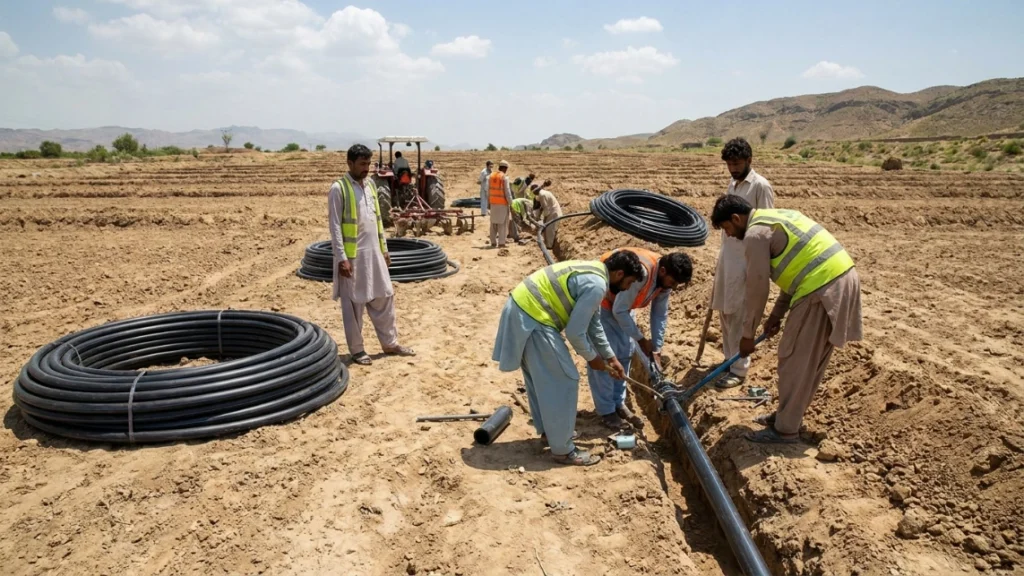
Installing HDPE irrigation pipe in Pakistan correctly requires proper trench depth (minimum 600mm in tractor-trafficked zones), clean butt-fusion or compression joints, and a pressure test before covering. Most farm failures trace to shallow burial, contaminated fusion surfaces, or using the wrong SDR pipe on the pump outlet.
Installation Checklist — HDPE Irrigation Pipe Pakistan
| Step | Action | Tool / Material | Critical Note |
|---|---|---|---|
| 1. Layout | Mark main line, sub-mains, and lateral routes | Marking paint, measuring tape | Follow hydraulic design; avoid tree root zones |
| 2. Trenching | Excavate to 600mm depth minimum (tractor zone) | Mini-excavator or hand | 300mm depth acceptable for surface-laid laterals |
| 3. Bedding | Lay 50mm sand/fine soil bed | Sand, spade | Remove sharp stones that puncture pipe |
| 4. Pipe Laying | Uncoil (coil pipe) or lay straight lengths | Pipe hooks | Avoid kinking coil pipe below min bend radius |
| 5. Jointing — Main Line | Butt-fusion at 220–235°C (PE100) | Butt-fusion machine | Clean pipe ends; check bead formation |
| 6. Jointing — Laterals | Compression fitting assembly | Compression tool / hand | Deburr pipe end; insert to full depth |
| 7. Air/Water Test | Pressurise to 1.5× operating pressure | Test pump, pressure gauge | Hold 30 minutes; zero drop = pass |
| 8. Backfill | Hand-compact 150mm over pipe crown, then machine | Compactor | No large stones in first 300mm over pipe |
| 9. Valve Installation | Fit gate or ball valves at zone entry points | Spanners, PTFE tape | Use PN-rated valves matching pipe pressure class |
| 10. Flushing | Flush system before connecting emitters | — | Clears fusion debris and construction grit |
Butt-fusion is the right joining method for mains DN 63mm and above. NEWTECH’s butt-fusion welding machines (link: /hdpe-pipes/) are available for project hire or purchase and come with full ISO 21307 welding procedure specifications — necessary if you’re installing for a provincial irrigation department contract.
Farm Irrigation Standards and Certifications That Matter in Pakistan
For government-funded farm irrigation projects in Pakistan — whether under the PM Agriculture Transformation Plan, provincial irrigation schemes, or donor-funded FAO projects — HDPE pipe must be ISO 4427-compliant and sourced from a PSQCA or PEC-approved manufacturer. Private farm projects have no legal pipe certification requirement, but insisting on certified pipe protects your investment.
According to the Pakistan Agriculture Department’s 2023 annual report, over PKR 18 billion was allocated for farm water efficiency infrastructure under the National Water Policy framework — and procurement rules on all provincial contracts above PKR 5 million require certified pipe with traceable batch markings.
What ISO 4427 Certification Means for Your Irrigation Pipe
ISO 4427 specifies:
- Compound quality: PE80 or PE100 designation with confirmed MRS (minimum required strength) of 8 or 10 MPa
- Dimensional tolerance: Wall thickness ±10% of nominal, ensuring SDR-rated pressure performance
- Slow crack growth resistance: Tested per ISO 13479 — critical in farm environments where pipes experience thermal cycling
- Hydrostatic strength: Pipe must withstand 100-hour and 1,000-hour pressure tests at elevated temperature without failure
NEWTECH is ISO 9001:2015 certified and manufactures its DuraPE HDPE range to ISO 4427 at its Lahore facility. Every pipe carries permanent OD, SDR, grade, and batch markings — a requirement for any irrigation project where the pipe is expected to stay in the ground for 30–50 years. Full product specifications are available in the NEWTECH pipe catalogue (link: /pipe-catalogue-pakistan/).
How Long Do HDPE Irrigation Pipes Last in Pakistan’s Agricultural Conditions?
HDPE irrigation pipes installed correctly in Pakistan last a minimum of 50 years, based on ISO 9080 long-term pressure rating methodology. Buried pipes in Pakistan’s agricultural soil conditions — even saline soils in Sindh and southern Punjab — experience no corrosion or chemical degradation. UV-stabilised HDPE pipe can also withstand 3–5 years of surface exposure before underground installation.
Farmers in Faisalabad who installed PE80 drip irrigation mains in the early 2000s are now 20+ years into service with no pipe replacement required — routine maintenance has been limited to dripper cleaning and pressure regulator servicing. The pipe itself remains intact.
Contrast this with the alternative materials:
- GI (galvanised iron) pipe: 10–15 years in saline soils; needs annual joint maintenance.
- Mild steel: 7–10 years; requires cathodic protection for underground use.
- uPVC (rigid): 25–30 years in buried irrigation applications; susceptible to UV degradation if surface-laid.
- Asbestos cement: No longer manufactured in Pakistan; existing systems being phased out due to health concerns and breakage rate.
The total lifecycle cost of HDPE irrigation pipe Pakistan farms use — pipe cost + installation + maintenance over 30 years — is significantly lower than any metal alternative. A 2021 ICID (International Commission on Irrigation and Drainage) technical review found that plastic pipe irrigation systems deliver 40–60% lower 30-year lifecycle costs compared to traditional open channel and metal pipe systems at farm scale.
CONCLUSION
The case for HDPE irrigation pipe on Pakistani farms is not theoretical — it’s built on 30 years of field data from Punjab’s canal commands to Balochistan’s drip-irrigated orchards. Every litre of water your system leaks is electricity wasted on pump run-time and crop yield left on the field.
Your four actionable decisions for the next project:
- Specify PE100 SDR 11 for pump outlet runs — the pressure rating margin protects against water hammer on start-up, which destroys undersized pipe within a single season.
- Use DN 90–160mm PE100 SDR 17 for main supply lines — match diameter to pump flow rate to keep velocity below 1.5 m/s.
- Insist on ISO 4427-certified pipe with visible batch markings — especially on any government-funded irrigation scheme where procurement audits are routine.
- Bury mains at 600mm minimum depth in tractor-trafficked zones — shallow burial is the single biggest cause of farm irrigation pipe failure in Punjab.
A well-designed HDPE irrigation pipe Pakistan farm system requires more planning upfront than laying open channel — but it pays back in water savings, energy cost reduction, and zero maintenance for 20+ years.
Ready to source the right pipes for your project? Request a free quote from NEWTECH’s expert team today. (link: /contact-us/)
Explore next on NEWTECH Pipes:
- Drip Irrigation Pipe Setup in Pakistan: Sizing Guide for 5 to 500 Acres
- HDPE Pipe Pressure Ratings in Pakistan: SDR Series Explained for Engineers
FAQ SECTION
1. What is the best HDPE irrigation pipe size for a tube well farm in Pakistan?
For a typical tube well–fed farm in Pakistan, DN 90mm PE100 SDR 17 is the standard main supply size for pumps delivering 15–30 m³/hr. Farms larger than 40 acres or with pump outputs above 30 m³/hr should move to DN 110mm or DN 160mm main lines. Lateral drip lines use DN 16–25mm coil pipe. Correct sizing prevents pressure loss and pump cavitation.
2. What is the price of HDPE irrigation pipe per metre in Pakistan in 2026?
HDPE irrigation pipe prices in Pakistan in 2026 range from PKR 55–145 per metre for small-diameter coil pipe (DN 20–32mm) to PKR 950–1,950 per metre for larger supply mains (DN 160–200mm PE100). Prices vary by SDR rating, PE grade, and order quantity. Bulk purchases above 1,000 metres typically attract 10–15% discounts from certified manufacturers.
3. How long do HDPE irrigation pipes last in Pakistan’s agricultural conditions?
HDPE irrigation pipes are rated for a minimum 50-year service life per ISO 9080. In Pakistan’s agricultural conditions — including saline soils in Sindh and southern Punjab, thermal cycling in buried applications, and groundwater with high mineral content — correctly installed PE100 pipe performs without corrosion, joint failure, or significant pressure loss degradation over 30–50 years. Regular maintenance is limited to fittings and emitter components, not the pipe itself.
4. What is the difference between PE80 and PE100 HDPE pipe for farm irrigation in Pakistan?
PE100 HDPE pipe has a higher minimum required strength (10 MPa vs. 8 MPa for PE80), which means thinner walls for the same pressure rating, or higher pressure capacity at the same SDR. For pump outlet connections and main supply lines running above 8 bar, PE100 is required. PE80 is acceptable for low-pressure lateral lines (drip or micro-sprinkler runs) where operating pressure stays below 6 bar.
5. Can HDPE pipe be used for underground irrigation in Pakistan without special treatment?
Yes — HDPE pipe requires no external coating, wrapping, or cathodic protection for underground burial in Pakistani soils, including saline and chemically aggressive agricultural land. Its chemical resistance to pH 2–14 (ISO 10358) covers all soil and groundwater conditions found in Punjab, Sindh, and KPK agricultural zones. Burial depth should be 600mm minimum under tractor-trafficked land and 300mm under non-trafficked field areas.
6. Which HDPE pipe brand is best for irrigation in Pakistan and why?
NEWTECH’s DuraPE series is one of Pakistan’s most widely used HDPE irrigation pipe ranges, manufactured to ISO 4427 in PE80 and PE100 grades from 20mm to 630mm at an ISO 9001:2015 certified facility in Lahore. For any government-funded irrigation project, the critical requirement is PSQCA certification and permanent batch markings — these ensure the pipe’s SDR and grade are independently verified, protecting both the buyer and the project audit trail.