A wrongly specified tube well pipe fails silently — collapsing under pump pressure at 80 metres, corroding within three seasons, or delivering water contaminated by leaching metals from substandard material. Pakistan sinks over 1.2 million tube wells annually for agriculture, municipal supply, and housing developments (Pakistan Bureau of Statistics, 2023), and a significant percentage of premature failures trace back to one decision made before installation: wrong pipe selection.
If you are specifying HDPE pipe for a tube well in Pakistan — whether for a housing society in Lahore, a farm in Bahawalpur, or a municipal borehole in Faisalabad — this guide gives you the exact SDR ratings, pressure classes, sizes, and installation requirements you need. No generic advice. No vague recommendations.
By the time you finish reading, you will know which PE grade to specify, which SDR suits your pump head, how to match pipe diameter to flow rate, and why the right PSQCA-certified material prevents the most common and costly errors contractors make at the borehole collar.
What Is HDPE Pipe and Why Does It Suit Tube Wells Better Than GI or uPVC?
HDPE (High-Density Polyethylene) pipe resists corrosion, handles dynamic bending during pump operation, and maintains pressure integrity underground without cathodic protection. Unlike GI pipe, it does not rust. Unlike uPVC, it flexes without cracking under lateral soil movement. For borehole depths beyond 40 metres, PE100 HDPE with SDR 11 is the standard international choice and increasingly the preferred material across Pakistan’s municipal and agricultural sectors.
Pakistan’s groundwater contains dissolved salts, iron, and chlorides — particularly in Punjab and Sindh. GI pipe in these conditions corrodes within 5–8 years, shedding iron oxide into drinking water and reducing bore yield through internal scaling. uPVC becomes brittle in deep bores where temperature differentials exist between surface and aquifer levels. HDPE PE100 material, manufactured to ISO 4427 standard, is chemically inert to groundwater chemistry and maintains flexibility at temperatures between -20°C and +60°C — relevant for surface sections exposed to Pakistan’s summer extremes above 45°C in cities like Multan and Bahawalpur.
HDPE also supports heat fusion (butt-welding) joints, eliminating the threaded connections that are the primary leak point in GI tube well columns. A properly welded HDPE joint exceeds the pipe’s own pressure rating. Compression fittings are used at surface connections where dismantling is required for pump servicing.
NEWTECH’s DuraPE HDPE pipe series (link: /hdpe-pipes/) is manufactured in PE80 and PE100 grades, 20mm to 630mm, certified under ISO 4427, PS 3580:1994, and PSQCA standards — making it suitable for WASA-approved projects and PEC-compliant installations across Pakistan.
How Deep Can HDPE Pipe Go in a Tube Well? Understanding Depth and Pressure Limits
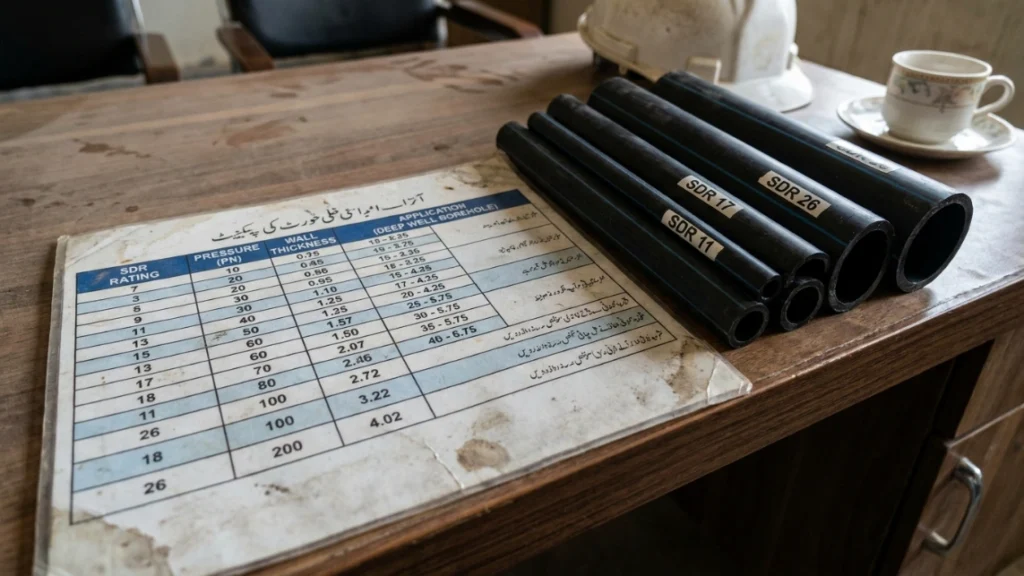
HDPE PE100 SDR 11 pipe handles operating pressures up to 16 bar, which corresponds to approximately 160 metres of static head. For submersible pump installations, the working pressure combines static water column plus pump discharge pressure. Most tube well applications in Pakistan between 60–150 metres depth are safely covered by PE100 SDR 11 or SDR 13.6 (PN 12.5 bar). Shallower wells under 60 metres can use SDR 17 (PN 10 bar).
The pressure at any depth is calculated simply: 1 bar ≈ 10 metres of water column. A submersible pump set at 120 metres with a 4 bar pump discharge head creates approximately 16 bar at the pump outlet. PE100 SDR 11 at PN 16 covers this with zero margin to spare — which is why for high-head boreholes in Rawalpindi, Islamabad, and Attock (where aquifer depths commonly reach 150–200 metres), specifying SDR 9 (PN 20 bar) is the correct engineering decision.
Depth-to-SDR Quick Reference
| Bore Depth (m) | Recommended SDR | Pressure Class | PE Grade |
|---|---|---|---|
| Up to 60 m | SDR 17 | PN 10 bar | PE80 or PE100 |
| 60–100 m | SDR 13.6 | PN 12.5 bar | PE100 |
| 100–150 m | SDR 11 | PN 16 bar | PE100 |
| 150–200 m | SDR 9 | PN 20 bar | PE100 |
| Industrial / High-pressure | SDR 7.4 | PN 25 bar | PE100 |
Note: Pressure class (PN) assumes water at 20°C. In summer conditions where surface pipe temperatures exceed 40°C, de-rate operating pressure by 20% as per ISO 4427 guidance.
⚙️ Expert Insight from NEWTECH The most common specification error we see on contractor orders is choosing SDR 17 for boreholes exceeding 80 metres — often to save PKR 40–60 per metre on material cost. At those depths, the pipe wall is undersized for combined hydrostatic and pump discharge pressure. Over three to five monsoon cycles, fatigue cracking begins at the pump coupling point. The cost of pulling and replacing a 100-metre bore column runs PKR 80,000–150,000. The pipe upgrade costs PKR 6,000–9,000. Choose the right SDR the first time.
Which HDPE Pipe Size Is Right for Your Submersible Pump? Flow Rate and Diameter Selection
Pipe diameter for a tube well column must match submersible pump flow rate to keep water velocity below 1.5 m/s and avoid pressure loss. For pumps delivering 1–3 inches (25–76mm) bore diameter, 63mm to 110mm HDPE pipe covers most agricultural and residential applications. Industrial boreholes with 6-inch pumps delivering 50+ m³/hr require 160mm or larger.
Flow velocity inside a pipe above 2 m/s causes cavitation, vibration, and premature wear on pump impellers. Below 0.5 m/s, solids settle inside the column and restrict yield. Matching pipe size to pump output is not optional — it directly affects pump lifespan and well productivity.
HDPE Pipe Size Selection for Tube Well Applications
| Pump Output (m³/hr) | Recommended Pipe Size | Typical Application | Wall Thickness SDR 11 |
|---|---|---|---|
| 1–3 m³/hr | 32mm | Domestic, rooftop tank | 2.9mm |
| 3–6 m³/hr | 40mm | Small farm, single unit | 3.7mm |
| 6–12 m³/hr | 63mm | Residential plot, small housing | 5.8mm |
| 12–25 m³/hr | 90mm | Housing society, medium farm | 8.2mm |
| 25–50 m³/hr | 110mm | Commercial block, large farm | 10.0mm |
| 50–100 m³/hr | 160mm | Municipal supply, industrial | 14.6mm |
| 100–200 m³/hr | 200mm | WASA borehole, large industrial | 18.2mm |
| 200+ m³/hr | 250mm–315mm | Municipal main bore | 22.7mm–28.6mm |
NEWTECH’s DuraPE series (link: /hdpe-pipes/) covers the full range from 20mm to 630mm in PE80 and PE100. For tube well contractors in Lahore, Karachi, and Islamabad, NEWTECH supplies cut lengths and coiled pipe with same-week delivery to site.
For pump sizes between sizes listed above, always round up to the next diameter — pressure loss rises exponentially, not linearly, as velocity increases through undersized pipe.
HDPE vs GI vs uPVC for Borehole Water Supply in Pakistan: Which Pipe Wins?
For borehole water supply in Pakistan, PE100 HDPE is the superior material across all performance metrics — lifespan, corrosion resistance, joint integrity, and total installed cost over a 20-year horizon. GI pipe corrodes in 5–8 years in saline groundwater conditions common in Punjab and Sindh. uPVC becomes brittle under continuous vibration from submersible pumps. HDPE maintains structural integrity for 50+ years under ISO 4427 rated conditions.
Material Comparison: Borehole Water Supply Applications
| Attribute | HDPE PE100 | GI Pipe | uPVC Class D |
|---|---|---|---|
| Corrosion resistance | Excellent — inert to groundwater chemistry | Poor — rusts in saline/hard water | Good — but UV-sensitive |
| Lifespan | 50+ years (ISO 4427) | 5–12 years in Pakistan conditions | 15–25 years |
| Pressure rating | PN 10–25 bar (SDR-dependent) | Moderate — thread joints weaken | PN 6–16 bar |
| Joint type | Heat fusion / compression (leak-free) | Threaded — primary leak point | Solvent-cement / push-fit |
| Vibration resistance | Excellent — flexible material | Poor — rigid, joint fatigue | Poor — brittle fracture |
| Weight per metre (110mm) | ~2.1 kg/m | ~9.5 kg/m | ~1.9 kg/m |
| Relative installed cost (20-yr) | Lowest | Highest (replacement cycles) | Medium |
| PSQCA certification | Available | Available | Available |
| Drinking water safety | NSF-61 / ISO 4427 compliant | Leaches iron, zinc | Safe if certified |
The weight difference matters practically on site. A 100-metre column in 110mm HDPE weighs approximately 210 kg versus 950 kg in GI. For your crew, that means faster installation, less crane hire, and reduced risk of bore casing collapse from weight loading during pull-out.
According to a PCRWR (Pakistan Council of Research in Water Resources) groundwater quality study, iron contamination from corroded GI bore columns is a documented contributor to elevated iron levels in agricultural groundwater in central Punjab — a direct health and irrigation quality concern.
HDPE Pipe Installation for Tube Wells: Step-by-Step Checklist for Pakistan Contractors
Installing HDPE pipe in a tube well requires correct joint preparation, pump-to-pipe coupling selection, and surface termination method. Butt-fusion welding is standard for column joints at depth; compression fittings are used at surface connections and service points. Incorrect pipe handling during lowering — particularly kinking the column — is the leading cause of installation failure before the bore even goes into service.
Installation Checklist: HDPE Tube Well Pipe
| Step | Action | Tool/Method | Key Note |
|---|---|---|---|
| 1 | Verify pipe pressure class vs bore depth | SDR chart, pump spec sheet | Do before ordering — not on site |
| 2 | Check PSQCA certification on pipe | Inspect pipe marking | Reject unmarked pipe |
| 3 | Measure and cut pipe lengths | Pipe cutter or hacksaw + deburring tool | Clean square cut essential for fusion |
| 4 | Prepare fusion joints | Butt-fusion machine (HDPE rated) | Use NEWTECH butt-fusion machine for correct temp/pressure |
| 5 | Pressure test above-ground assembly | Hydrostatic test kit | Test to 1.5× PN rating before lowering |
| 6 | Lower column with safety rope | Rope + clamp at each joint | Never rely on pipe weight alone |
| 7 | Secure surface termination | Flange adapter + support clamp | Pipe must not carry pump weight unsupported |
| 8 | Install check valve | At pump outlet | Prevents water hammer on shutdown |
| 9 | Connect discharge to header | Compression or flanged fitting | Allow for thermal expansion at surface |
| 10 | Commission with flow test | Flow meter | Verify against pump curve before handover |
NEWTECH supplies HDPE butt-fusion welding machines (link: /hdpe-pipes/) suitable for 63mm to 630mm pipe, calibrated for PE100 fusion parameters per ISO 21307. For site teams in Multan, Faisalabad, and Gujranwala, NEWTECH’s field support team provides on-site fusion training for new contractors.
Common Installation Errors to Avoid
Contractors in Pakistan’s tube well sector repeatedly make three preventable errors:
Error 1 — Kinking during lowering. HDPE is flexible, which is an advantage underground, but a tight kink during lowering creates a stress concentration point that fails under pump cycling within 12–18 months. Always use a steel guide roller at the bore mouth when lowering long columns.
Error 2 — Undersized surface clamp. The pipe column must be supported at the wellhead by a properly sized clamp rated for the column weight plus pump weight. Omitting this transfers all vertical load to the pump coupling — which it is not designed to carry.
Error 3 — Using unapproved fittings at depth. Compression fittings are for surface connections only. At depth, the combination of hydrostatic pressure and column weight exceeds the rated pull-out resistance of compression joints. All below-surface joints must be heat-fused.
PSQCA and PEC Standards for HDPE Borehole Pipe in Pakistan: What Your Project Requires
PSQCA-certified HDPE pipe meeting PS 3580:1994 is required for government-funded tube well projects, WASA supply infrastructure, and any installation requiring PEC engineering sign-off in Pakistan. PE100 pipe conforming to ISO 4427 is internationally accepted and satisfies most private developer and industrial specifications. Always request the manufacturer’s PSQCA license number and test certificate before accepting pipe on site.
Pakistan’s Public Works Department and WASA authorities in Lahore, Karachi, and Rawalpindi have increasingly mandated HDPE in preference to GI for new borehole and distribution projects. The WASA Lahore Groundwater Project (2021–2024) specified PE100 SDR 11 exclusively for all new production bore columns, citing reduced maintenance cost and 50-year design life against the 10-year GI replacement cycle previously experienced.
NEWTECH Pipes holds ISO 9001:2015 certification and PSQCA approval for its HDPE pipe range, with PEC registration covering supply to infrastructure projects across Pakistan. When submitting pipe material submittals on PEC-supervised projects, specify:
- Material: PE100 as per ISO 4427-2
- Pressure class: PN per SDR selection
- Standard: PS 3580:1994 (Pakistan Standard) or ISO 4427
- Manufacturer’s PSQCA license number
- Third-party test report for MRS (Minimum Required Strength) at 20°C
For WASA or municipal projects, request NEWTECH’s material compliance pack (link: /about/) which includes ISO certificates, PSQCA license copies, and test reports pre-formatted for project submittal.
HDPE Pipe Prices for Tube Well Applications in Pakistan: 2025 Rate Guide
HDPE PE100 pipe for tube wells in Pakistan ranges from PKR 180 to PKR 2,800 per metre depending on diameter, SDR rating, and quantity. PE100 SDR 11 in 63mm (the most common tube well size for residential applications) runs PKR 380–520 per metre ex-factory in 2025. Prices shift with resin (HDPE compound) import costs, which are denominated in USD and follow international polymer markets.
HDPE Pipe Price Guide — Tube Well Grades (PE100, Pakistan 2025)
| Pipe Size (OD) | SDR Rating | Pressure Class | Approx. Price (PKR/m) | Common Application |
|---|---|---|---|---|
| 32mm | SDR 11 | PN 16 | PKR 180–240 | Domestic, single house |
| 40mm | SDR 11 | PN 16 | PKR 230–310 | Small plot, farm house |
| 50mm | SDR 11 | PN 16 | PKR 340–440 | Medium residential |
| 63mm | SDR 11 | PN 16 | PKR 380–520 | Housing society unit |
| 90mm | SDR 11 | PN 16 | PKR 680–880 | Small housing society |
| 110mm | SDR 11 | PN 16 | PKR 980–1,280 | Housing society main bore |
| 160mm | SDR 11 | PN 16 | PKR 1,900–2,400 | Municipal / industrial |
| 200mm | SDR 11 | PN 16 | PKR 2,600–3,200 | WASA production bore |
Source: NEWTECH Pipes internal pricing data and Pakistan plastic pipe market observations, 2025.
Resin prices in Pakistan follow imported HDPE compound costs. When the PKR depreciates or international polyethylene prices spike (as in Q3 2022 and Q1 2024), pipe prices adjust within 4–8 weeks. Lock in project pricing with a firm purchase order before starting bore site works to avoid mid-project cost escalation — particularly relevant for large housing society projects in Bahria Town, DHA, or Green Gulberg where bore programmes span 6–18 months.
Conclusion
Specifying the wrong pipe for your bore column is not a minor error you can fix at commissioning — it is a failure you discover at 3 a.m. when the pump shuts down and the bore column has to come out. The right specification is made before the first metre of pipe is ordered.
Here are four decisions that separate a correctly specified tube well from one that fails early:
1. Match SDR to depth: SDR 17 for shallow, SDR 11 for 100–150 metres, SDR 9 for deep boreholes in Rawalpindi and Attock.
2. Size the column to your pump: keep flow velocity between 0.8–1.5 m/s to protect pump impellers and prevent sedimentation.
3. Specify PE100, not PE80, for any bore over 60 metres depth — the higher MRS rating is not a luxury, it is the minimum correct engineering choice.
4. Use PSQCA-certified HDPE pipe for tube well installations on any project subject to WASA, PEC, or PWD approval — unmarked pipe will not pass inspection and will not pass 20 years of service.
NEWTECH’s DuraPE HDPE pipe range covers every size and pressure class needed for borehole water supply in Pakistan, manufactured under ISO 9001:2015 quality management and certified to PSQCA and ISO 4427 standards.
FAQ SECTION
1. Which HDPE pipe is best for a tube well at 100 metres depth in Pakistan?
For a 100-metre tube well in Pakistan, specify PE100 HDPE pipe with SDR 11 (PN 16 bar). This handles the combined hydrostatic head and submersible pump discharge pressure at that depth. PE80 or SDR 17 is undersized for this application and will fail under sustained operating pressure. Always verify PSQCA certification on the pipe before installation.
2. What is the price of HDPE pipe for tube well in Lahore per metre?
HDPE PE100 SDR 11 pipe for tube well applications in Lahore ranges from PKR 380–520 per metre for 63mm (the most common residential bore size) and PKR 980–1,280 per metre for 110mm as of 2025. Prices vary with order quantity, SDR rating, and current HDPE resin import costs. Request a current price list from NEWTECH Pipes directly for project-specific rates.
3. Can I use uPVC pipe instead of HDPE for a borehole water supply pipe?
uPVC is not recommended for borehole water supply pipe below 40 metres depth. uPVC becomes brittle under continuous submersible pump vibration and can fracture at depth where bore retrieval is difficult and expensive. HDPE PE100 is the correct material for deep borehole applications — it is flexible, corrosion-resistant, and rated for 50+ years service life under ISO 4427.
4. How do I select the right HDPE pipe size for my submersible pump?
Match HDPE pipe internal diameter to your pump flow rate so water velocity stays between 0.8 and 1.5 metres per second. For a pump delivering 12–25 m³/hr, 90mm HDPE pipe is correct. For 25–50 m³/hr, use 110mm. Oversizing wastes cost; undersizing increases velocity, causing pressure loss and pump wear. Request the pump performance curve and calculate velocity before finalising your HDPE pipe tube well specification.
5. How long does HDPE pipe last in a tube well in Pakistan?
PE100 HDPE pipe rated to ISO 4427 has a design life of 50 years at rated temperature and pressure. In Pakistan’s groundwater conditions — which often contain dissolved salts, iron, and chlorides — HDPE outperforms GI (5–12 years) and uPVC (15–25 years) significantly. Actual service life depends on correct SDR selection for operating pressure; undersized pipe shortens lifespan through fatigue cracking.
6. Is PSQCA-certified HDPE pipe required for WASA tube well projects in Pakistan?
Yes. WASA projects in Lahore, Karachi, Rawalpindi, and other cities require PSQCA-certified pipe conforming to PS 3580:1994 or ISO 4427. PEC-supervised projects also require manufacturer certification. Always request the PSQCA license number and third-party test reports from the supplier before accepting HDPE pipe tube well materials on a government or utility-funded bore project. Uncertified pipe will fail project submittals.