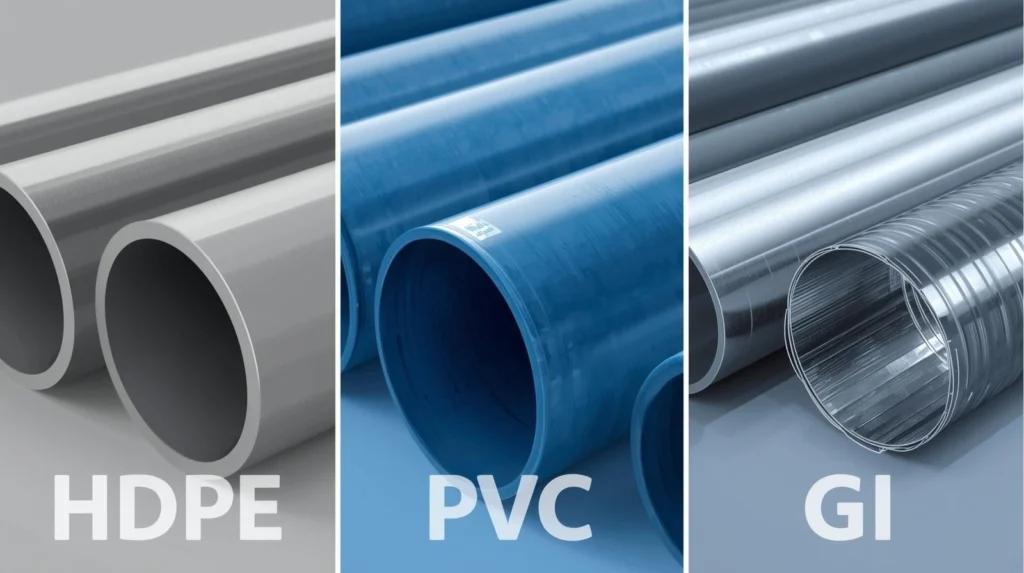
When it comes to choosing the right pipes for your home or industrial setup, the decision between HDPE, PVC, and GI pipes can be overwhelming. With various materials available, understanding the differences in cost, durability, and long-term maintenance is crucial for making an informed decision. The question arises: Which pipe is truly the best for your investment?
In this comprehensive guide, we’ll break down the pros and cons of each pipe material—HDPE (High-Density Polyethylene), PVC (Polyvinyl Chloride), and GI (Galvanized Iron)—to help you determine which one delivers the best value over time. You’ll learn how these pipes perform under different conditions, and how the long-term costs can impact your budget.
What is the Difference Between HDPE, PVC, and GI Pipes?
Before diving into cost analysis, let’s first understand the key characteristics of these three popular types of pipes.
HDPE (High-Density Polyethylene) Pipes
HDPE is a flexible, durable thermoplastic known for its ability to resist corrosion, chemicals, and extreme weather conditions. It’s commonly used in a variety of industries, including water distribution, gas supply, and drainage systems. Its lightweight nature makes it easy to transport and install.
PVC (Polyvinyl Chloride) Pipes
PVC pipes are rigid and durable, made from a synthetic plastic polymer. They are widely used in plumbing, irrigation, and drainage systems due to their affordability and resistance to chemicals and corrosion. PVC pipes are easy to install and maintain, making them a popular choice for residential and commercial applications.
GI (Galvanized Iron) Pipes
Galvanized iron pipes are steel pipes coated with a layer of zinc to protect them from rust and corrosion. Although they are durable and have been used for many years, they are heavier and more prone to rusting over time compared to HDPE and PVC. They are often used for water supply systems and are commonly found in older buildings.
Which Pipe Is the Most Cost-Effective Option?
One of the most significant considerations when choosing pipes is cost—both upfront and long-term. Let’s break down the initial investment and ongoing costs for each type of pipe.
HDPE Pipe Cost
HDPE pipes are generally more expensive than PVC pipes initially, but their long lifespan and low maintenance costs often make them the most cost-effective option in the long run. The installation of HDPE pipes can be more expensive due to the need for specialized welding equipment, but their resistance to corrosion and chemicals makes them a durable choice for long-term use.
PVC Pipe Cost
PVC pipes are the most affordable option in terms of both initial installation and material cost. They are widely available and easy to install, which makes them a go-to option for residential plumbing and drainage systems. However, PVC pipes may require more frequent replacements over time, especially in regions with extreme temperatures or corrosive water supplies.
GI Pipe Cost
Galvanized iron pipes tend to have a higher initial cost compared to PVC, but they are cheaper than HDPE pipes. However, their susceptibility to rust and corrosion over time leads to higher maintenance costs and frequent replacements. This makes GI pipes a less cost-effective option in the long run.
Maintenance and Durability: Which Pipe Lasts the Longest?
HDPE Pipe Durability
HDPE pipes are known for their long lifespan, often lasting over 50 years with minimal maintenance. They are resistant to corrosion, chemicals, and abrasion, making them ideal for a wide range of applications, especially in areas with harsh conditions. The flexible nature of HDPE also allows it to expand and contract with temperature changes without cracking.
PVC Pipe Durability
PVC pipes can last anywhere from 20 to 40 years, depending on the environmental conditions. While they are highly resistant to corrosion and chemicals, they are more brittle than HDPE and can crack under extreme pressure or temperature fluctuations. Over time, they may also become vulnerable to UV degradation if exposed to sunlight.
GI Pipe Durability
GI pipes are more durable than PVC in the short term but are prone to rust and corrosion as they age. They typically last between 20 and 40 years, but as the zinc coating wears off, they become susceptible to rusting, which can compromise their integrity. In areas with hard water, GI pipes may degrade faster, leading to costly repairs and replacements.
Long-Term Cost Analysis: How Much Will You Really Save?
When considering the long-term cost, it’s essential to factor in the maintenance, repairs, and replacement of the pipes. While HDPE pipes may have a higher initial cost, their resistance to corrosion and chemicals means they will require fewer repairs over time. This makes them a better long-term investment for systems that demand reliability.
On the other hand, PVC pipes are affordable upfront but might need to be replaced more frequently in harsh environments, resulting in higher maintenance costs over the years. GI pipes may seem like a cost-effective solution initially, but their vulnerability to corrosion and rusting can lead to more frequent replacements and higher repair costs.
Real-World Case Studies: Which Pipe Saves More Money?
Case Study 1: Residential Plumbing
In a residential building with average water supply pressure and temperatures, PVC pipes were installed due to their low cost. However, within 15 years, the pipes began to show signs of cracking and required several repairs. In contrast, a similar house using HDPE pipes experienced fewer issues and has lasted for over 30 years with minimal maintenance, proving to be a more cost-effective long-term solution.
Case Study 2: Industrial Water Systems
In an industrial water treatment plant, GI pipes were initially used for water distribution. Due to the harsh water conditions, rust and corrosion set in quickly, leading to frequent repairs and downtime. The plant switched to HDPE pipes, which resulted in a 40% reduction in maintenance costs over 10 years, demonstrating the superior durability and cost-effectiveness of HDPE in industrial applications.
Case Study 3: Irrigation System
In an agricultural setting, PVC pipes were used for irrigation. The system worked well initially, but after a few years, the pipes began to deteriorate due to exposure to UV light and fluctuating temperatures. HDPE pipes, on the other hand, offered a significantly longer lifespan without the same issues, reducing the need for replacements and improving the system’s overall cost-efficiency.
Conclusion: Which Pipe Should You Choose?
When comparing HDPE vs PVC vs GI pipes, the choice depends largely on your specific needs. Here’s a quick summary:
- HDPE pipes: Best long-term investment due to durability, resistance to corrosion, and minimal maintenance.
- PVC pipes: Most cost-effective option upfront but may incur higher long-term costs due to replacements.
- GI pipes: Suitable for short-term use but less cost-effective in the long run due to susceptibility to rust and corrosion.
Ultimately, HDPE pipes offer the best value for money in most applications, especially for long-term use. If you want a reliable, durable, and low-maintenance option, HDPE is the way to go. However, if you’re working with a tight budget and only need temporary or low-pressure piping, PVC might still be a viable choice.
FAQ
1. What is the difference between HDPE and PVC pipes?
HDPE pipes are more flexible and durable, making them ideal for long-term use. PVC pipes are rigid and are best suited for less demanding applications. HDPE is generally more expensive, but offers better long-term value.
2. Are GI pipes cheaper than HDPE and PVC?
GI pipes have a lower initial cost compared to HDPE but are more expensive than PVC. However, their susceptibility to rust and corrosion can lead to higher long-term costs due to maintenance and replacements.
3. Which pipes are best for residential plumbing?
PVC pipes are often used for residential plumbing due to their low cost, but HDPE pipes are a better long-term investment due to their durability.
4. Can I use PVC pipes in industrial applications?
While PVC pipes can be used in some industrial applications, HDPE pipes are generally a better choice for industrial systems due to their strength, resistance to chemicals, and longevity.
5. How long do HDPE, PVC, and GI pipes last?
HDPE pipes can last 50+ years, PVC pipes last 20-40 years, and GI pipes last around 20-40 years, but are prone to rust and corrosion as they age.