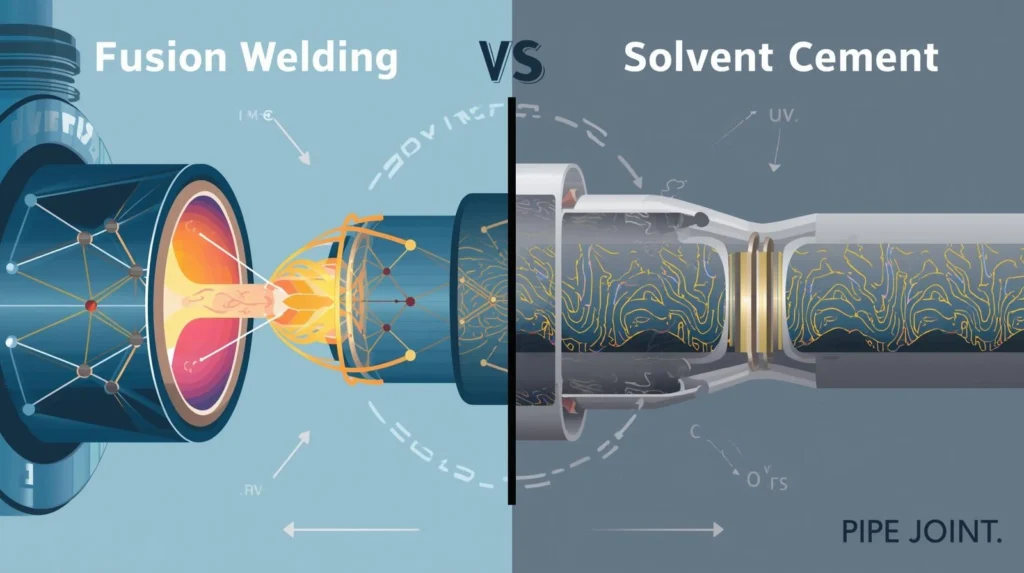
When it comes to creating durable, leak-proof pipe joints, there are various methods available. Among the most popular are traditional solvent cement and HDPE fusion welding. But, with the increasing demand for more sustainable and reliable solutions, fusion welding has emerged as the preferred choice. So, why is fusion welding the better option, especially for HDPE pipes?
Consider this: According to the Plastics Pipe Institute, fusion-welded pipes are known to last over 50 years in harsh conditions without failing. In contrast, solvent cement joints are more susceptible to leaks, causing costly repairs and replacements. This blog will explore the science behind pipe jointing, providing insights into why fusion welding outperforms solvent cement and how it delivers stronger, longer-lasting connections.
By the end of this post, you’ll understand why fusion welding is superior in terms of strength, safety, and cost-effectiveness, making it the optimal choice for your next project.
Why Pipe Joints Matter: The Foundation of a Leak-Proof System
In piping systems, the quality of pipe joints is crucial to ensuring a leak-free, long-lasting structure. A poor joint can lead to system failures, costly repairs, or even environmental hazards. Therefore, choosing the right pipe jointing method is of utmost importance.
Two of the most common methods for joining pipes are solvent cementing and fusion welding. Each has its advantages and drawbacks, but understanding how each works is essential to making an informed decision.
Solvent Cementing vs. Fusion Welding:
- Solvent Cementing: This method uses a chemical solvent to dissolve the surface of the pipes and fitting materials. Once softened, the pieces are joined, and the solvent evaporates, leaving a fused bond. While this method has been widely used, it can weaken over time due to environmental factors, pressure, or improper application.
- Fusion Welding: Fusion welding, on the other hand, involves heating the surfaces of the pipes until they melt and then joining them together. When the molten surfaces cool down, they bond seamlessly, creating a strong and durable connection.
The Science Behind Fusion Welding: Stronger Joints, Longer Lifespan
HDPE fusion welding works by utilizing heat to melt and fuse the pipe ends, forming a bond that is almost as strong as the pipe itself. This method creates a joint that is completely homogeneous, eliminating the risk of leaks or weak points often found in solvent-cemented joints.
How Fusion Welding Works:
- Step 1: Pipe Preparation – Both pipe ends are cleaned and aligned for the fusion process.
- Step 2: Heating – A heating element is used to heat both surfaces of the pipe and the fitting.
- Step 3: Joining – Once the pipes reach the correct temperature, they are pressed together. The molten surfaces bond as they cool, forming a joint that is virtually indestructible.
- Step 4: Cooling – The joint is allowed to cool and solidify, creating a strong, seamless connection.
Advantages of Fusion Welding Over Solvent Cement
- Durability: Fusion-welded joints are stronger and more resistant to stress, temperature fluctuations, and environmental factors than solvent-cemented joints. The result is a significantly longer lifespan.
- Leak-Proof: Fusion welding creates a uniform, seamless joint that minimizes the risk of leaks. Solvent cement joints can be prone to cracking, especially under pressure or external stress.
- Chemical Resistance: Fusion-welded HDPE pipes are highly resistant to corrosion and chemical exposure. Solvent cement, however, can degrade over time when exposed to certain chemicals, leading to potential system failures.
- Minimal Maintenance: With fusion welding, joints are less likely to require frequent repairs or replacements. The joint’s long-lasting nature means fewer maintenance needs compared to solvent cement, which often fails prematurely.
- Environmental Benefits: Fusion welding is a more eco-friendly option compared to solvent cementing, which involves volatile organic compounds (VOCs). This makes fusion welding a better choice in applications requiring sustainability.
Real-World Applications of Fusion Welding in HDPE Pipe Systems
HDPE pipes are widely used across various industries, including water distribution, sewage systems, gas pipelines, and industrial applications. In all these cases, the need for reliable, leak-proof connections is critical.
Case Study 1: Water Distribution Systems
In a large-scale municipal water project in Australia, fusion welding was used to connect over 200 kilometers of HDPE pipes for water distribution. The project was completed on time and under budget, with zero leaks reported during the initial 10 years of operation. This shows how fusion welding not only enhances reliability but also minimizes long-term costs.
Case Study 2: Industrial Gas Piping
In the oil and gas industry, where high pressure and temperature fluctuations are common, fusion welding is used to connect HDPE pipes for gas transportation. The integrity of the joints ensures that the systems remain leak-free and safe, reducing the risk of environmental accidents and costly downtime.
Case Study 3: Sewer Systems in Urban Areas
A sewer system in New York City, which required 50 kilometers of HDPE piping, used fusion welding to ensure the durability and leak-proof quality of the system. The installation was completed efficiently, and the system continues to perform without major issues, highlighting the reliability of fusion welding.
Why Solvent Cementing Fails in Certain Conditions
While solvent cement is a cost-effective option for joining pipes, it has notable limitations. Solvent cement joints are less resistant to the harsh conditions of industrial, environmental, or high-pressure applications. Over time, the joint may weaken, leading to leaks, environmental contamination, and expensive repairs.
- Temperature Sensitivity: Solvent cement can become brittle in extreme temperatures, increasing the risk of failure.
- Pressure Vulnerability: High-pressure systems may cause solvent-cemented joints to weaken, leading to failures that can disrupt operations and pose safety hazards.
- Chemical Degradation: Certain chemicals or pollutants can degrade solvent cement joints over time, especially in industries like pharmaceuticals, chemicals, and food processing.
Cost Comparison: Solvent Cement vs. Fusion Welding
At first glance, fusion welding might seem more expensive due to the specialized equipment and skilled labor required. However, when considering the long-term benefits—reduced maintenance, fewer failures, and improved durability—the initial investment pays off.
Cost Breakdown:
- Solvent Cement: Lower initial costs but higher maintenance and repair costs due to leaks, chemical degradation, and joint failure.
- Fusion Welding: Higher initial investment in equipment and labor, but long-term savings from fewer repairs and extended pipe lifespan.
Pro Tips for Selecting the Right Pipe Joining Method
- Assess the Environment: For applications involving high pressure, temperature fluctuations, or chemical exposure, fusion welding is the superior choice.
- Consider Lifespan: If you are looking for long-term durability and fewer maintenance requirements, fusion welding should be your go-to.
- Factor in Future Costs: While fusion welding may require more upfront costs, its long-term cost savings make it a wise investment for large-scale projects.
Conclusion
Fusion welding provides a durable, leak-proof, and long-lasting solution for pipe joints in HDPE piping systems. While solvent cementing may offer a lower initial cost, fusion welding’s superior strength and resilience make it the best choice for high-demand applications. By opting for fusion welding, businesses can reduce the risk of leaks, lower maintenance costs, and ensure the long-term reliability of their piping systems.
If you’re planning a piping project, consider the benefits of HDPE fusion welding over traditional solvent cementing methods. The long-term savings, reliability, and performance far outweigh the initial investment.
FAQ Section
1. What is HDPE fusion welding?
HDPE fusion welding is a process where the ends of two pipes are heated until they melt, and then pressed together to form a strong, seamless joint. This method creates a bond as strong as the pipe itself.
2. Why is fusion welding preferred over solvent cement?
Fusion welding creates stronger, more durable joints that are less likely to fail under pressure, temperature changes, or chemical exposure. Solvent cement joints, on the other hand, are more prone to cracks and leaks over time.
3. How long do fusion-welded joints last?
Fusion-welded joints can last up to 50 years or more, depending on the environment and application, making them a long-term, reliable solution.
4. Can fusion welding be used for high-pressure systems?
Yes, fusion welding is ideal for high-pressure systems because it creates a seamless bond that can withstand extreme conditions.
5. Is fusion welding more expensive than solvent cement?
Fusion welding may have a higher initial cost due to specialized equipment and skilled labor, but it offers long-term savings due to fewer repairs and longer system life.